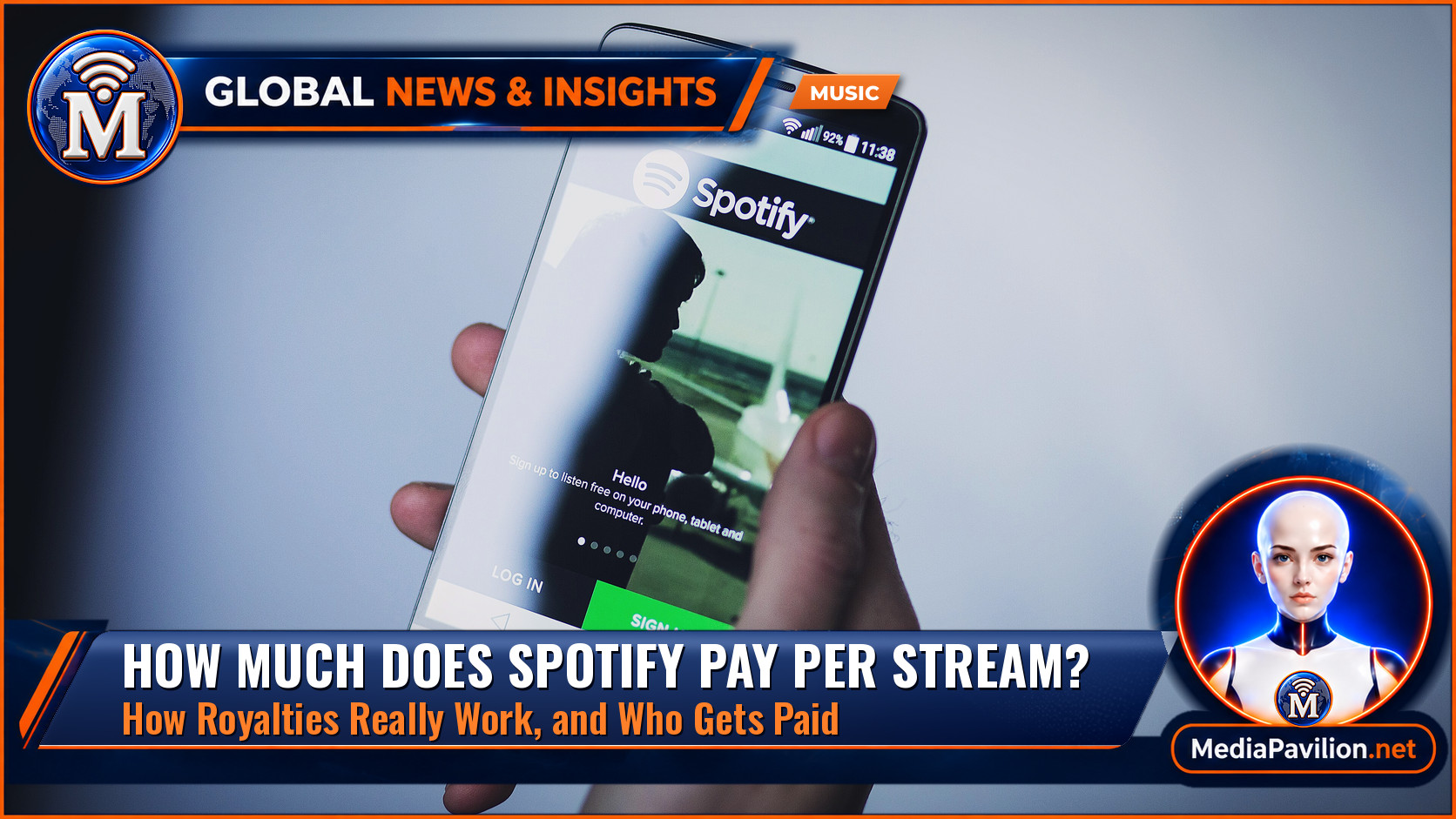
How Much Does Spotify Pay Per Stream? How Royalties Work
Quick answer: Spotify does not pay a fixed amount per stream. It pays roughly two-thirds of the money it makes from music to rights holders (labels, distributors and publishers), split according to each artist’s share of total streams in a given market, which Spotify calls “streamshare”. Divide the payouts by the streams and you get an *effective* rate commonly estimated at around $0.003 to $0.005 per stream, or roughly $3 to $5 per 1,000 streams before the label or distributor takes its cut. Since 2024, tracks need at least 1,000 streams in the previous 12 months to earn recording royalties at all.
“A fraction of a penny per stream” is one of the most quoted complaints in modern music. It is not wrong, but it is not the whole picture either. Spotify paid more than $11 billion to the music industry in 2025, according to the company, yet many working musicians still earn very little from it. Understanding why requires knowing where the money goes before it ever reaches an artist.
How Much Does Spotify Pay Per Stream?
There is no official per-stream rate. Spotify’s Loud & Clear site, which publishes its royalty data, says a per-stream rate “isn’t actually how anyone gets paid”. Instead, the money is pooled and divided by share of streams. That means the effective value of a stream varies with:
- The listener’s country. Subscription prices and ad revenue differ, so a stream in the US usually earns more than one in a lower-priced market.
- Premium vs free. Paying subscribers generate more revenue than ad-supported listeners.
- The overall number of streams that month. More total streams means each individual stream is a smaller slice of the pool.
- The artist’s deal. A signed artist on a traditional contract is often said to receive somewhere around 15% to 25% of recorded royalties from their label, while an independent artist using a distributor might keep most of it, minus fees.
Industry estimates based on artist statements usually land between $0.003 and $0.005 per stream on Spotify, but treat any single figure as a rough average, not a rate card.
How Much Does an Artist Make From 1 Million Streams?
Using the common estimate, one million streams generate roughly $3,000 to $5,000 in recording royalties paid to the rights holder. What the artist personally takes home depends on who owns the recording:
| Artist set-up | Rough share of recording royalties | Approx. take-home from $4,000 |
|---|---|---|
| Independent, using a distributor that charges a flat fee | Close to 100% | Close to $4,000 |
| Independent, distributor taking a percentage (e.g. 15%) | About 85% | About $3,400 |
| Signed to a label with a traditional deal | Often 15% to 25%, after recouping advances | $600 to $1,000, possibly nothing until recouped |
Songwriters are paid separately through publishing royalties, so an artist who writes their own songs earns from both sides.
How Does Spotify Decide Who Gets Paid?
- Spotify collects revenue from subscriptions and ads in each market.
- It pays roughly two-thirds of every dollar generated from music to rights holders, which Spotify says is in line with other major services.
- The pool is split by streamshare. If an artist’s tracks were 1 in every 1,000 streams in a country that month, their rights holders receive about 1/1,000 of the pool.
- Rights holders pay artists according to their contracts. Spotify does not pay most artists directly.
Why Don’t Songs With Fewer Than 1,000 Streams Earn Money?
In 2024 Spotify introduced a rule that a track needs at least 1,000 streams in the previous 12 months to generate recording royalties. Spotify says 99.5% of all streams are of tracks that meet this threshold, and that tiny payments of a few cents were often swallowed by distributors’ minimum withdrawal amounts and bank fees. The money is redistributed to eligible tracks rather than kept by Spotify. Critics argue it hurts the smallest artists most. Spotify also introduced penalties for artificial streaming and minimum lengths for noise tracks at the same time.
How Many Artists Actually Make Money on Spotify?
According to Spotify’s own data for 2025:
- It paid more than $11 billion to the music industry, up more than 10% on 2024, and nearly $70 billion in total since its founding.
- More than 81,000 artists generated at least $10,000 from Spotify alone.
- The 10,000th-ranked artist generated about $147,000, up from $34,000 in 2017.
- Independent artists and labels accounted for about half of Spotify’s royalties.
- Spotify says it makes up about 30% of global recorded music revenue, so an artist earning $10,000 on Spotify probably earns more than $30,000 across all recorded income.
Those figures are generated revenue to rights holders, not take-home pay, and they come from Spotify itself. But they show that streaming income is extremely concentrated: millions of artists upload music, and only a small fraction earn meaningful sums.
Does Apple Music or YouTube Pay More Than Spotify?
Apple Music is often cited as paying a higher effective rate per stream, partly because it has no free tier. Apple reportedly told artists in 2021 that its average was about one cent per play. YouTube’s effective rate is usually lower because so much listening is ad-supported. But per-stream comparisons can mislead: a service with more listeners can pay far more in total, which is the figure that matters for an artist’s income. Our explainer on lossless vs hi-res audio compares the services from a listener’s point of view.
How Do Musicians Really Make Money?
For most artists, streaming is a discovery tool as much as an income source. Live shows, merchandise, sync licensing for TV, film and adverts, fan platforms such as Bandcamp and Patreon, and physical sales such as vinyl often earn more per fan. Successful artists use streaming to build an audience, then convert it into ticket and merchandise sales.
Frequently Asked Questions
How many streams do you need to make $1,000 on Spotify?
Roughly 200,000 to 330,000 streams, using the common estimate of $0.003 to $0.005 per stream, before any label or distributor share.
Does Spotify pay artists directly?
Mostly no. It pays labels, distributors and publishers, who then pay artists and songwriters under their contracts.
How much does Spotify pay for podcasts?
Podcasts are paid under separate programmes, including ad revenue sharing and Spotify’s Partner Program for video podcasts, not the music royalty pool.
Do free-tier streams count?
Yes, but they generate less revenue than Premium streams because they are funded by advertising.
Why is Spotify’s per-stream rate so low?
Because listeners pay a flat monthly fee for unlimited music, so each stream is a tiny slice of a subscription. Heavy listeners dilute the value of each stream further.
The Bottom Line
Spotify pays out billions, but through a pooled, share-based system rather than a fixed per-stream fee. A rough rule of thumb is $3 to $5 per 1,000 streams to the rights holder, and far less to many signed artists. For fans who want to support musicians directly, buying merchandise, records and concert tickets still goes much further than streaming alone. Curious about the industry’s top honours? See our guide to the Oscars, Emmys, Grammys and Golden Globes, or read about Bad Bunny’s record-breaking career.
Related Reading
- Lossless vs Hi-Res Audio: What Streaming Quality Do You Actually Need?
- Vinyl Records for Beginners
- Bad Bunny: Career Profile of the Grammy-Winning Puerto Rican Superstar
- SVOD, AVOD, FAST and TVOD: Streaming Service Types Explained
Featured image: Spotify App (23745887894), by freestocks.org / Wikimedia Commons, CC0. Cropped, colour-graded and combined with MediaPavilion branding.
Sources
- Spotify Loud & Clear — Your Questions, Answered (FAQ).
- Spotify Loud & Clear — The Payouts.
- Spotify Newsroom — From $11B in 2025 Payouts to What We’re Building for Artists in 2026 (28 January 2026).
- Spotify for Artists — Modernizing our royalty system (November 2023).