How Much Do Movie Theaters Make From Ticket Sales?
Quick answer: US cinemas typically keep only around half of what you pay for a ticket, and sometimes less. In 2025, AMC paid film distributors 51.2% of its US admissions revenue, while Cinemark’s US film rental and advertising costs came to 58.0% of admissions. Applied to Cinemark’s $10.52 average US ticket, those rates leave the cinema roughly $4.40 to $5.10 before staff, rent and utilities. The real profit engine is the snack bar: food and drink supplies cost cinemas only about 18–19 cents of every concession dollar.
When you buy a cinema ticket, it feels as if the money goes to the place showing the film. In reality, a large slice travels straight to the studio that made it. That split explains why popcorn costs what it does, why cinemas push loyalty schemes and premium screens, and why a blockbuster can be less profitable for a cinema than you might think. Here is how the money really divides, using the latest annual reports from America’s two largest cinema chains.
How Much of a Movie Ticket Goes to the Theater?
Cinemas license films from distributors, usually owned by the big studios, and pay a “film rental” fee that is mostly a share of ticket sales. AMC’s 2025 annual report explains that these licences typically base rental fees on each film’s box office performance, and that its seven largest distributors (Disney, Warner Bros., Universal, Sony, Paramount, 20th Century Studios and Lionsgate) accounted for about 83% of its US admissions revenue.
| 2025 figure (US) | AMC | Cinemark |
|---|---|---|
| Paid to distributors, share of admissions | 51.2% (film exhibition costs) | 58.0% (film rentals and advertising) |
| Average ticket price | Not directly comparable | $10.52 |
| Food and drink revenue per customer | $8.57 | $8.30 |
| Cost of food and drink supplies, share of concession revenue | 18.1% | 18.9% |
Cinemark’s figure includes advertising costs as well as film rent, so the pure rental share is a little lower. Either way, the theatre’s cut of the ticket is roughly 42% to 49%, and that money still has to pay for staff, rent, power, cleaning and equipment.
Why Do Studios Take a Bigger Share of Blockbusters?
Film rental terms vary from title to title, and the most in-demand films command the toughest terms. AMC said its 2025 film exhibition cost percentage fell slightly, from 51.6% to 51.2% in the US, “primarily due to the concentration of box office revenues in lower grossing films”, which typically carry lower rental costs. Cinemark similarly cited “a lower concentration of high-grossing films” as a partial offset. In other words, a huge superhero opening fills seats, but the studio keeps a bigger slice of each ticket than it does for a smaller film.
Studios have historically taken a larger share in a film’s opening weeks, with the cinema’s share improving the longer a film plays, although modern deals are often negotiated on an overall basis rather than strict weekly sliding scales. Terms differ by film, distributor and country; in some European territories, AMC says rental fees are set weekly or as a flat amount per ticket.
How Much Do Movie Theaters Make From Popcorn and Snacks?
This is where the business model makes sense. Cinemark reported US concession revenue of $8.30 per customer in 2025, with concession supplies costing 18.9% of that revenue. AMC’s US food and drink revenue was $8.57 per customer, with costs of 18.1%. Put simply:
- On the ticket: a cinema typically keeps around $4 to $5 of a $10 to $11 ticket.
- At the snack bar: a cinema keeps roughly $6.70 to $7 of every $8.30 to $8.57 spent, before staff and overheads.
- The result: a customer who buys popcorn and a drink can be worth more to the cinema than the ticket itself.
That is why cinemas invest so heavily in dine-in menus, bars, loyalty programmes and combo deals. AMC described food and beverage as its second-largest source of revenue after admissions and said it operates 48 Dine-In Theatres in the US.
How Do Cinemas Make Money Beyond Tickets and Snacks?
- Premium formats. IMAX, Dolby Cinema and other large-format screens carry higher ticket prices. AMC said higher prices across all formats and more attendance at 3D, IMAX and premium screens pushed its average ticket price up 5.9% in 2025. Read our guide to IMAX vs Dolby Cinema to see what the extra money buys.
- On-screen advertising before the trailers.
- Online booking fees. AMC cited income from ticket fees as more customers paid them.
- Subscriptions and loyalty schemes, such as AMC Stubs A-List and Cinemark Movie Club, which bring in steady monthly income and encourage snack spending.
- Event cinema, including concerts. AMC distributed *Taylor Swift
- The Official Release Party of a Showgirl* in 2025.
How Does the Money Flow From Ticket to Studio?
- You buy a ticket from the cinema, plus any booking fee.
- The cinema reports box office to the distributor.
- The cinema pays film rent, mainly a percentage of ticket sales agreed for that film.
- The distributor keeps a fee and recovers marketing and distribution costs.
- The studio and profit participants share what is left, according to their contracts.
That chain means reported “box office” figures are not a studio’s profit. A film that grosses $300 million worldwide may return only a fraction of that to its studio as profit once cinemas, distribution and marketing costs are accounted for.
Are Movie Theaters Profitable?
Many cinemas operate on thin margins once film rent, wages, rent and utilities are paid. Attendance is also volatile: AMC said 2025 attendance fell 2.1%, from 224.2 million to 219.4 million customers, while Cinemark’s worldwide attendance fell 4.0% to 193 million. Both chains offset some of the decline with higher ticket prices and higher spending per customer. The industry is still adjusting to shorter cinema-only release windows and competition from streaming. For how home viewing fits in, see our explainer on SVOD, AVOD, FAST and TVOD.
Frequently Asked Questions
Do movie theaters make money from tickets?
Yes, but only around half of ticket revenue or less, and that has to cover many operating costs. Concessions usually generate much higher margins.
What percentage of box office goes to the studio?
In the US, distributors typically receive roughly half of ticket sales. AMC’s 2025 US film exhibition costs were 51.2% of admissions.
Why is movie theater popcorn so expensive?
Because the cinema keeps most of what you spend on snacks. Concession supplies cost AMC and Cinemark only around 18% to 19% of concession revenue in 2025, and those margins help support low cinema profits from tickets.
Does buying a ticket directly from the cinema help it?
Booking direct can avoid third-party fees, but the film rental share applies however you buy the ticket. Buying snacks or joining a cinema’s loyalty programme makes a bigger difference to its income.
How much does a movie theater make per ticket?
Based on Cinemark’s 2025 US average ticket price of $10.52 and its 58.0% film rental and advertising rate, the cinema retains about $4.40 per ticket before other operating costs.
The Bottom Line
Your ticket money is split with the studio, often roughly 50/50 in the US and more in the studio’s favour for big releases. Cinemas rely on popcorn, drinks, premium screens, fees and memberships to make the economics work. Next time the snack prices seem steep, remember they help keep the screen lit. For more film-world explainers, read film age ratings explained and our guide to how TV shows get renewed or cancelled.
Related Reading
- IMAX vs Dolby Cinema: Which Premium Screen Is Worth It?
- Film Age Ratings Explained
- SVOD, AVOD, FAST and TVOD Explained
- How Much Does Spotify Pay per Stream?
- Oscars vs Emmys vs Grammys vs Golden Globes
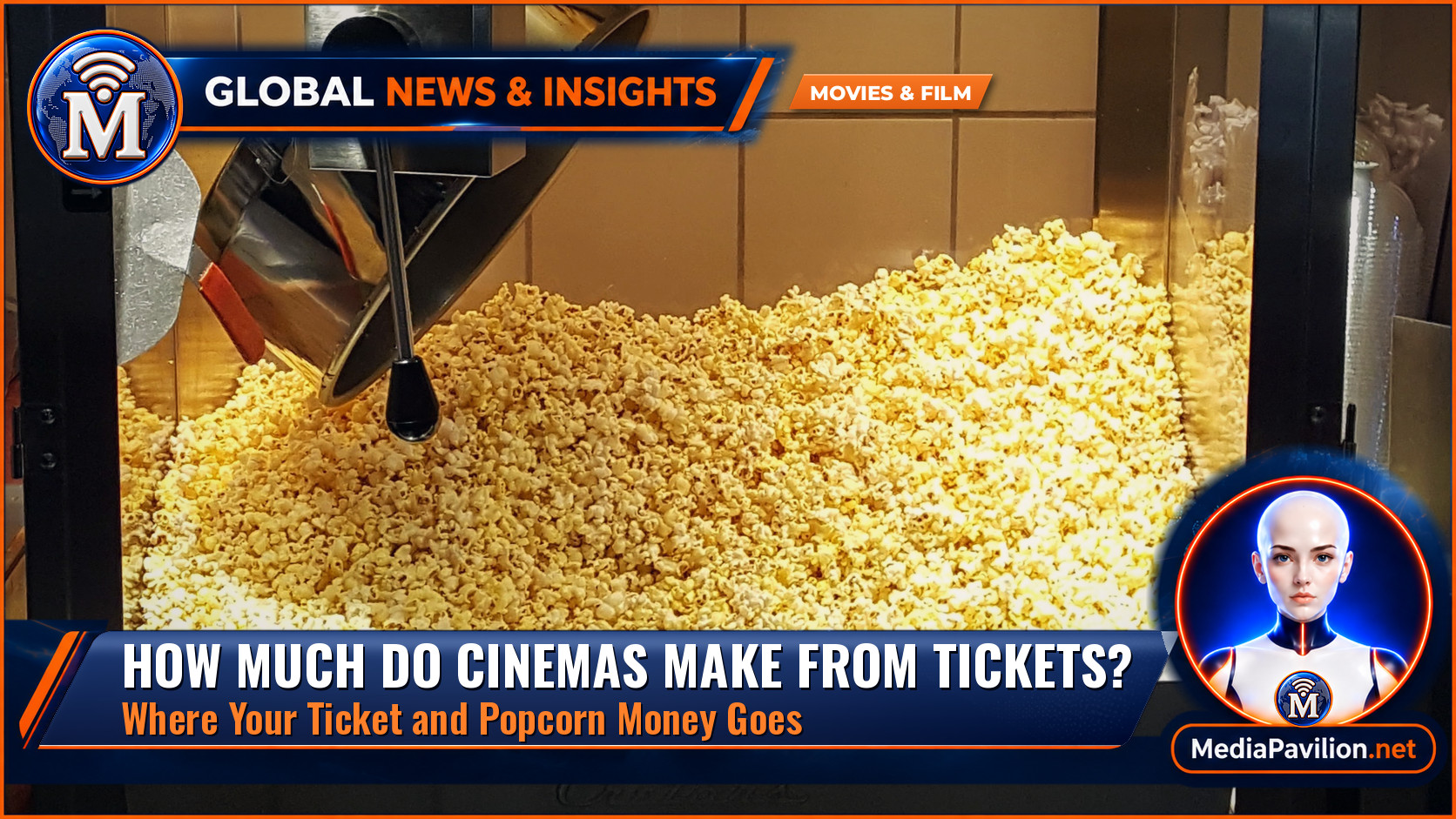
Featured image: Movie theater popcorn machine, by Tim Evanson / Wikimedia Commons, CC BY-SA 2.0. Cropped, colour-graded and combined with MediaPavilion branding.
Sources
- AMC Entertainment Holdings (SEC) — Annual Report on Form 10-K for the year ended 31 December 2025 (2026).
- Cinemark Holdings (SEC) — Annual Report on Form 10-K for the year ended 31 December 2025 (2026).