Supreme Court to Hear Trump Asylum Ban Case
The US Supreme Court on Friday agreed to hear the Trump administration’s appeal over a proclamation that suspends access to asylum at the southern border. The justices will review a ruling by the federal appeals court in Washington that found the policy went beyond what Congress allowed. The restrictions remain in place for now, because that court put its own decision on hold while the government appealed.
The case, Mullin v. Refugee and Immigrant Center for Education and Legal Services, is one of several immigration disputes already on the court’s docket. Oral arguments are expected next spring, with a decision likely by the end of the term in June 2027. Here is what the proclamation does, why lower courts objected, and what the Supreme Court has and has not agreed to decide.
What Is the Policy the Court Will Review?
On 20 January 2025, President Donald Trump issued a proclamation declaring that “an invasion is ongoing at the southern border” and suspending the entry of non-citizens “engaged in the invasion,” SCOTUSblog reported. The proclamation also indicated that those people could no longer seek protections, including asylum, that would let them stay in the country. The Department of Homeland Security then issued guidance that, among other things, barred non-citizens from applying for asylum and said that anyone who entered despite the suspension could be removed quickly, without some of the usual procedural protections.
The administration told the justices that the US-Mexico border “had become overwhelmed by an ungovernable influx of millions of aliens,” and that suspending illegal entry and access to asylum was among “the most important and effective pieces” of the president’s response, Solicitor General D. John Sauer wrote. The challengers, 13 people who say they have been persecuted or tortured in their home countries plus three immigration non-profits, argue that federal law still lets eligible people apply for asylum “irrespective of status,” and that a president cannot invent a new removal system by proclamation.
What Did the Lower Courts Decide?
US District Judge Randolph Moss recognised a class of people who are or would be subject to the proclamation, struck down the DHS guidance and barred officials from carrying out those parts of the policy. A three-judge panel of the US Court of Appeals for the District of Columbia Circuit later largely upheld that result. Judge J. Michelle Childs, joined by Judge Cornelia Pillard, wrote that the “text, structure, and history” of immigration law showed Congress did not give the executive “the expansive removal authority it asserts” when it allowed a president to suspend entry.
Judge Justin Walker dissented in part. He argued that the president has discretion to deny all asylum applications and so can skip the application process, but he agreed that the government cannot remove people to countries where they would be persecuted and cannot strip away the procedures that protect against that. The appeals court then kept its ruling on hold, so the administration has been able to maintain the asylum restrictions while the case proceeds.
What Exactly Will the Supreme Court Decide?
The court agreed to consider whether the proclamation and the DHS guidance are lawful, and whether Judge Moss had the power to issue an order with such broad effect. It declined to take up the government’s separate argument that the class of challengers was improper because it included people still overseas. The questions presented are set out in the court’s official question document for case 26-239.
Sauer has also argued that federal immigration law limits the power of lower courts to issue orders that require officials to keep asylum procedures in place. The challengers say that bar does not apply here because the proclamation rests on different provisions. Those disputes over both the merits and the scope of the injunction will now be briefed and argued before the justices.
Why Does the Timing Matter?
Because the appeals court’s stay is still in effect, a grant of review does not, by itself, change what is happening at the border today. A final ruling is unlikely before next summer. The case joins other immigration matters already before the court, including challenges to “third-country” removals and to detention without a hearing for people arrested inside the United States.
The challengers told the justices that by January 2025, before the proclamation took effect, border apprehensions had “returned to historically routine levels, down over 90 percent from their peak,” and that if the executive wants new tools, Congress must provide them. The administration says the president is using inherent and delegated powers to exclude people from the country. The court will now decide which of those readings of the law prevails. For readers following the wider political backdrop, we covered the 2026 midterm results last week. Separate, practical explainers on how much an ESTA costs and the UK student visa for Americans cover ordinary travel rules, which are distinct from asylum law.
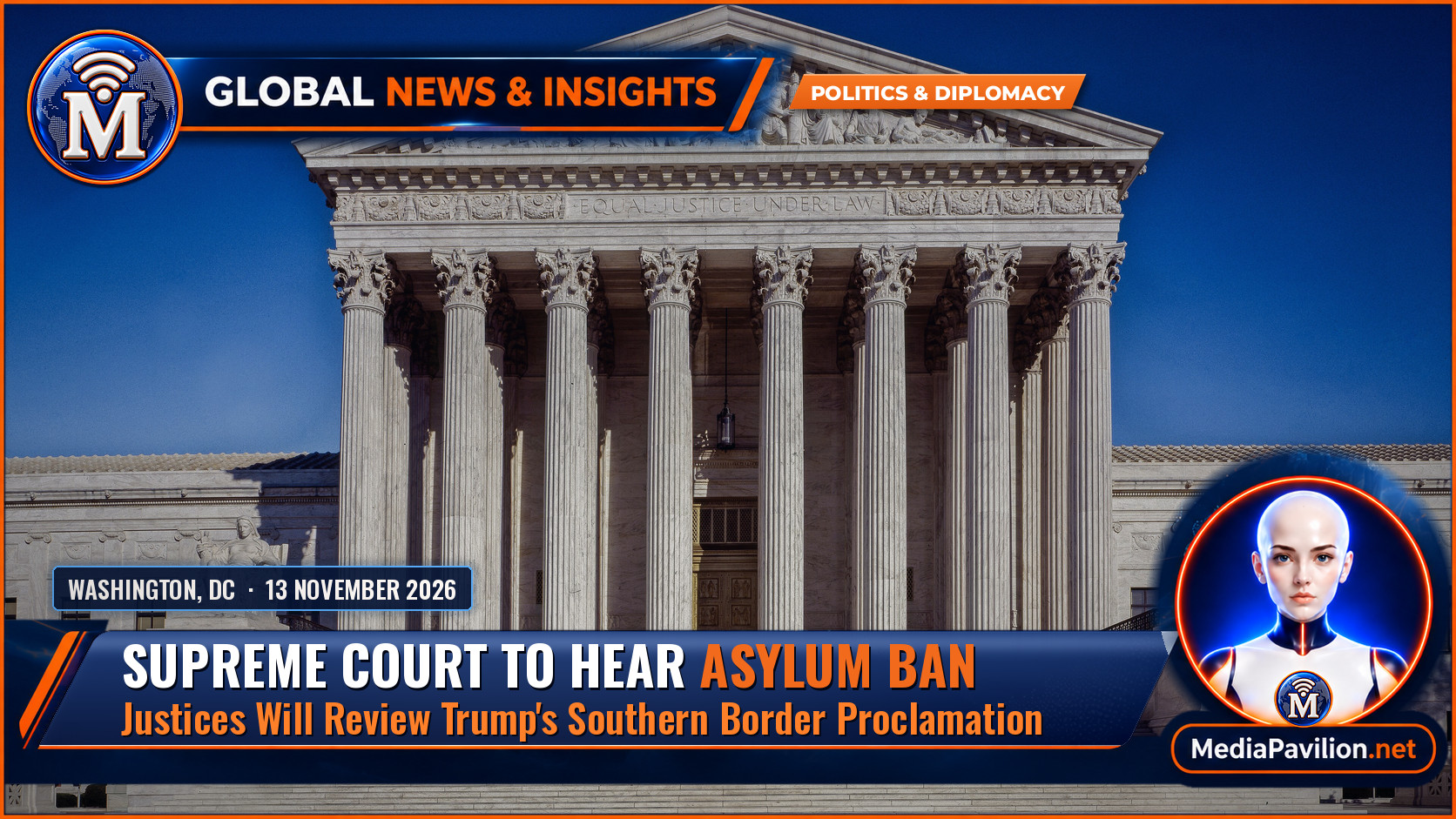
Featured image: the US Supreme Court building in Washington, DC, by Carol M. Highsmith / Wikimedia Commons, public domain. File photo.
- SCOTUSblog — Supreme Court agrees to hear case on Trump administration’s suspension of asylum (13 November 2026).
- Associated Press — Supreme Court will consider Trump’s executive order suspending asylum access at the southern border (13 November 2026).
- Supreme Court of the United States — Questions Presented, Mullin v. Refugee and Immigrant Center for Education and Legal Services, No. 26-239.
- American Civil Liberties Union — Supreme Court to Hear Challenge to Trump Proclamation Eliminating Asylum (13 November 2026).