
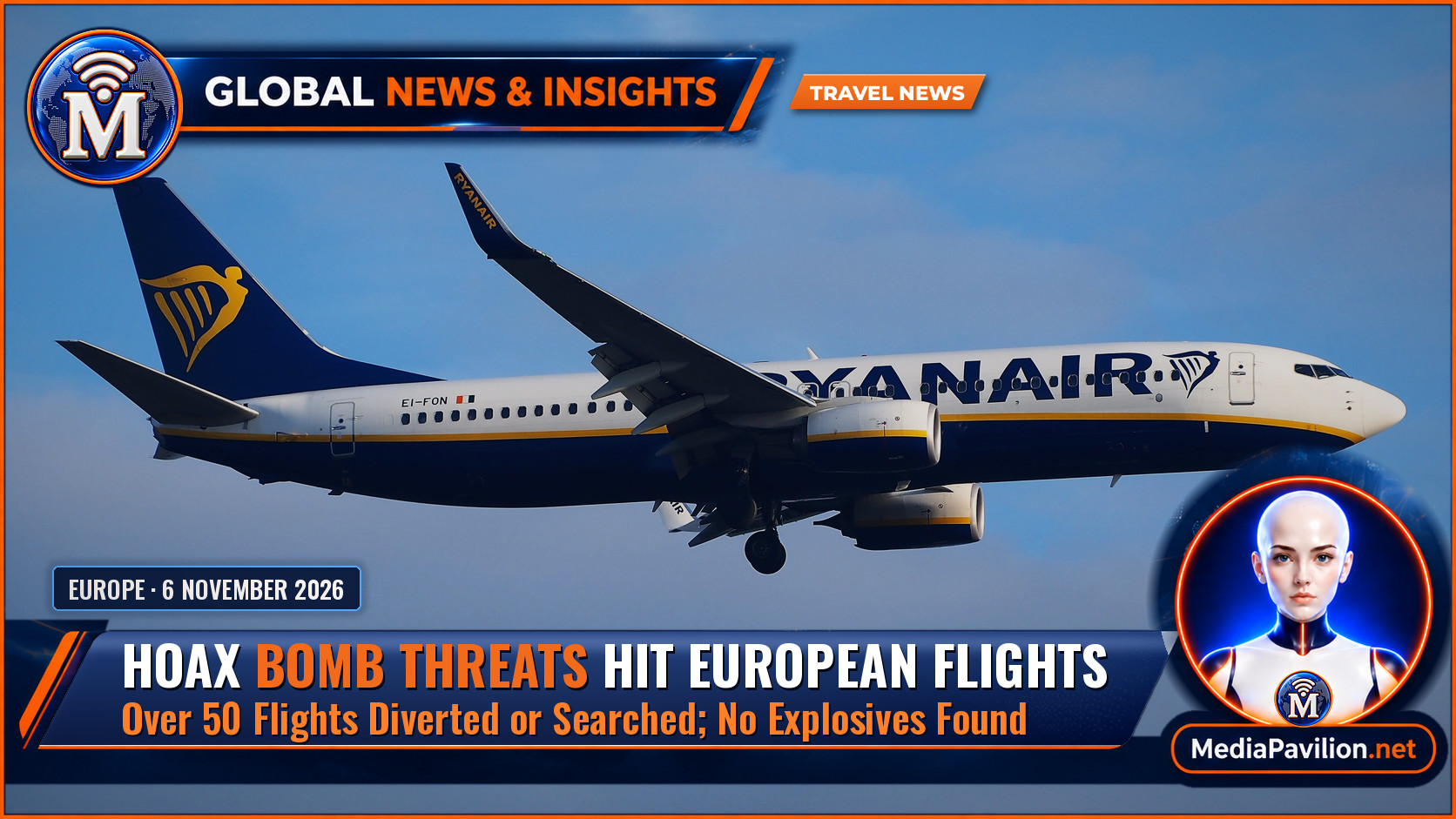
Hoax Bomb Threats Disrupt More Than 50 European Flights in a Week
A fresh wave of hoax bomb threats disrupted at least 18 more flights across Europe on Friday 6 November, after earlier alerts on Tuesday and Thursday forced at least 35 flights to be diverted or searched, The Guardian reported. Every affected aircraft landed safely, and security searches found no explosive devices.
Friday’s alerts hit flights to or from Bulgaria, Cyprus, Czechia, France, Hungary, Italy, Portugal, Romania and the UK. They included at least nine flights to and from Prague, four flights over France, two flights heading to Sofia and a Lisbon–Rome service. Hungary scrambled fighter jets three times to escort civilian aircraft through its airspace, its defence minister said.
What Happened on the Affected Flights?
The disruption began on Monday, when a Wizz Air flight from London Luton to Sofia was diverted to Budapest, according to The Guardian. On Thursday, at least 25 threats hit airports including London, Birmingham, Brussels, Bucharest, Madrid, Milan, Prague, Rome, Sofia and Warsaw. Sofia and Milan each recorded six incidents, Rome five and Prague four. Ryanair was the hardest-hit airline, with eight reported cases by Thursday.
In several cases in Bulgaria, Italy, Poland and Spain, the threats were reportedly sent by email. Italy’s Ansa news agency reported that warnings about Helsinki–Rome and Dublin–Rome flights came from an anonymous email in Italian sent to Rome’s airport operator, while another email to Milan Malpensa listed flight numbers, airline names and landing times.
Who Is Behind the Bomb Threats?
No one has been identified. Investigators have said there is no evidence so far that a terror group or a state such as Russia or Iran is directing the hoaxes, but inquiries are continuing. Several European media outlets reported receiving an email from a group claiming responsibility and warning of further action against transport across Europe. “This is only the beginning,” it reportedly said.
Some of Thursday’s threats were signed “fighters of the Male State”, a reference to a Russian far-right movement. Its founder denied involvement on Telegram and said the group had not existed since 2021. Spain’s foreign minister, José Manuel Albares, said there appeared to be a pattern, and some officials suspect a link to European support for Ukraine. Italian Prime Minister Giorgia Meloni said it was unclear whether the hoaxes and recent cyberattacks on supermarket refrigeration systems in at least seven countries were “all connected”, but that “what is under attack are civilian infrastructures”.
The threats also reached newsrooms. On Friday, threats against media organisations in Ireland, including RTÉ, disrupted broadcasts and led to evacuations, and Britain’s Sky said it had received a security threat. Taoiseach Micheál Martin said the threats were an effort to sow fear and anxiety.
Is It Still Safe to Fly in Europe?
Aviation experts say hoax threats happen daily, but the number this week is unusual. The disrupted flights were a tiny share of traffic: on Friday they made up about 0.07% of the 26,709 flights Eurocontrol expected in European airspace.
Airlines take every possible threat seriously. Joji Waites, director of flight safety at the British Airline Pilots’ Association, told The Guardian that threats are graded as credible, partly credible or not credible. If a plane is already in the air, the priority is to land “as soon and as safely as possible”.
What Should Travellers Do?
- Check your flight status with your airline before leaving for the airport, especially on routes to or from Italy, Bulgaria and Czechia.
- Allow extra time for security checks, which may be stricter at affected airports.
- Know your rights: if your flight is diverted or badly delayed, EU and UK rules (EU261 and UK261) may entitle you to care and, in some cases, compensation, although airlines may argue that security threats are extraordinary circumstances.
- Keep receipts for meals and hotels if you are stranded.
- Consider travel insurance that covers delays; see our guide on whether travel insurance is worth it.
Travellers to the United States should also note the separate US Ebola attestation rule that now applies to all international flights.
Featured image: A Ryanair Boeing 737-800 landing at Amsterdam Schiphol, by Alf van Beem / Wikimedia Commons, public domain. File photo; not one of the affected flights.
Sources
- The Guardian — Further bomb threats disrupt at least another 18 flights across Europe (6 November 2026).
- The Guardian — Why have more than 30 European flights been hit by bomb threats this week? (5 November 2026).
- AP News — What to know about the hoax bomb threats that targeted flights in Europe (November 2026).
- Al Jazeera — New bomb threats force more European flights into emergency landings (5 November 2026).