Nasdaq Plunges 5.5% as AI Stocks Crash After the Midterms
The Nasdaq Composite fell 5.5% on Thursday 5 November, its worst day since the April 2025 tariff shock, as investors feared that Democrats’ sweeping midterm wins could slow the construction of AI data centres. The S&P 500 dropped about 4.4% and the Dow Jones Industrial Average lost roughly 1,833 points, or 3.4%, according to CNBC.
The sell-off wiped out the gains from Wednesday’s post-election rally and then some. The Nasdaq ended the day in correction territory, meaning at least 10% below its recent peak, alongside the small-cap Russell 2000 index.
Why Did AI Stocks Fall After the Midterms?
Markets had largely expected Democrats to win Congress, but not by such a margin. NBC News reported that hundreds of candidates who pledged to rein in AI data centres were elected, including in Texas, Ohio, Michigan and Georgia, all major data-centre markets. Voters also sided against data centres in all but one of 41 local ballot measures in 10 states, according to Ballotpedia figures cited by CNBC.
Investors worry that tighter rules on power, water and land use could slow the huge spending on AI infrastructure that has driven US growth and stock gains. Meta President Dina Powell McCormick said building data centres was “going to be harder” after the elections, according to The Wall Street Journal. Qualcomm added to the pressure with a disappointing forecast for the current quarter.
How Bad Was the Sell-Off?
- Nasdaq Composite: −5.5%, worst day since 4 April 2025
- Nasdaq 100: −6.3%, about $2.3 trillion in market value erased, per NBC News
- S&P 500: −4.4%, with all 11 sectors lower
- “Magnificent Seven”: more than $1 trillion in combined value lost
- Nvidia: down more than 9%, losing over $440bn and turning negative for the year
- S&P 500 technology sector: −7.3%, its worst day since March 2020
Chipmakers AMD, Micron and Applied Materials suffered double-digit losses, while Qualcomm fell more than 9%. Shares in Elon Musk’s companies SpaceX and Tesla each dropped more than 9%. The Cboe Volatility Index, Wall Street’s “fear gauge”, jumped 11.57 points to its highest level since 31 March.
The rout spread to Asia on Friday. South Korea’s Kospi plunged 8% at the open, triggering a temporary market-wide trading halt, and Japan’s Nikkei 225 fell 6%, NBC News reported. Cryptocurrencies also slid, with Bitcoin erasing its post-election gains.
What Did Trump and Analysts Say?
President Trump blamed Democrats. “The Stock Market suffered one of the Worst Days in History based on the results of the Election,” he wrote on Truth Social, adding that “your 401(k)s have, therefore, dropped”.
Some analysts urged caution about calling the end of the AI boom. “I don’t think this is an AI bubble bursting,” Ed Yardeni, president of Yardeni Research, told NBC News. “I think it’s an AI bubble losing some air very, very rapidly.” Despite the slide, the Nasdaq is still up more than 30% since Election Day 2024.
What Should Investors Watch Next?
Investors will watch how new governors and lawmakers act on data-centre promises once they take office in January, as well as spending plans from the biggest cloud companies. Meta, Alphabet, Amazon and Microsoft have each laid out plans to spend heavily on AI infrastructure, but several have turned free-cash-flow negative, CNBC reported. A stronger-than-expected jobs report on Friday also raised the odds of a Fed rate rise in December. For a refresher on how the main US indexes differ, see our guide to the S&P 500 vs Dow vs Nasdaq.
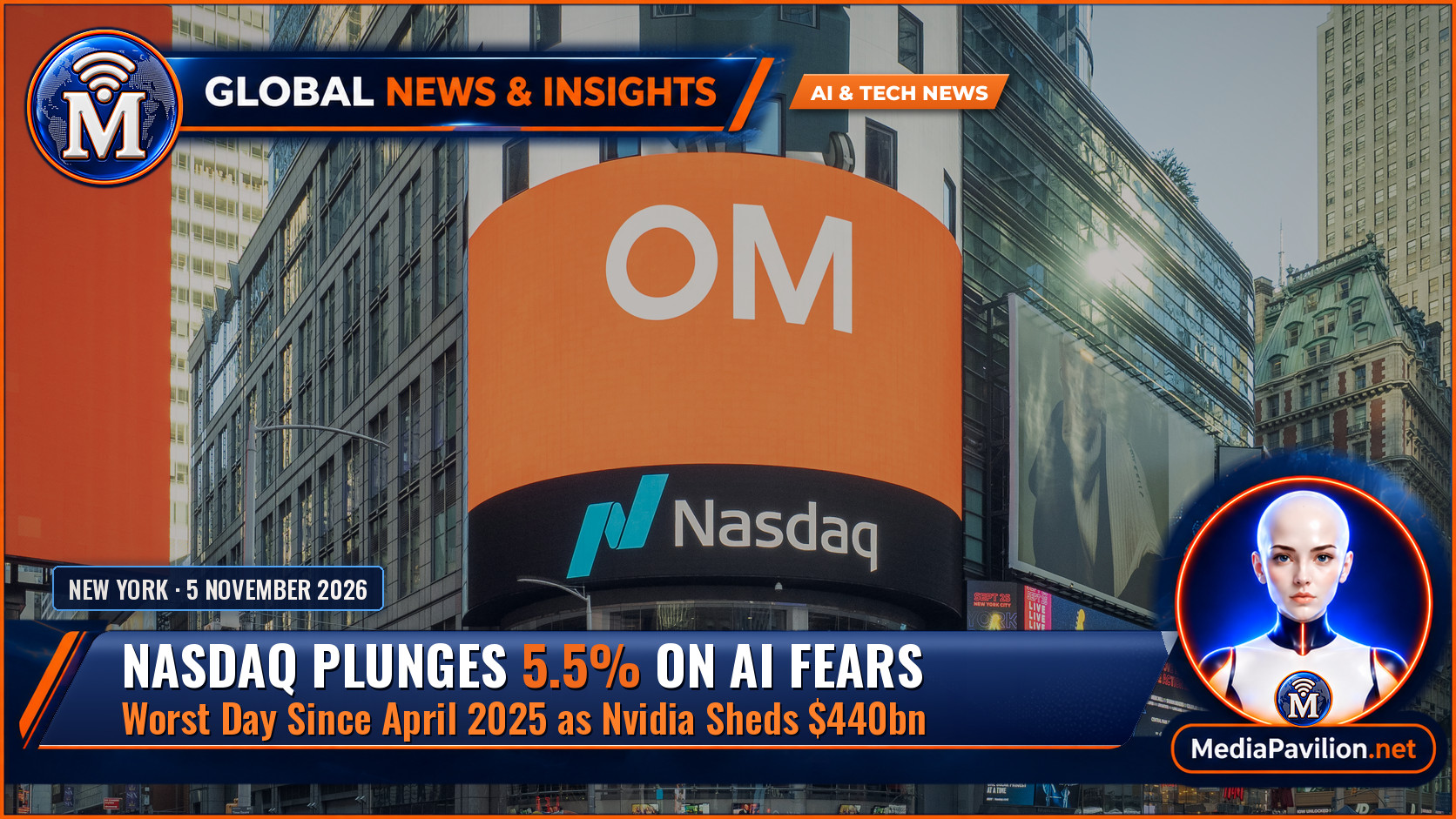
Featured image: The Nasdaq MarketSite in Times Square, New York, by ajay_suresh / Wikimedia Commons, CC BY 2.0. File photo.
Sources
- CNBC — Magnificent 7 loses $1 trillion. The most eye-popping stats from Thursday’s tech stock plunge (5 November 2026).
- CNBC — AI meltdown: Nvidia and Qualcomm drop more than 9%, pushing Nasdaq to worst day since April 2025 (5 November 2026).
- NBC News — Stocks plunge as election outcome and AI worries crush tech shares (6 November 2026).
- AP News — A brutal sell-off for AI stocks sends Wall Street reeling (5 November 2026).