Black Hole vs Neutron Star: What’s the Difference?
A black hole and a neutron star are both what remains when a massive star dies, but they are very different objects. A neutron star is an incredibly dense ball of matter about 20 kilometres across, while a black hole is a region where gravity is so strong that nothing, not even light, can escape. Which one a dying star becomes depends mainly on how much mass is left in its collapsing core. This guide explains how each forms, how big and heavy they are, how astronomers detect them and what happens when they collide.
How Do Neutron Stars and Black Holes Form?
Stars shine by fusing lighter elements into heavier ones in their cores. When a massive star, several times the mass of our Sun, runs out of fuel, its core can no longer support itself and collapses in a fraction of a second. The outer layers are often blasted away in a supernova explosion.
What is left depends on the core’s mass. According to NASA’s Imagine the Universe, if the collapsing core is between about 1 and 3 times the mass of the Sun, the protons and electrons are crushed together into neutrons, and the pressure of those neutrons stops the collapse, leaving a neutron star. If the core is heavier, nothing can stop the collapse, and it continues to form a stellar-mass black hole.
Smaller stars like our Sun do neither. They end their lives as white dwarfs, about the size of Earth.
Black Hole vs Neutron Star: The Key Differences
- What it is: a neutron star is a solid, ultra-dense object made mostly of neutrons; a black hole is a region of space where gravity prevents anything from escaping
- Surface: a neutron star has a real surface and crust; a black hole has an event horizon, a boundary of no return rather than a surface
- Size: a neutron star is about 20 km (12.5 miles) across; a black hole’s event horizon grows with its mass, about 6 km across for every solar mass
- Mass: neutron stars are typically about 1.4 to 2 times the Sun’s mass; stellar black holes range from about five to dozens of solar masses, and supermassive ones reach billions
- Light: neutron stars can emit radio waves, X-rays and visible light; black holes emit no light themselves, though the hot gas around them can glow brightly
- Density: a sugar cube of neutron star material would weigh about a billion tonnes on Earth, NASA says; a black hole’s mass is hidden behind the event horizon
What Is a Neutron Star Like?
A neutron star packs more mass than the Sun into a sphere the size of a city. NASA describes the result as “the most dense object known”. Its gravity is so strong that the surface is extremely smooth, and anything falling onto it hits at a large fraction of the speed of light.
Most known neutron stars are pulsars. They spin rapidly, sometimes hundreds of times a second, and their strong magnetic fields channel beams of radiation from their magnetic poles. When a beam sweeps across Earth, we see a regular pulse, like a lighthouse. The first pulsar was discovered in 1967 by the astronomer Jocelyn Bell Burnell, then a PhD student at Cambridge.
A rarer type, the magnetar, has a magnetic field about a thousand times stronger than an ordinary neutron star’s, which itself is trillions of times stronger than Earth’s, according to NASA.
What Is a Black Hole Like?
A black hole is defined by its event horizon. Outside it, light and matter can still escape if they move fast enough; once inside, nothing can get out. At the centre, general relativity predicts a singularity, a point where our current laws of physics break down.
There are two main kinds. Stellar-mass black holes form from collapsing stars, as described above. Supermassive black holes, millions to billions of times the mass of the Sun, sit at the centres of most large galaxies, including our own. The Milky Way’s central black hole, Sagittarius A*, has about four million solar masses.
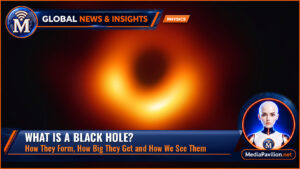
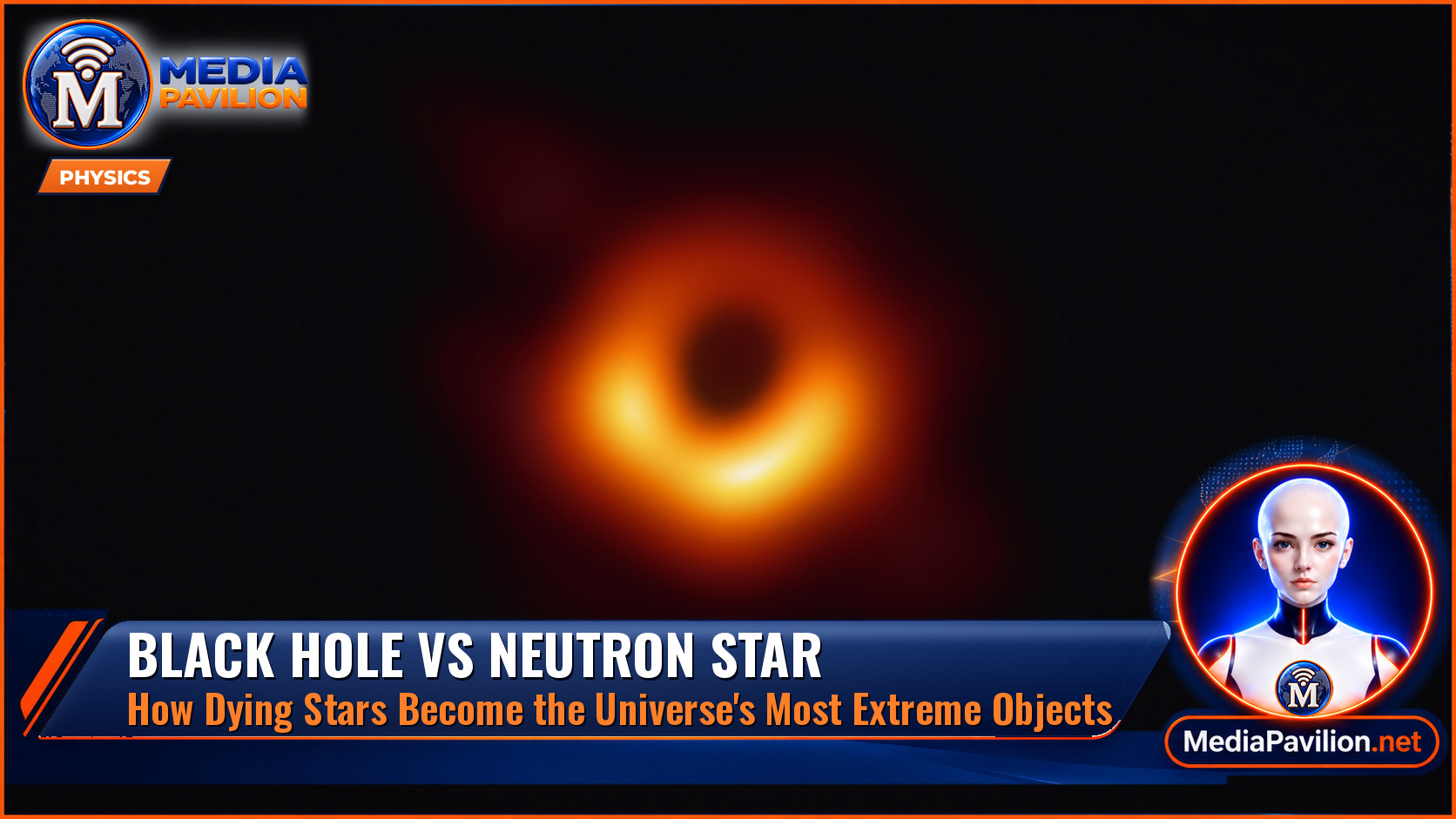
Because black holes do not emit light, astronomers find them through their effects: stars orbiting an invisible mass, X-rays from gas heated as it spirals in, and ripples in space-time called gravitational waves. In 2019, the Event Horizon Telescope collaboration published the first image of a black hole’s shadow, in the galaxy M87, which is the image used at the top of this article. It followed with an image of Sagittarius A* in 2022.
What Happens When Neutron Stars or Black Holes Collide?
Pairs of these objects can orbit each other and slowly spiral together, giving off gravitational waves. In September 2015, the LIGO detectors in the US recorded gravitational waves from two merging black holes for the first time, a discovery that won the 2017 Nobel Prize in Physics.
In August 2017, LIGO and its European partner Virgo detected the merger of two neutron stars, an event called GW170817. Telescopes around the world then saw the explosion, known as a kilonova, in light across the spectrum. The observations showed that such mergers forge heavy elements including gold and platinum, LIGO said.
Could a Neutron Star Become a Black Hole?
Yes, in theory. A neutron star can only support a limited amount of mass, thought to be a little above two solar masses. If it gains enough extra matter, for example from a companion star or a merger, it can collapse further into a black hole. Astronomers think the object left behind by the GW170817 merger may have done exactly that, although this has not been confirmed.
Black Hole vs Neutron Star: Quick Answers
- Which is denser? In everyday terms, a neutron star is the densest form of matter we can observe directly; a black hole’s matter is hidden behind its event horizon
- Which is bigger? A stellar black hole’s event horizon is usually wider than a neutron star, because black holes are heavier
- Can we see them? Neutron stars can be seen as pulsars or X-ray sources; black holes are seen only through their surroundings
- Are they dangerous to Earth? No. The nearest known examples are many light years away
Featured image: Black hole – Messier 87, by Event Horizon Telescope / Wikimedia Commons, CC BY 4.0. Cropped, colour-graded and combined with MediaPavilion branding.
Sources
- NASA Imagine the Universe — Neutron Stars.
- NASA Science — Black Holes.
- European Space Agency — Black holes.
- LIGO Caltech — GW170817 press release: LIGO and Virgo make first detection of gravitational waves produced by colliding neutron stars (16 October 2017).