COP31 Opens in Antalya: What’s at Stake at the 2026 UN Climate Summit
The 2026 United Nations climate summit, COP31, opened on Monday 9 November in Antalya, Türkiye, with delegations from close to 190 countries gathering for two weeks of talks on how to turn the world’s climate targets into action. The conference runs until 20 November. It opens against a difficult backdrop: record temperatures, a fight over money for poorer countries, and an energy shock linked to the Iran war that has pushed some governments back towards coal.
Brazilian diplomat André Aranha Corrêa do Lago, who presided over last year’s COP30 in Belém, opened the proceedings before handing over to the new leadership. “We know the wealthiest people are those increasing their emissions, but we have to bring people out of poverty,” he said, according to The Guardian’s live coverage.
What Is COP31 and Where Is It Being Held?
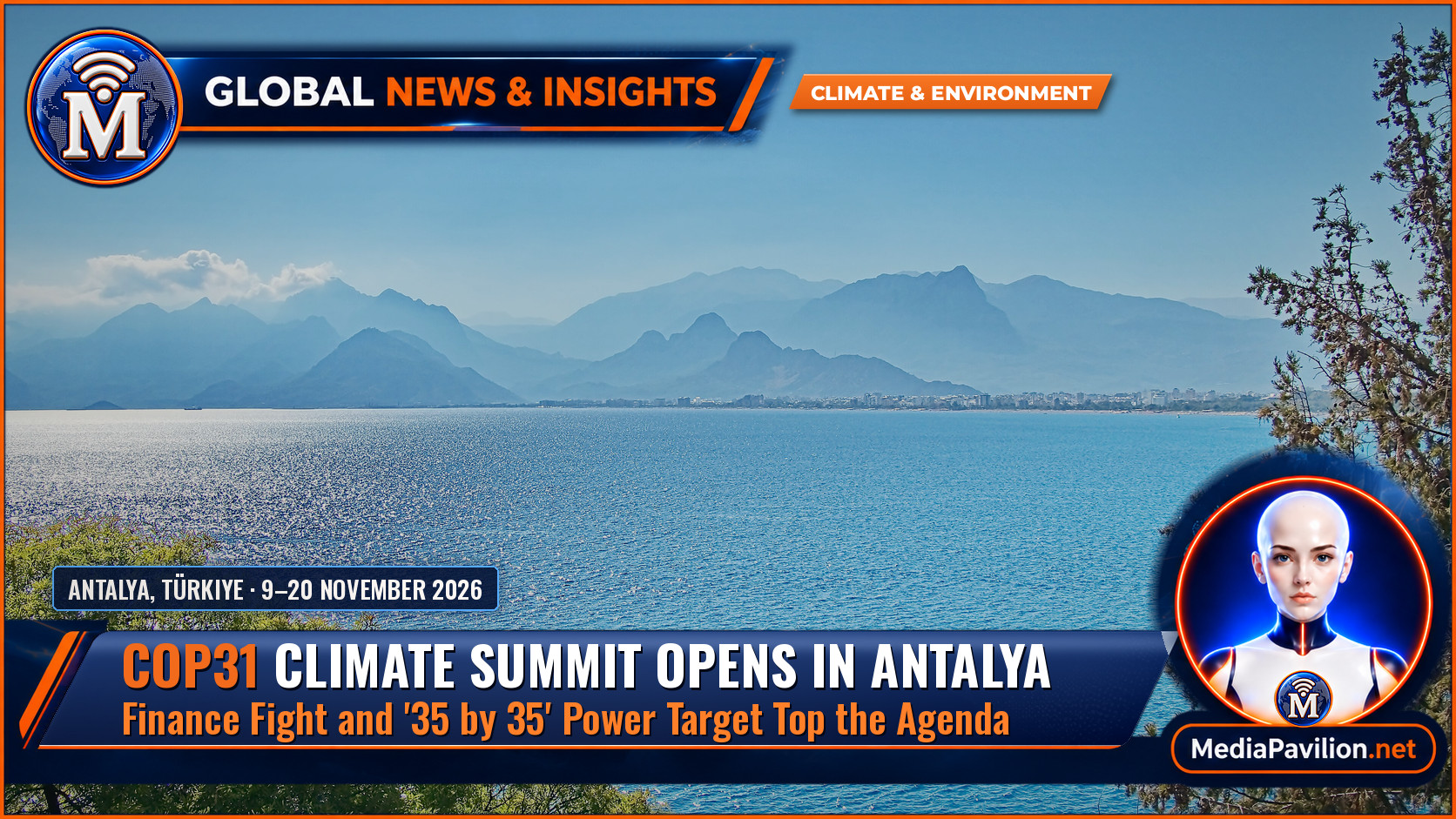
COP31 is the 31st Conference of the Parties to the UN Framework Convention on Climate Change (UNFCCC), the annual meeting where governments negotiate how to limit global warming and cope with its effects. The first COP was held in Berlin in 1995, Anadolu Agency noted. This year’s summit is taking place in Antalya, a resort city on Türkiye’s Mediterranean coast.
The arrangement is unusual. Türkiye and Australia both bid to host the 2026 summit, and under a compromise agreed last year, Türkiye is hosting the event while Australia presides over the formal negotiations. Turkey’s environment minister, Murat Kurum, is president of the COP, and Australia’s climate and energy minister, Chris Bowen, is president of the negotiations. UN climate chief Simon Stiell was also due to address the opening plenary.
- Dates: 9 to 20 November 2026
- Venue: Antalya, Türkiye
- Host and COP president: Türkiye (Murat Kurum)
- President of negotiations: Australia (Chris Bowen)
- Expected attendance: about 70,000 registered participants and more than 90 heads of state and government, according to The Guardian
What Will Be Negotiated at COP31?
The talks are billed as an “implementation” summit, focused on delivering targets countries have already agreed rather than setting new ones. One of the most watched proposals comes from the Turkish presidency, which wants countries to back raising electricity’s share of global energy use from about 21% to 35% by 2035, a target known as “35 by 35”. Critics say the pledge does not require that extra electricity be low-carbon, 10 Things News reported.
Electrification matters because, despite rapid growth in renewables, nearly 80% of the world’s primary energy still comes from fossil fuels. Electric vehicles, heat pumps and other electric technologies are far more efficient, and The Guardian noted that adopting them at scale could halve global primary energy needs. If you want a refresher on why burning fossil fuels warms the planet, our explainer on what the greenhouse effect is covers the basics.
Other issues include a “just transition” mechanism to help workers in high-carbon industries move to new jobs, a clearer path away from fossil fuels, and climate finance. Developing countries are angry that several rich nations are cutting aid budgets, and a pledge to triple money for adapting to extreme weather has yet to be spelled out in detail.
Why Is This Year’s Climate Summit So Difficult?
The past two years have broken temperature records and gone beyond the Paris Agreement’s 1.5C threshold above pre-industrial levels, although the goal is formally judged on a decade-long average. Scientists now warn that warming will exceed 1.5C, and the summit follows a year of deadly heatwaves and flooding.
The Iran war has added a new layer. Disruption to oil shipments through the Strait of Hormuz has raised energy prices and pushed some countries to burn more coal, while the rapid growth of artificial intelligence is driving up electricity demand, 10 Things News reported. Our recent report on the US blockade operations in the Gulf of Oman explains how the conflict is affecting shipping routes.
Which World Leaders Are Attending COP31?
Most leaders are expected on Wednesday and Thursday for the leaders’ summit segment. Several big names will be absent. China’s Xi Jinping and India’s Narendra Modi rarely attend COPs, and US President Donald Trump has withdrawn the United States from the Paris Agreement and is in the process of leaving the UNFCCC itself. The US, the world’s second-largest emitter, is not taking part in the talks.
According to The Guardian, France’s Emmanuel Macron, Germany’s Friedrich Merz and Canada’s Mark Carney are also not expected to attend. Brazil’s Luiz Inácio Lula da Silva will be there and is expected to focus on inequality between rich and poor, including high-emitting elites in both developed and developing countries. European Commission President Ursula von der Leyen is also due to attend.
What Happens Next?
The first week will be dominated by technical negotiations, with ministers taking over in the second week. Any final agreement is expected around 20 November, although COP summits regularly run past their scheduled end. Key tests will be whether countries can agree a finance package that satisfies developing nations and whether the “35 by 35” electricity target wins broad support. We will follow the main decisions as the talks progress. For more on how ocean patterns shape extreme weather, read our guide to El Niño and La Niña.
Featured image: the Gulf of Antalya, Türkiye, by Joe Wallace / Wikimedia Commons, CC BY-SA 2.0. File photo.
Sources
- The Guardian — Cop31 live: world leaders gather for crucial climate crisis talks (9 November 2026).
- Anadolu Agency — Morning Briefing: Nov. 9 (9 November 2026).
- 10 Things News — 10 Things Global News, 9th November 2026 (9 November 2026).