Global Warming vs Climate Change: What’s the Difference?
Global warming and climate change are often used as if they mean the same thing, but they are not quite the same. Global warming is the long-term rise in Earth’s average surface temperature, caused mainly by burning fossil fuels. Climate change is the wider set of changes that warming causes, from rising seas and melting ice to heavier rainfall, longer droughts and shifting seasons. In short, global warming is one part of climate change, and arguably its main driver. This guide explains the difference, why scientists and governments now prefer “climate change”, and what the latest numbers show.
What Is Global Warming?
Global warming refers to the increase in the average temperature of the Earth’s surface and lower atmosphere since the pre-industrial period, usually measured against the average for 1850 to 1900. It is driven by the build-up of heat-trapping greenhouse gases, mainly carbon dioxide (CO2) from coal, oil and gas, plus methane and nitrous oxide from farming, industry and waste.
Those gases strengthen the natural greenhouse effect, which keeps the planet warm enough to support life. Adding more of them traps extra heat. Our explainer on what the greenhouse effect is covers the physics in more detail.
The World Meteorological Organization (WMO) confirmed that 2024 was the warmest year on record, at about 1.55C above the pre-industrial level. That was the first calendar year to pass 1.5C, although the Paris Agreement’s 1.5C goal refers to long-term warming averaged over decades, not a single year.
What Is Climate Change?
Climate change is a broader term. It describes long-term shifts in temperatures and weather patterns, whether natural or caused by people. NASA describes it as a long-term change in the average weather patterns that define Earth’s local, regional and global climates. Since the mid-1800s, human activity has been the main driver of the changes scientists are now recording.
Climate change therefore includes global warming, but also its many effects, such as:
- Rising sea levels: as ocean water warms and expands and land ice melts
- Shrinking ice: retreating glaciers, smaller Arctic sea ice and loss from the Greenland and Antarctic ice sheets
- More extreme heat: heatwaves that are hotter, longer and more frequent
- Changing rainfall: heavier downpours in some places and longer droughts in others
- Ocean changes: marine heatwaves and more acidic seawater as oceans absorb CO2
- Shifting seasons: earlier springs, longer wildfire seasons and changes to where plants and animals can live
Global Warming vs Climate Change: What’s the Key Difference?
The simplest way to remember it is that global warming is a cause and a measurement, while climate change is the whole system’s response.
- Global warming: one variable, the rise in global average surface temperature
- Climate change: temperature plus everything else that changes with it, including rain, ice, sea level and extreme weather
- Scale: global warming is a global average; climate change can be described for any region
- Direction: warming means temperatures go up; climate change can mean some places get colder winters, wetter summers or drier springs, even while the planet as a whole warms
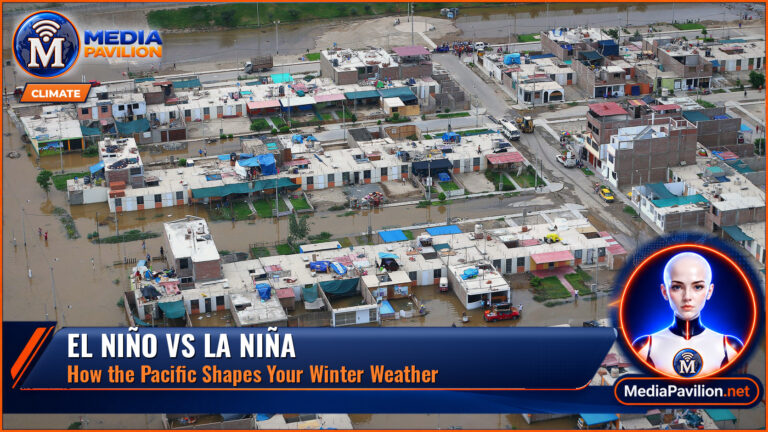
That last point matters. A cold winter in one country does not disprove global warming, because weather is what happens on a given day and climate is the long-term average. Natural cycles also play a part. Our guide to El Niño and La Niña explains how Pacific Ocean patterns can push global temperatures up or down for a year or two on top of the long-term trend.
Which Term Came First?
Both terms have been used by scientists for decades. Climate change appeared in scientific papers in the 1950s, including work by the physicist Gilbert Plass on carbon dioxide. “Global warming” became widely known after the geochemist Wallace Broecker used it in the title of a 1975 paper in the journal Science, and it entered public debate in 1988, when NASA scientist James Hansen told the US Congress that warming was already under way.
International bodies have generally used “climate change”. The Intergovernmental Panel on Climate Change (IPCC) was set up in 1988, and the UN Framework Convention on Climate Change (UNFCCC) was agreed in 1992. Today, many scientists prefer climate change because it captures the full range of effects, and some organisations and media now use terms such as “climate crisis” to signal urgency.
How Much Has the Earth Warmed So Far?
According to the IPCC’s Sixth Assessment Report, global surface temperature in 2011 to 2020 was about 1.1C higher than in 1850 to 1900, and human influence is “unequivocal”. Warming has continued since then, with recent years running higher, helped by an El Niño in 2023 and 2024.
Carbon dioxide levels in the atmosphere have risen from about 280 parts per million before the industrial era to more than 420 parts per million today, the highest in at least hundreds of thousands of years, according to NASA and the US National Oceanic and Atmospheric Administration (NOAA).
What Is Being Done About Climate Change?
The main international framework is the Paris Agreement of 2015, under which countries aim to keep warming “well below” 2C and to pursue efforts to limit it to 1.5C. Each country sets its own targets, known as nationally determined contributions, and they are reviewed at the annual UN climate summit, the Conference of the Parties (COP).
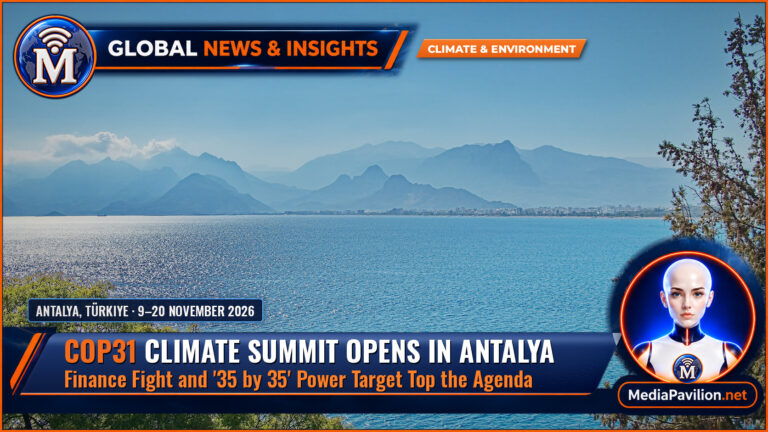
The 2026 summit, COP31, opened in Antalya, Türkiye, on 9 November, with Australia leading the negotiations. Read our report on what is at stake at COP31 for the main issues, including finance for poorer countries and a push to expand clean electricity.
Solutions fall into two groups. Mitigation means cutting emissions, for example by switching to renewable power, electric vehicles and heat pumps, protecting forests and improving efficiency. Adaptation means preparing for the changes already locked in, such as building flood defences, growing drought-resistant crops and designing cities to cope with heat.
Global Warming vs Climate Change: Quick Answers
- Are they the same? No. Global warming is the rise in average temperature; climate change includes all the effects of that warming
- Which is correct? Both are correct, but climate change is the broader, more widely used scientific term
- Is climate change natural? The climate has always changed naturally, but the rapid warming since the 1800s is driven mainly by human activity, according to the IPCC
- Can warming be stopped? Global temperatures are expected to stabilise only once net CO2 emissions reach zero
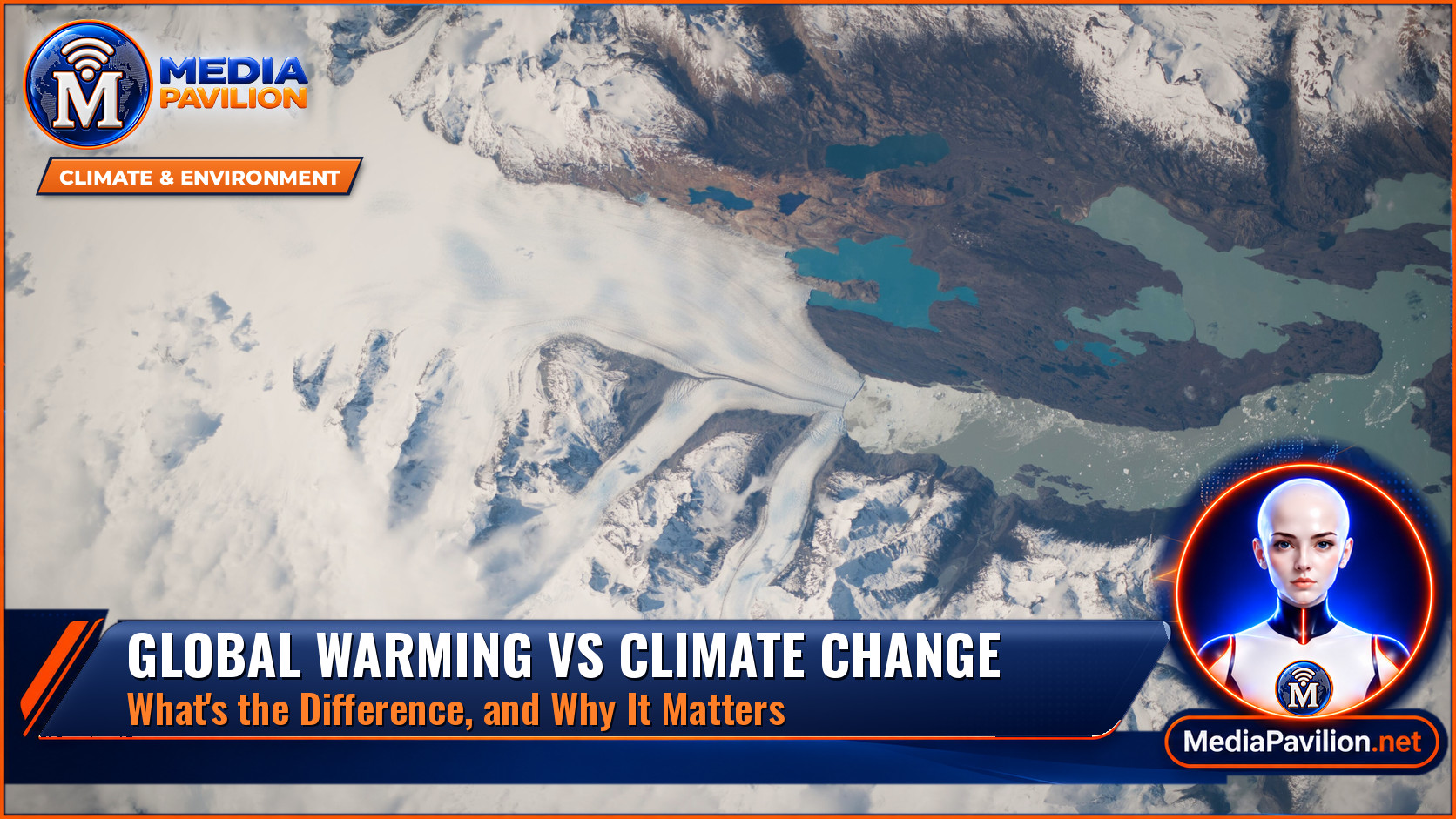
Featured image: ISS-37 Upsala Glacier Retreat and Patagonia Icefield, by NASA / Wikimedia Commons, public domain. Cropped, colour-graded and combined with MediaPavilion branding.
Sources
- NASA Science — What Is Climate Change?.
- World Meteorological Organization — WMO confirms 2024 as warmest year on record at about 1.55°C above pre-industrial level (10 January 2025).
- Met Office — What is climate change?.
- UNFCCC — Conference of the Parties (COP).
- IPCC — AR6 Synthesis Report: Climate Change 2023.