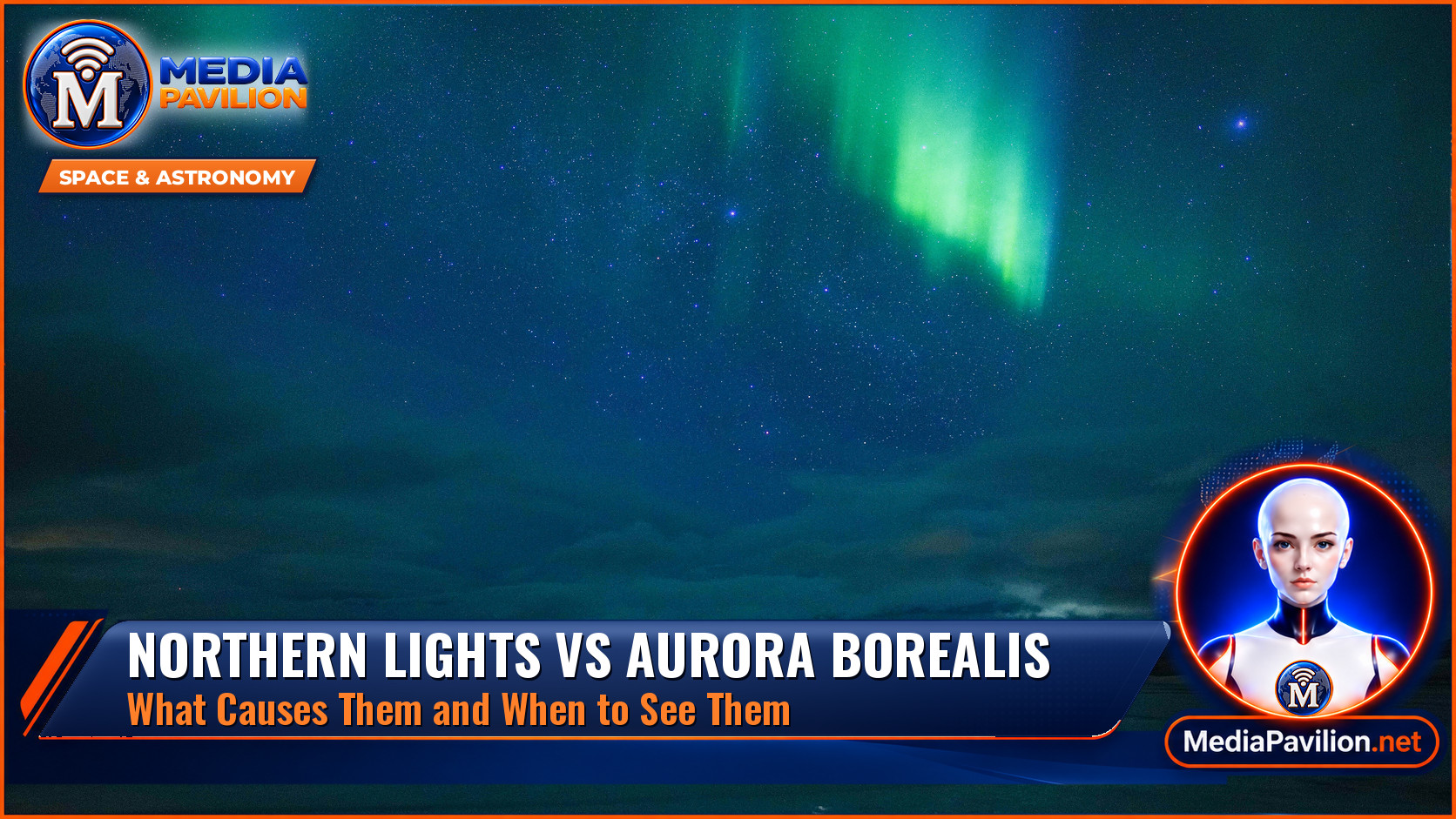
Northern Lights vs Aurora Borealis: Is There a Difference? Causes, Colours and Best Times to See Them
The northern lights and the aurora borealis are the same thing. “Aurora borealis” is the scientific name for the glowing curtains of green, pink and purple light seen in the skies of the far north, and “northern lights” is its everyday name. In the southern hemisphere, the same display is called the aurora australis, or southern lights. This guide explains what causes auroras, why they come in different colours, where and when you have the best chance of seeing them, and how to photograph them.
Northern Lights vs Aurora Borealis: Is There a Difference?
No. The two names describe exactly the same phenomenon. “Aurora” comes from the Roman goddess of the dawn, and “borealis” comes from Boreas, the Greek god of the north wind. The Italian astronomer Galileo Galilei is often credited with popularising the name in the early 17th century.
Scientists also simply say “aurora” (plural “auroras” or “aurorae”) to cover both hemispheres. The southern lights, aurora australis, are just as bright, but fewer people see them because most land under the southern auroral zone is in Antarctica or the open Southern Ocean.
- Aurora borealis: northern hemisphere, best seen from places such as Norway, Sweden, Finland, Iceland, Canada and Alaska
- Northern lights: the common name for the aurora borealis
- Aurora australis: southern hemisphere, sometimes seen from Tasmania, southern New Zealand, Patagonia and Antarctica
- Southern lights: the common name for the aurora australis
What Causes the Northern Lights?
Auroras start with the Sun. It constantly releases a stream of charged particles called the solar wind, and sometimes throws out huge clouds of magnetised gas known as coronal mass ejections. When these reach Earth, they disturb our planet’s magnetic field.
That disturbance accelerates electrons, which then pour down along the magnetic field lines towards the polar regions. According to the US National Oceanic and Atmospheric Administration’s Space Weather Prediction Center (NOAA SWPC), the aurora is the result of these electrons colliding with the upper reaches of Earth’s atmosphere. The collisions give energy to oxygen and nitrogen atoms and molecules, which release it as light, in a similar way to a neon sign.
This happens mostly in a ring around each magnetic pole called the auroral oval. During strong geomagnetic storms, the oval expands towards the equator, which is why auroras are sometimes seen much further south than usual. In May 2024, an extreme storm produced auroras visible across much of Europe and the United States.
Why Are the Northern Lights Different Colours?
The colour depends on which gas is hit and how high up the collision happens.
- Green: the most common colour, produced by oxygen at roughly 100 to 300 km altitude
- Red: produced by oxygen at higher altitudes, often above 300 km, and more common in strong storms
- Blue and purple: produced by nitrogen, usually at the lower edge of the display
- Pink: often a mix of red, blue and green, seen along the bottom of active curtains
Cameras often record colours more strongly than the human eye, especially when the aurora is faint. That is why photos can look more dramatic than what you see on the night.
Where Is the Best Place to See the Northern Lights?
The best places are under or close to the auroral oval, roughly between 65 and 72 degrees north. Popular choices include Tromsø and the Lofoten Islands in Norway, Abisko in Swedish Lapland, Rovaniemi and Inari in Finland, Iceland, Fairbanks in Alaska and Yellowknife in Canada’s Northwest Territories. Our guide to the best time to visit Iceland covers aurora season there in detail.
Darkness matters as much as location. Get away from city lights, check the cloud forecast, and look north. Clear skies are essential, since auroras happen far above the clouds.
When Is the Best Time to See the Northern Lights?
- Season: from about September to March in the northern hemisphere, when nights are long and dark
- Time of night: activity often peaks between about 10pm and 2am local time, though displays can happen at any time of darkness
- Moon: a new moon gives darker skies, but bright auroras are still visible under a full moon
- Equinoxes: many observers report more activity around the March and September equinoxes
- Solar cycle: the Sun’s activity rises and falls over about 11 years, and NASA and NOAA announced in October 2024 that the Sun had reached the solar maximum period of its current cycle. That peak phase was expected to last about a year, but strong storms often continue in the declining years of a cycle
For forecasts, NOAA SWPC publishes a 30-minute aurora forecast and a three-day outlook, and many countries have local aurora apps and alert services. The Kp index, which runs from 0 to 9, gives a rough guide to geomagnetic activity: the higher the number, the further from the poles the aurora may be visible.
How Do You Photograph the Northern Lights?
- Use a tripod: you will need exposures of several seconds
- Manual settings: start around ISO 1600 to 3200, the widest aperture your lens allows (for example f/2.8) and 5 to 15 seconds, then adjust
- Focus: set manual focus to infinity, and check it on a bright star
- Phones: many recent smartphones have a night mode that can capture auroras; keep the phone very still
- Keep warm: bring spare batteries, as cold drains them quickly
Northern Lights vs Aurora Borealis: Quick Answers
- Are they the same? Yes. Northern lights is the common name for the aurora borealis
- What is the southern version? The aurora australis, or southern lights
- What causes them? Electrons from Earth’s magnetic environment, energised by the solar wind, colliding with gases in the upper atmosphere
- Are they dangerous? Not to people on the ground, though strong geomagnetic storms can affect satellites, radio and power grids
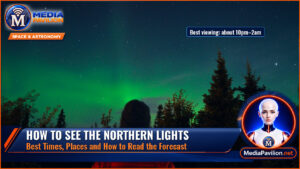
Featured image: 039 Northern lights over Mývatn (Iceland) Photo by Giles Laurent, by Giles Laurent / Wikimedia Commons, CC BY-SA 4.0. Cropped, colour-graded and combined with MediaPavilion branding.
Sources
- NOAA Space Weather Prediction Center — Aurora.
- NASA Science — Auroras.
- NASA Science — NASA, NOAA: Sun Reaches Maximum Phase in 11-Year Solar Cycle (15 October 2024).