How Much Car Can I Afford? Payments and Budget Caps
Quick answer: There is no official US government cap on “how much car you can afford,” but the Consumer Financial Protection Bureau (CFPB) says you should budget for the full cost of owning the car, not just the monthly loan payment: insurance, fuel, maintenance, repairs, registration and typcial running costs on top of the finance. A widely used rule of thumb, sometimes called the 20/4/10 guideline, is to put down at least 20 per cent, finance for no more than four years, and keep total monthly motoring costs at or below 10 per cent of gross income. That is informal advice from lenders and educators, not a CFPB rule. Always run the numbers on *your* income and debts before you sign.
Dealers and loan calculators often start with a monthly payment that looks harmless. The better question is whether that payment, plus everything else the car will cost, still leaves room for rent, food, savings and an emergency fund. Stretching to a more expensive car on a seven-year loan can feel easy in the showroom and tight six months later.
This guide explains what the CFPB tells borrowers to count, how common rules of thumb work, and how to set a price cap before you shop.
What Does the CFPB Say About How Much Car You Can Afford?
That is why two buyers with the same payment can have very different outcomes. A short loan on a modest used car, with a decent deposit, usually costs less over its life than a long loan on a new car with a small deposit, even if the sticker monthly figures look similar.
What Is the 20/4/10 Rule?
The 20/4/10 rule is a popular shorthand, not a law. It says: put down 20 per cent so you are less likely to owe more than the car is worth; keep the loan to four years or less so you pay it off while the car still has value; and keep the total monthly cost of the car (loan, insurance and running costs, not the loan alone) at or around 10 per cent of your gross monthly income. Some advisers use 15 or 20 per cent of take-home pay for the same idea. Treat these as ceilings to test, not targets to spend up to.
On a $5,000 gross monthly income, 10 per cent is $500 for everything to do with the car. If insurance is $150 and fuel and maintenance average $150, you have about $200 left for a loan payment, which points to a much cheaper car than a dealer calculator might suggest if it ignored those other costs.
How Should You Set a Price Cap Before You Shop?
Start with a written budget. List rent or the mortgage, utilities, food, minimum debt payments and the amount you want to save. What remains is the most you can put toward a car each month, and it has to include insurance and fuel, not just finance. Then decide on a deposit you can pay without emptying an emergency fund. A larger deposit reduces the loan, the interest and the risk of being “upside down” if the car is written off.
Get a quote for insurance on the specific car before you agree to buy; some models cost far more to cover than others. Compare loan offers from a credit union or bank with the dealer’s finance office, and ask in writing for the annual percentage rate (APR), the exact term in months, and the total amount payable, not just the advertised monthly figure. If the only way the payment “fits” is a six- or seven-year term, the car is probably too expensive. Sales tax, title fees and the first insurance premium can also surprise you at the desk, so leave a cash buffer above the deposit.
New, Used or a Lease?
A cheaper, reliable used car is often the more affordable path because someone else has already paid the steepest depreciation. A new car can make sense if the finance rate, warranty and your deposit are genuinely good, but it is not automatically the better deal. Leasing can look cheaper month to month, but you are paying for use, not building ownership, and mileage or wear charges can hurt at the end. We compare those options in more detail in lease versus buy a car.
Frequently Asked Questions
How much car can I afford on my salary?
There is no official salary multiple. Use your leftover monthly budget after essential bills and savings, subtract insurance and running costs, and only then look at a loan payment. The 10 per cent of gross income guideline is a starting ceiling, not a promise that you can spend that much.
Is a longer loan a good way to afford a nicer car?
It can make the payment look smaller, but you will usually pay more interest and spend more years owing money on a depreciating asset. The CFPB highlights this trade-off in its auto-loan guidance.
Should the payment include insurance?
Your budget should. A loan payment that only just fits will not fit once insurance, fuel and maintenance are added.
What if I already have a car loan I am struggling with?
Contact the lender early, and be cautious about refinancing into a longer loan or rolling negative equity into a new car. The CFPB accepts complaints if you think you were misled about costs or add-ons.
The Bottom Line
Decide, in writing, what you can afford before you fall for a particular model on the forecourt or online. Count the full monthly cost, put down as much as you safely can, and be sceptical of long terms that shrink the payment but inflate the total. Official CFPB advice is to budget for the full cost of ownership, not just the finance payment; informal rules such as 20/4/10 help you stay conservative. For the next steps, see our guides to GAP insurance, lease versus buy, the 50/30/20 budget rule and how to build an emergency fund.
Related Reading
- What Is GAP Insurance? How It Works, Costs and When You Need It
- Lease vs Buy a Car: Which Is Cheaper and Which Is Right for You?
- The 50/30/20 Rule: How to Budget Your Paycheck (With Examples)
- How to Build an Emergency Fund: How Much to Save and Where to Keep It
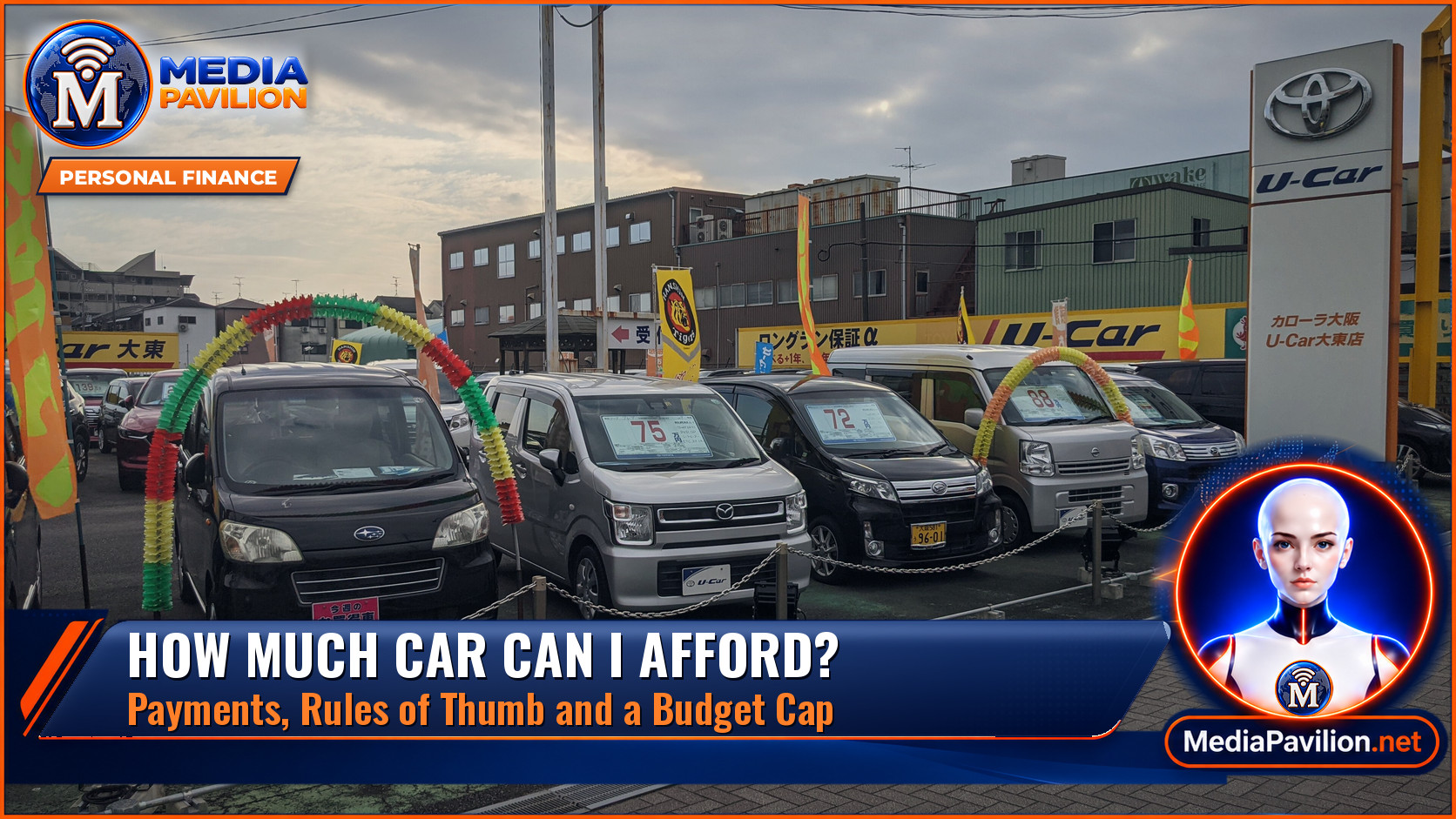
Featured image: Used cars for sale on a dealership lot, by Mr.ちゅらさん / Wikimedia Commons, CC BY-SA 4.0. Cropped, colour-graded and combined with MediaPavilion branding. Image licensed CC BY-SA 4.0.
Sources
- Consumer Financial Protection Bureau — How much can I afford to borrow for a car or auto loan?.
- Consumer Financial Protection Bureau — Take control of your auto loan: a step-by-step guide.
- Consumer Financial Protection Bureau — What is Guaranteed Asset Protection (GAP) insurance?.