Santa Claus Rally: What It Is and 2026 Dates
Quick answer: The Santa Claus rally is the tendency for US stocks to rise over the last five trading days of December and the first two trading days of January. Since 1950 the S&P 500 has gained about 1.3 per cent on average in that seven-day window and has risen in roughly three out of four years. In 2026 the window runs from Thursday 24 December 2026 to Tuesday 5 January 2027. It is a historical pattern, not a guarantee, and it is a poor reason on its own to buy or sell.
Every December, as markets thin out for the holidays, someone on financial television asks whether Santa will visit Wall Street. This year the question has an edge: the S&P 500 has just entered a correction after a sharp sell-off in AI stocks. So what exactly is the Santa Claus rally, how reliable has it been, and should it change anything you do? This guide explains the dates, the history, the theories and the limits. It is general information, not financial advice.
What Is the Santa Claus Rally?
The term was coined by Yale Hirsch, founder of the Stock Trader’s Almanac, in 1972. He defined it narrowly: the last five trading days of the year plus the first two of the new year. It does not mean “December” in general, and it does not start at Thanksgiving, even though many commentators use the phrase loosely for any end-of-year gain.
Hirsch’s book also popularised a rhyme that traders still quote: “If Santa Claus should fail to call, bears may come to Broad and Wall.” Broad Street and Wall Street are where the New York Stock Exchange stands. The idea is that a missing Santa rally can be an early warning of a weak January or a tougher year.
When Is the Santa Claus Rally in 2026?
Christmas Day 2026 falls on a Friday and New Year’s Day 2027 on the following Friday, and US stock markets are closed on both. That gives this window:
| Day | Date | Notes |
|---|---|---|
| 1 | Thursday 24 December 2026 | Christmas Eve; NYSE and Nasdaq close early, at 1pm Eastern |
| 2 | Monday 28 December 2026 | Full trading day |
| 3 | Tuesday 29 December 2026 | Full trading day |
| 4 | Wednesday 30 December 2026 | Full trading day |
| 5 | Thursday 31 December 2026 | New Year’s Eve, normal hours |
| 6 | Monday 4 January 2027 | First trading day of 2027 |
| 7 | Tuesday 5 January 2027 | Second trading day of 2027 |
The usual way to measure it is the S&P 500’s close on 23 December, the last day before the window, against its close on 5 January. For holiday hours, see our guide on whether the stock market is open today, and the official NYSE holiday calendar.
How Often Does the Santa Claus Rally Happen?
More often than not. According to data cited by Investopedia and the Almanac, the S&P 500 has risen in the seven-day window in roughly three-quarters of years since 1950, with an average gain of about 1.3 per cent. That compares with an average seven-day gain of only a fraction of that across the year as a whole, which is why the pattern gets attention.
Averages hide plenty of exceptions. Some years the window has been flat or negative, and a few negative Santa periods were followed by difficult markets. Others were followed by perfectly good years. The sample is also small: about 75 windows in total, which is not much for any statistical rule.
Why Do Stocks Tend to Rise at the End of December?
Nobody knows for sure. Common explanations include:
- Holiday optimism: a general upbeat mood and fewer negative news releases.
- Lighter trading: many professional traders are on holiday, so smaller retail flows can move prices more easily.
- Year-end bonuses and new money: some investors put fresh cash to work in late December and early January.
- End of tax-loss selling: selling to realise losses for tax purposes tends to fade by late December, removing pressure on beaten-down shares.
- Window dressing: some fund managers buy recent winners before year-end reports.
None of these is guaranteed to repeat, and once a pattern is widely known, traders may try to front-run it, which can blunt it.
Will There Be a Santa Claus Rally in 2026?
No one can say in advance. The setting is unusual: the S&P 500 and the Dow both closed in a correction on 20 November, more than 10 per cent below their records, and the Nasdaq turned negative for 2026, as we reported in our S&P 500 correction story. Markets that have fallen sharply sometimes rebound strongly into the year-end, but they can also keep falling if the reasons for the sell-off, such as worries over AI spending or interest rates, intensify.
Watch the Federal Reserve’s December meeting, AI company news and how the market behaves after Thanksgiving. Whatever happens, remember that a seven-day window is a tiny slice of an investing lifetime.
Should You Invest Based on the Santa Claus Rally?
For most people, no. Seasonal patterns are interesting, but they are too weak and inconsistent to build a strategy around, and trading costs and taxes can wipe out a 1 per cent edge. A more reliable approach is:
- Keep investing on schedule. Regular contributions to a 401(k) or index fund avoid trying to time short windows.
- Keep a cash buffer. An emergency fund means you will not have to sell shares in a bad week.
- Check your mix once a year. Year-end is a natural time to rebalance between shares and bonds if your target has drifted.
- Think about taxes before 31 December. Tax-loss harvesting and retirement contributions have year-end deadlines, so check the rules or ask a qualified adviser.
What Is the January Effect, and How Is It Different?
The January effect is a separate theory: that small-company shares tend to outperform in January, partly as tax-loss selling reverses. The Almanac also tracks the “first five days” indicator and the “January barometer”, which suggest that the direction of the market in early January hints at the full year. All three are patterns with mixed track records, not rules.
Frequently Asked Questions
What are the Santa Claus rally dates for 2026?
Thursday 24 December 2026 to Tuesday 5 January 2027, covering the last five trading days of 2026 and the first two of 2027.
How much does the stock market go up during the Santa Claus rally?
Since 1950 the S&P 500 has averaged a gain of about 1.3 per cent over the seven days, but individual years range from losses to gains of several per cent.
Does the Santa Claus rally start at Thanksgiving?
Not by the original definition. Yale Hirsch’s Santa Claus rally covers only the last five trading days of December and the first two of January, though some commentators use the phrase for any gains between Thanksgiving and New Year.
Is the Santa Claus rally real?
It is a real historical tendency, but it is not reliable enough to predict any single year, and it says little about long-term returns.
Is the stock market open on Christmas Eve?
Yes. In 2026 US stock markets are open on Thursday 24 December but close early, at 1pm Eastern Time. They are closed on Christmas Day.
The Bottom Line
The Santa Claus rally is a seven-day window from late December into early January when US stocks have historically tended to rise, by about 1.3 per cent on average. In 2026 it runs from 24 December to 5 January, against the backdrop of a fresh market correction. It is a fun piece of market folklore, but sticking to a long-term plan matters far more than what happens in one holiday week.
Related Reading
- What Is a Stock Market Correction?
- Bull vs Bear Market: What’s the Difference?
- S&P 500 vs Dow vs Nasdaq
- Index Funds vs ETFs
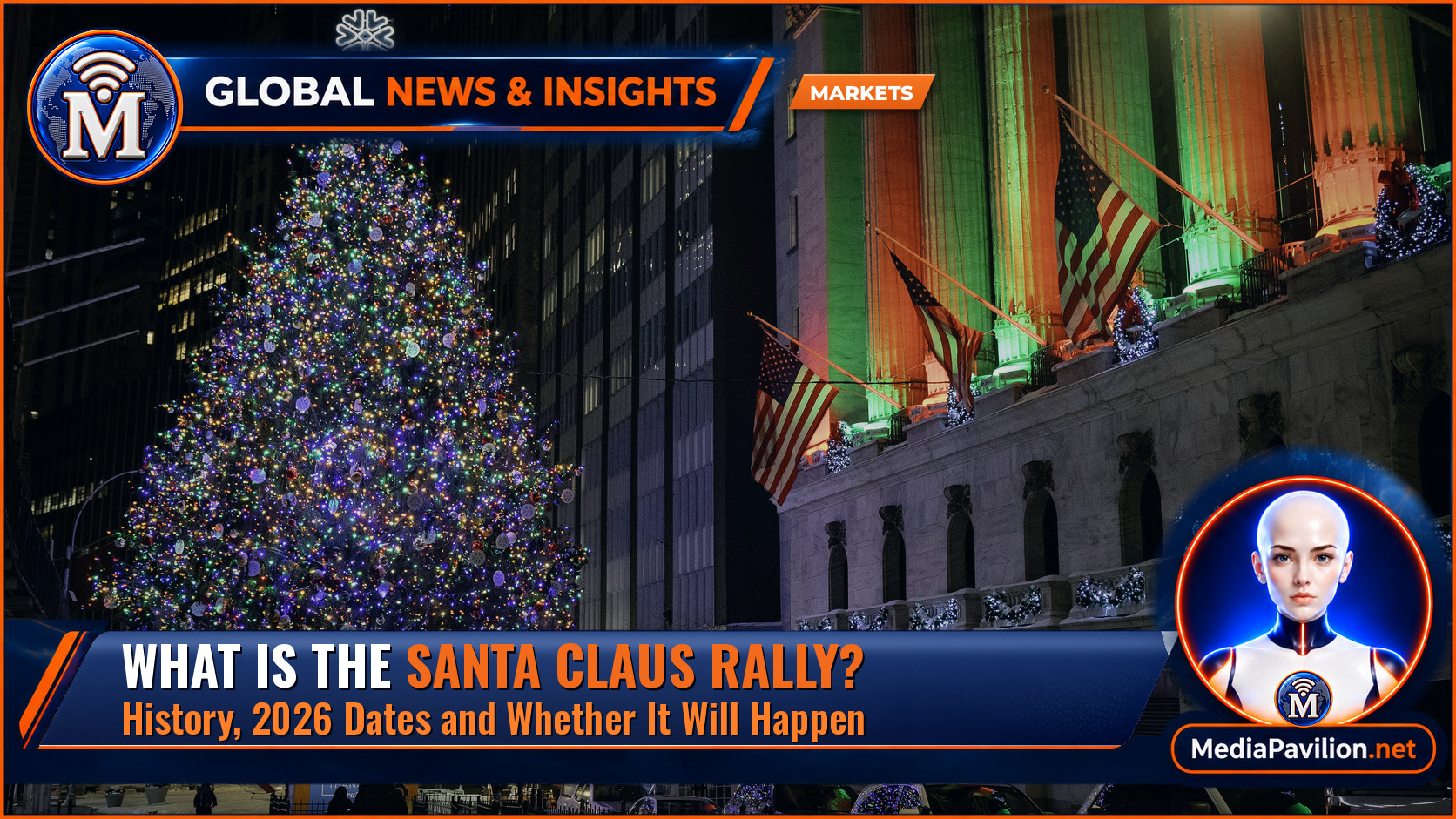
Featured image: the New York Stock Exchange Christmas tree on Wall Street (file photo), by Billie Grace Ward / Wikimedia Commons, CC0. Cropped, colour-graded and combined with MediaPavilion branding.
Sources
- Investopedia — Santa Claus Rally: What It Is and Means for Investors.
- Stock Trader's Almanac — Santa Claus Rally Results.
- CME Group OpenMarkets — The History of the Santa Claus Rally (2020).
- New York Stock Exchange — Holidays and trading hours.