How Long Does It Take to Charge an Electric Car?
Quick answer: How long it takes to charge an electric car depends on the charger. On a standard Level 1 (120-volt) household socket, you add about 5 miles of range per hour, so a full charge can take 40 hours or more. A Level 2 (240-volt) home or public charger adds about 25 miles per hour and fills most EVs overnight, in roughly 6 to 12 hours. A DC fast charger can add 100 to 300+ miles in about 30 minutes, typically taking a battery from about 10% to 80% in 20 to 40 minutes. Figures are from the US EPA; your car’s battery size, the charger’s power, the weather and how full the battery is all change the time.
Charging time is the question most people ask before buying an electric vehicle (EV), and the honest answer is “it depends”. The good news is that most EV owners rarely wait for a charge at all: they plug in at home overnight, as they would a phone. This guide explains the three charging levels, gives worked examples for a typical car, and shows why the last 20% takes so long.
How Long Does It Take to Charge an Electric Car?
The US Environmental Protection Agency groups chargers into three types:
| Charger type | Power source | Range added | Typical time for a full or useful charge |
|---|---|---|---|
| Level 1 | 120-volt household socket (about 1.9 kW) | About 5 miles per hour | 40-50+ hours from empty for a typical EV; fine for short daily commutes |
| Level 2 | 240-volt outlet or wall charger (about 6.6-11.5 kW) | About 25 miles per hour at 6.6 kW; more with faster units | About 6-12 hours from empty, so overnight |
| DC fast charging | Public stations (50-350 kW) | About 100-300+ miles per 30 minutes | About 20-40 minutes from 10% to 80% on many newer EVs |
The EPA’s Level 1 and Level 2 estimates assume 1.9 kW and 6.6 kW respectively. Many newer home wall chargers can deliver more, up to about 11.5 kW on a 48-amp circuit, but your car’s on-board charger sets the ceiling for Level 2 speed.
How Do You Work Out Charging Time for Your Car?
A simple estimate is: battery energy needed (kWh) ÷ charger power (kW) = hours, plus about 10% for charging losses. For a car with a 75 kWh usable battery charging from 20% to 80% (45 kWh):
| Charger | Power | Approximate time, 20% to 80% |
|---|---|---|
| Level 1 | 1.9 kW | About 26 hours |
| Level 2 (EPA estimate) | 6.6 kW | About 7.5 hours |
| Level 2 (faster wall unit) | 11.5 kW | About 4.3 hours |
| DC fast charger | 150 kW peak | About 25-30 minutes (the car’s charging curve limits the average speed) |
These are examples, not specifications for any model. Your car’s manual and app show its maximum AC and DC charging rates.
Why Does Fast Charging Slow Down After 80%?
Lithium-ion batteries accept energy fastest when they are fairly empty. As they fill, the car’s battery management system reduces the power to protect the cells and keep them cool. The EPA says it generally saves time to fast charge only to about 80% and carry on to the next station, because charging beyond 80% “tends to be significantly slower and it can sometimes double your time spent charging to reach 100%.” For daily use, many carmakers also recommend a routine limit of around 80% to 90% to look after the battery.
Does Cold Weather Make Charging Slower?
Yes. A cold battery charges more slowly, especially on a DC fast charger, until it warms up. Cold also reduces range: FuelEconomy.gov reports that, in tests at 20°F, EV range fell by about 41% in mixed driving with the cabin heater on, and about two-thirds of the extra energy went on heating the cabin. Without the heater, range was about 12% lower. To limit the hit, precondition the car while it is still plugged in, use seat and steering-wheel heaters, and, if your car offers it, use the navigation system to route to a fast charger so the battery warms on the way.
How Much Does It Cost to Charge an Electric Car?
At home, multiply the kWh you add by your electricity rate. For example, adding 45 kWh at 18 cents per kWh costs about $8.10 before charging losses, or about $9 with them. Off-peak time-of-use tariffs can cut that sharply. Public DC fast charging usually costs more per kWh than home charging, and some networks add session or idle fees, so check prices in the network’s app before you plug in.
Do You Need a Level 2 Charger at Home?
Not always. The EPA notes that many people who drive less than about 40 miles a day find Level 1 enough to recharge overnight. If you drive more, have a larger battery or share one car between several drivers, a Level 2 charger is far more convenient. A qualified electrician can tell you whether your panel has the capacity and install a 240-volt circuit; the Department of Energy’s guide to charging at home covers the options.
Disclosure: the product links in this section go to the makers’ or retailers’ official pages. MediaPavilion may earn a commission from some links; that never changes what we include. Popular Level 2 home chargers include the ChargePoint Home Flex, which can be set to suit circuits of different sizes. Check that any charger is safety-certified and works with your car’s connector (J1772 or NACS) or comes with an adapter.
Small habit, more range: under-inflated tyres increase rolling resistance and cut range, and tyre pressure drops in cold weather. Our Store lists the cordless Fanttik X11 Pro+ Tire Inflator ($64.99 from Fanttik’s official shop) for topping up at home; always inflate to the pressure on your door-frame sticker.
Where Can You Find Public Chargers?
The Department of Energy’s Alternative Fuels Station Locator maps public charging stations across the US, filterable by connector type and charging level. Apps from networks and carmakers show live availability and prices. Many non-Tesla EVs can now use Tesla Superchargers with the right adapter or a built-in NACS port; check your carmaker’s guidance first.
Frequently Asked Questions
How long does it take to charge an electric car at home?
Overnight on a Level 2 charger, typically 6 to 12 hours from nearly empty. On a regular socket, a full charge can take two days, though a night’s charge adds around 40 to 50 miles.
How long does a Tesla take at a Supercharger?
Often around 15 to 30 minutes to add a large share of range, depending on the model, the station’s power and the battery’s starting level. Tesla’s app estimates time for each stop.
Can I charge an EV in the rain?
Yes. Chargers and charging ports are designed and certified to be used outdoors in wet weather.
Is it bad to charge an EV to 100% every day?
Many carmakers recommend a daily limit of 80% to 90% for lithium-ion batteries, and 100% only before long trips. Some cars with LFP batteries are an exception; check your manual.
How long does it take to charge an electric car at a gas station?
Petrol stations with DC fast chargers work like any public fast charger: about 20 to 40 minutes for a 10% to 80% top-up on many EVs.
The Bottom Line
Most EV owners charge at home overnight and wake up to a car with enough range for the day. On the road, a DC fast charger takes most newer EVs from about 10% to 80% in 20 to 40 minutes, so plan stops around 80% rather than 100%. Your own car’s battery size and maximum charging rate, and the weather, decide the exact times.
Related Reading
- How Do Self-Driving Cars Work?
- How Much Car Can I Afford?
- Lease vs Buy a Car
- How to Check Car Recalls by VIN
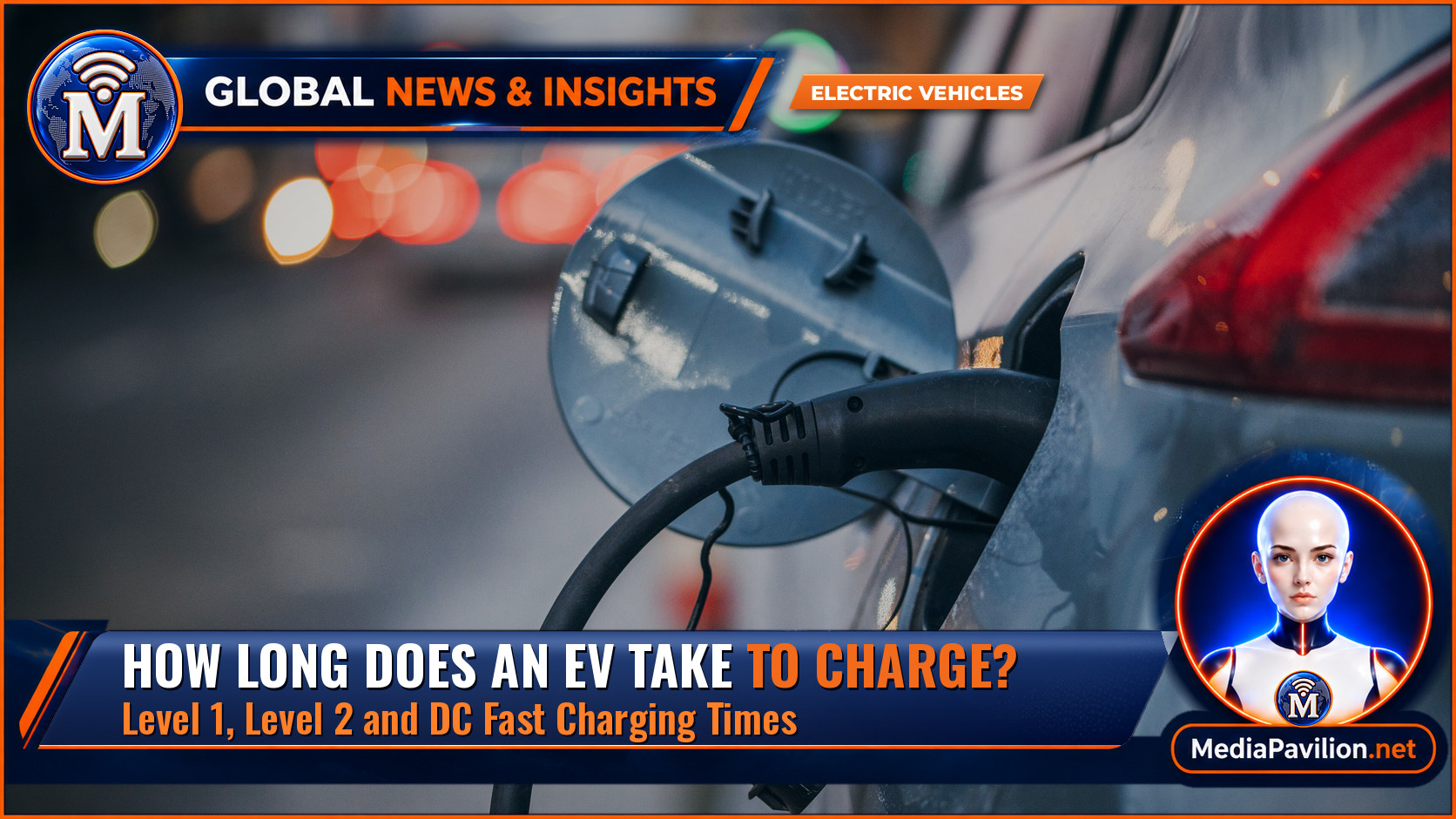
Featured image: an electric car charging at a public charger (file photo), by Ivan Radic / Wikimedia Commons, CC BY 2.0. Cropped, colour-graded and combined with MediaPavilion branding.
Sources
- US Environmental Protection Agency — Plug-in electric vehicle charging: the basics.
- FuelEconomy.gov (US DOE and EPA) — Fuel economy in cold weather.
- US Department of Energy, Alternative Fuels Data Center — Charging plug-in electric vehicles at home.
- US Department of Energy, Alternative Fuels Data Center — Alternative fuels station locator.