How Long Are Thanksgiving Leftovers Good For?
Quick answer: Thanksgiving leftovers are good for 3 to 4 days in the fridge (at 40°F/4°C or below), according to the USDA. That covers turkey, stuffing, mashed potatoes, casseroles, gravy and pumpkin or pecan pie. If you made dinner on Thursday 26 November, eat or freeze leftovers by Monday 30 November. Get food into the fridge within 2 hours of serving, and reheat it to 165°F (74°C). Frozen leftovers stay safe indefinitely, but taste best within about 3 to 4 months.
The turkey is carved, the guests have gone home and the fridge is stacked with containers. Now comes the question millions of Americans type into Google every year: how long is all this actually safe to eat? The answer is shorter than many people think, and it starts counting the moment dinner is served, not when the food goes into the fridge. This guide covers the official rules, food-by-food storage times, how to freeze and reheat leftovers properly, and the warning signs that mean it is time to throw something out.
How Long Are Thanksgiving Leftovers Good For in the Fridge?
The US Department of Agriculture’s Food Safety and Inspection Service says leftovers can be kept in the refrigerator for 3 to 4 days. That is the rule of thumb for almost every cooked Thanksgiving dish. Bacteria that cause food poisoning can grow in the fridge without changing how food looks, smells or tastes, so the clock matters more than the sniff test.
| Thanksgiving food | Fridge (40°F or below) | Freezer (0°F) |
|---|---|---|
| Cooked turkey (sliced or in pieces) | 3 to 4 days | 2 to 6 months |
| Stuffing or dressing (cooked separately) | 3 to 4 days | 3 to 4 months |
| Mashed potatoes and vegetable casseroles | 3 to 4 days | 3 to 4 months (egg-based casseroles 2 to 3 months) |
| Gravy | 3 to 4 days (bring to a rolling boil to reheat) | 3 to 4 months |
| Turkey soup or stock | 3 to 4 days | 2 to 3 months |
| Pumpkin or pecan pie (baked) | 3 to 4 days | 1 to 2 months |
| Custard or chiffon pie | 3 to 4 days | Do not freeze |
| Ham, cooked and sliced | 3 to 5 days | 1 to 2 months |
Fridge and freezer times are from FSIS and the federal FoodSafety.gov cold storage chart; where a dish is not listed separately, we use FSIS’s general guide of 3 to 4 months in the freezer. Freezer times are for quality only: food kept continuously at 0°F stays safe indefinitely.
When Does the 3-to-4-Day Clock Start?
It starts when the food is cooked and served, not when you finally put it away. If Thanksgiving dinner is on Thursday, treat Sunday or Monday as the last day for fridge leftovers. A simple trick: write the date on each container with masking tape and a marker, or stick a note on the fridge door that says “Leftovers out by Monday”.
How Long Can Thanksgiving Food Sit Out?
No more than 2 hours at room temperature, or 1 hour if the room is above 90°F, says FSIS. Bacteria multiply fastest between 40°F and 140°F, a range food scientists call the “danger zone”. That two-hour limit includes the time the food spends on the table while everyone is eating, watching football and going back for seconds.
One bacterium in particular loves holiday meals. The US Centers for Disease Control and Prevention notes that outbreaks of *Clostridium perfringens*, which grows in large cooked meat dishes left at the wrong temperature, are most common in November and December, and are often linked to foods like turkey and roast beef. You can read more on the CDC’s C. perfringens page.
How Do You Store Thanksgiving Leftovers Safely?
- Carve the turkey off the bone. FSIS advises slicing breast meat and cutting the bird into smaller pieces; legs and wings can stay whole. A whole carcass cools far too slowly.
- Use shallow containers. Divide big batches of stuffing, potatoes or gravy into small, shallow containers so they chill quickly.
- Do not wait for food to cool. Hot food can go straight into the fridge. Leaving it on the counter to cool first eats into your two hours.
- Cover everything. Airtight lids or wrap keep bacteria out and moisture in.
- Check your fridge temperature. It should be 40°F (4°C) or below; a cheap fridge thermometer is worth having.
- Do not overpack the fridge. Cold air needs space to circulate, especially after a big shop.
Can You Freeze Thanksgiving Leftovers?
Yes, and it is the easiest way to stretch the feast beyond Monday. Freeze anything you will not eat within 3 to 4 days, ideally on day one or two, while it is still at its best. Turkey freezes very well in portions with a splash of broth or gravy to stop it drying out. Mashed potatoes, stuffing, soups and pumpkin pie also freeze well. Custard pies, cream-based desserts and salads with mayonnaise do not.
To thaw, use the fridge (the safest method), cold water in a leak-proof bag, or the microwave. FSIS says food thawed in the fridge should be eaten within 3 to 4 days, and you can safely reheat frozen leftovers without thawing them first; it just takes longer. If you are already thinking about next year’s bird, our guide on how long to thaw a turkey has the full timetable.
How Do You Reheat Leftovers Safely?
Reheat all leftovers to an internal temperature of 165°F (74°C), measured with a food thermometer, and bring sauces, soups and gravy to a rolling boil, FSIS says. Cover food while reheating so it heats evenly, and in the microwave, stir or rotate and check the temperature in several spots because microwaves leave cold patches. Only reheat what you plan to eat; repeated warming and cooling is bad for both safety and flavour.
Disclosure: product links on this page go to the maker’s official page, and MediaPavilion may earn a commission from some links; that never changes what we recommend. An instant-read thermometer such as the ThermoWorks Thermapen ONE makes the 165°F check quick, though any accurate digital food thermometer does the job.
How Can You Tell If Leftovers Have Gone Bad?
Throw food away if it smells sour or off, looks slimy, or shows any mould. But do not rely on your senses alone: the bacteria that cause food poisoning usually do not change the look, smell or taste of food. If you cannot remember when something was cooked, or it has been in the fridge more than four days, follow the food-safety rule: when in doubt, throw it out. Never taste food to check whether it is safe.
Myth or Fact: Common Leftover Questions
- “It smells fine, so it’s fine.” Myth. Dangerous bacteria are usually odourless.
- “Reheating kills everything.” Not quite. Heating to 165°F kills many bacteria, but some produce toxins that heat does not destroy, which is why the 2-hour and 4-day rules matter.
- “You can’t refreeze leftovers.” Myth. FSIS says it is safe to refreeze leftovers that were thawed in the fridge, or reheated to 165°F.
- “The cold garage or porch is a fine extra fridge.” Risky. Outdoor temperatures swing during the day, and food can warm into the danger zone or attract animals.
Frequently Asked Questions
How long are Thanksgiving leftovers good for in the fridge?
Three to four days for cooked turkey, stuffing, sides, gravy and baked pies, according to the USDA. After that, freeze them or throw them out.
Is turkey still good after 5 days?
The USDA recommends eating cooked turkey within 3 to 4 days. After five days the risk of bacterial growth is higher, so it is safest to discard it, even if it looks and smells normal.
How long are Thanksgiving leftovers good for in the freezer?
They stay safe indefinitely at 0°F, but quality is best within about 3 to 4 months for most leftovers (FSIS), 2 to 6 months for cooked turkey and 1 to 2 months for baked pies (FoodSafety.gov).
Can you eat Thanksgiving leftovers that were left out overnight?
No. Perishable food left at room temperature for more than 2 hours should be thrown away, FSIS says, even if you reheat it.
Where can I get help with a food safety question?
The USDA Meat and Poultry Hotline (1-888-674-6854) answers questions, and the USDA’s FoodKeeper app lists storage times for hundreds of foods.
Planning ahead for the holiday? See what Thanksgiving dinner costs in 2026, check whether gas prices could set a Thanksgiving record, and read why the Lions play on Thanksgiving.
Related Reading
- How Long to Thaw a Turkey
- How Much Does Thanksgiving Dinner Cost?
- Busiest Days to Travel for Thanksgiving
- Thanksgiving Gas Prices 2026 Could Set a Record
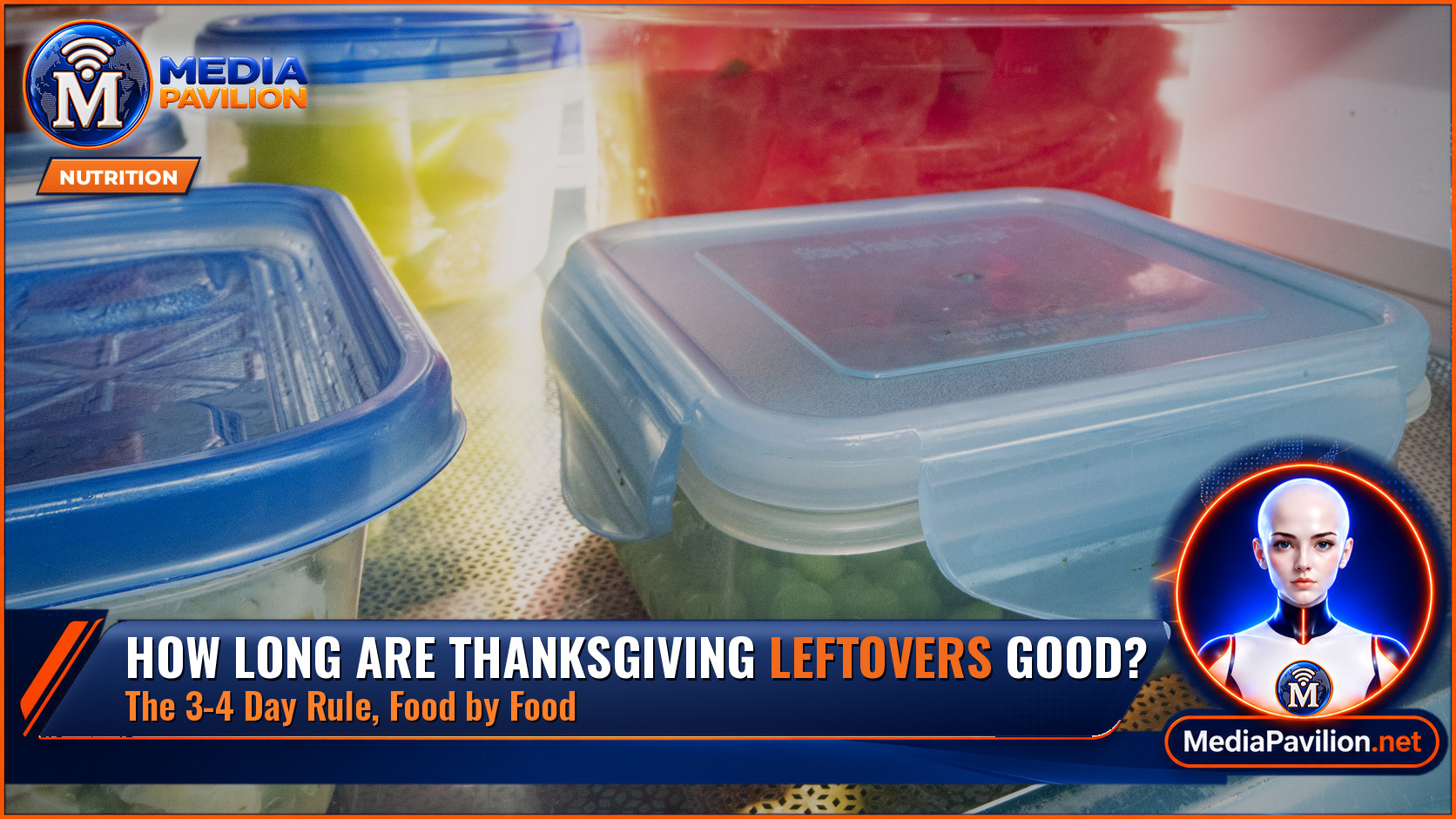
Featured image: leftovers stored in sealed containers in a refrigerator (file photo), by the US Department of Agriculture / Wikimedia Commons, public domain. Cropped, colour-graded and combined with MediaPavilion branding.
Sources
- USDA Food Safety and Inspection Service — Leftovers and Food Safety (updated 31 July 2020).
- FoodSafety.gov — Cold Food Storage Chart (reviewed 19 September 2023).
- CDC — About C. perfringens food poisoning (2024).
- USDA FSIS — Danger Zone (40°F – 140°F) (accessed 22 November 2026).