Beaver Supermoon 2026: Moonrise Times Tonight and How to See It
Quick answer: November’s full Beaver Moon is a supermoon. It reaches peak illumination at 9:53 a.m. EST on Tuesday 24 November 2026, when it is below the horizon for most of the US, so the best time to look is moonrise on Tuesday evening (about 4:07–4:42 p.m. local time in major US cities), facing east. It will also look full on Wednesday evening. NASA says it is the first of three supermoons in a row (November, December and January). You need no equipment, just a clear eastern horizon and, this week, a break in the clouds.
If you noticed a big, bright Moon on Monday night, you were looking at the run-up to this month’s supermoon. The full Beaver Moon peaks on Tuesday 24 November, two days before Thanksgiving, and because it falls close to perigee, the point in the Moon’s orbit nearest to Earth, it counts as a supermoon. Here is when to see it where you live, what “supermoon” actually means, and what the stormy Thanksgiving week weather could mean for your view.
When is the Beaver Moon 2026 at its fullest?
According to The Old Farmer’s Almanac, the Moon reaches peak illumination at 9:53 a.m. EST (6:53 a.m. PST) on 24 November. At that moment the Moon has already set for viewers across the continental US, so the moment of “exact” fullness is not the one to aim for. The Moon looks full to the eye for roughly a day either side, which is why the Almanac suggests looking on the evenings of 23 and 24 November.
The practical answer: go out around moonrise on Tuesday evening. A full Moon rises in the east at about the time the Sun sets in the west, and that is when it looks largest and most dramatic against trees, hills and skylines.
What time does the full moon rise tonight in my city?
These moonrise times for Tuesday 24 November are taken from Time and Date’s city tables (local time). Times shift by a few minutes within each metro area, and hills or buildings on your eastern horizon will delay the moment you actually see it.
| City (time zone) | Moonrise Mon 23 Nov | Moonrise Tue 24 Nov | Moonrise Wed 25 Nov |
|---|---|---|---|
| New York (ET) | 3:29 p.m. | 4:15 p.m. | 5:14 p.m. |
| Chicago (CT) | 3:21 p.m. | 4:07 p.m. | 5:06 p.m. |
| Denver (MT) | 3:39 p.m. | 4:28 p.m. | 5:28 p.m. |
| Los Angeles (PT) | 3:50 p.m. | 4:42 p.m. | 5:45 p.m. |
For any other town, use the moonrise calculator at Time and Date and change the location. In most of the country the Moon rises shortly before or around sunset on Tuesday, so you have a short window of twilight when the sky is still blue and the Moon glows orange near the horizon.
What is a supermoon, and will it really look bigger?
“Supermoon” is not an official astronomical term. NASA says it is typically used for a full Moon that comes within at least 90% of perigee. The Moon’s orbit is slightly oval, ranging from about 226,000 miles (363,300 km) to about 251,000 miles (405,500 km) from Earth.
The difference is real but subtle. The Almanac puts a supermoon at up to about 8% larger and 16% brighter than a typical full Moon; NASA’s comparison against the faintest full Moon of the year (a “micromoon”) is up to 14% bigger and 30% brighter. Most people will not notice the size change without a side-by-side photo. What makes it look huge near the horizon is the Moon illusion, a trick of perception that affects every full Moon.
- Bigger and brighter: slightly, compared with an average full Moon.
- Tides: near perigee, full Moons can bring slightly higher “king tides” on coasts, according to the Almanac; the effect is modest but can add to flooding when storms coincide.
- Safety: looking at the Moon is safe with the naked eye, binoculars or a telescope.
Why is it called the Beaver Moon?
The name comes from North American folklore. The Almanac explains that late November is when beavers retreat to their lodges with winter food stores, and during the fur trade it was the season for trapping them for their thick winter pelts. Other November names include the Frost Moon (Cree), the Digging or Scratching Moon (Tlingit), the Deer Rutting Moon (Dakota and Lakota) and the Whitefish Moon (Algonquin).
You will also see a lot of searches for the Beaver Moon’s “spiritual meaning” and horoscopes this week, because the Moon is in Gemini. That is astrology rather than astronomy; nothing about the Moon’s position changes how it looks from Earth.
Will clouds or Thanksgiving storms block the view?
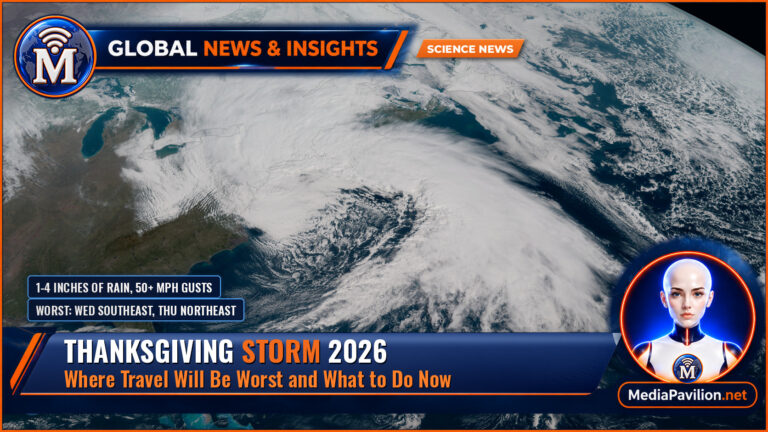
Possibly. Unsettled weather is forecast on both coasts this week, and our Thanksgiving storm 2026 travel forecast explains where rain and snow are most likely. If Tuesday is cloudy where you are, try again on Wednesday evening: the Moon will still look full and rises about an hour later. Check your local National Weather Service forecast for cloud cover before you head out.
How do you get the best view (and photos) of the supermoon?
- Find an open eastern horizon: a beach, field, hilltop or high floor facing east.
- Arrive 10–15 minutes before moonrise: the first few minutes, when the Moon is low and orange, are the most striking.
- Use something in the foreground: a skyline, tree or building makes the Moon look larger in photos.
- On a phone: tap the Moon to focus, then lower the exposure so it is not a white blob; avoid digital zoom and use a 2x–5x lens if you have one.
- Steady the camera: lean on a wall or use a small tripod; even a one-second shake blurs the craters.
- Binoculars help: any pair will show the dark “seas” and bright craters clearly.
When are the next supermoons?
NASA and the Almanac describe November as the first of three consecutive supermoons. Time and Date, which uses a slightly looser definition, counts a run of four stretching to February 2027. The next two everyone agrees on are:
| Full Moon | Peak (Eastern Time) | Traditional name | Note |
|---|---|---|---|
| 24 Nov 2026 | 9:53 a.m. | Beaver Moon | Supermoon, Thanksgiving week |
| 23 Dec 2026 | 8:28 p.m. | Cold Moon | Supermoon, the night before Christmas Eve |
| 22 Jan 2027 | 7:17 a.m. | Wolf Moon | Supermoon |
Meteor fans also have the Geminids in mid-December, one of the year’s best showers, and they peak around 13–14 December, well before the 23 December full Moon, so moonlight should be less of a problem than in some years. Our meteor shower calendar 2026–27 has dates and viewing tips.
What does the supermoon mean for you?
- Skywatchers: Tuesday evening at moonrise is the moment; Wednesday is the backup.
- Thanksgiving travellers: the bright Moon will light up Tuesday and Wednesday night drives, but watch the weather rather than the Moon; see our guide to the busiest days to travel for Thanksgiving.
- Coastal residents: perigee tides can be a little higher this week, so take flood warnings seriously if a storm is also forecast.
- Photographers: you get two more chances, on 23 December and 22 January.
Frequently asked questions
Is the full moon tonight or tomorrow night?
The exact peak is on the morning of Tuesday 24 November (9:53 a.m. EST). For viewing, Tuesday evening is best, and the Moon will still look full on Wednesday evening.
What time is the full moon tonight in Eastern, Central, Mountain and Pacific time?
The peak is 9:53 a.m. EST, 8:53 a.m. CST, 7:53 a.m. MST and 6:53 a.m. PST on 24 November. To see it, use the evening moonrise times in the table above.
Is November’s full moon a supermoon in 2026?
Yes. NASA lists 24 November as a full supermoon and the first in a series of three consecutive supermoons.
What is the spiritual meaning of the Beaver Moon?
Traditions link it to preparing for winter, which is where the name comes from. Astrological interpretations vary by author and are not scientific.
Can you see the supermoon from anywhere?
Yes. The full Moon is visible from everywhere on Earth where the sky is clear at night; only the local time changes.
Related reading: How to see the northern lights · Artemis Moon landing: NASA’s new lander plans · Meteor shower calendar 2026–27
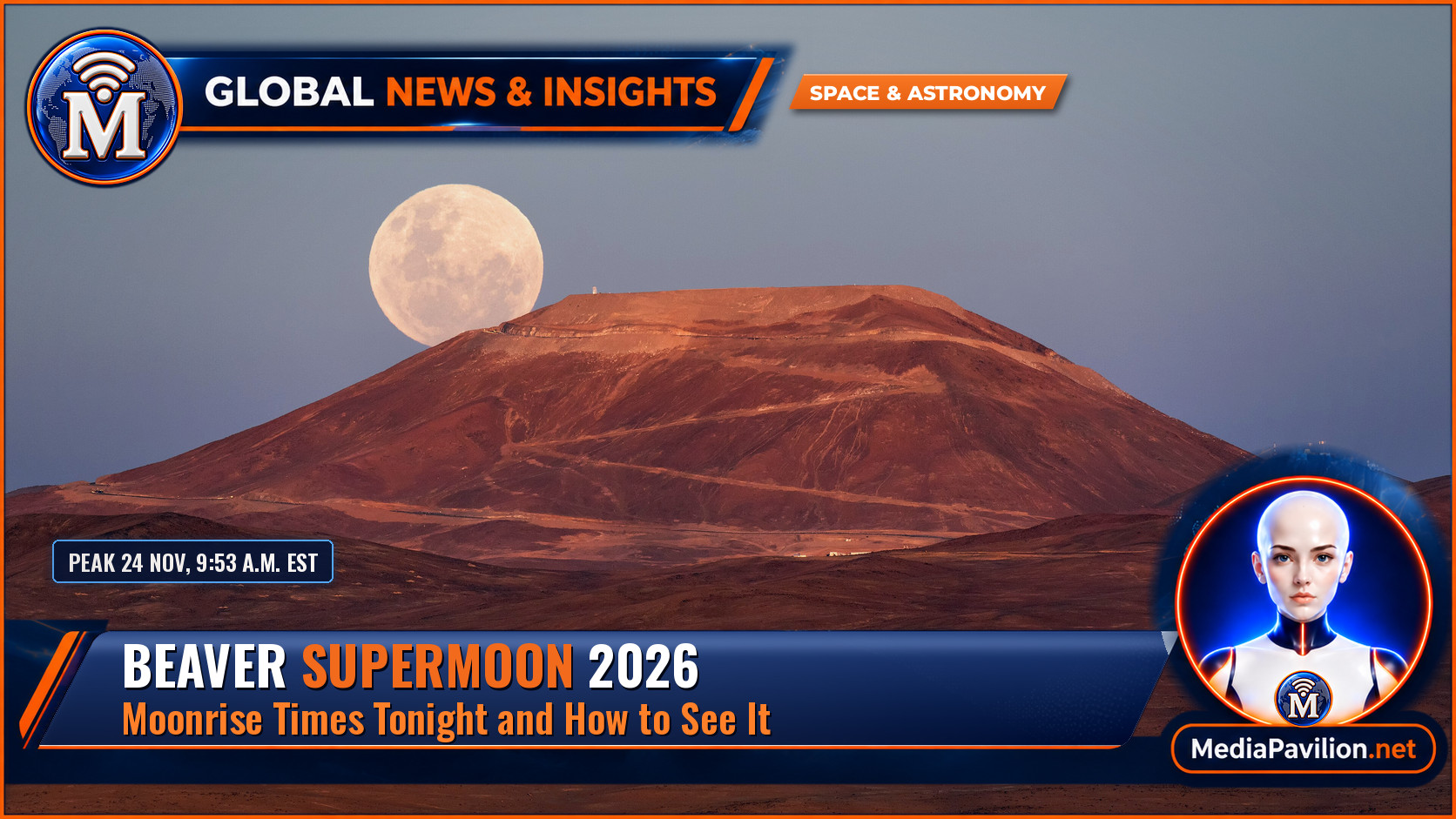
Featured image: G. Hüdepohl (atacamaphoto.com)/ESO / Wikimedia Commons, CC BY 4.0 (a 2018 supermoon over Cerro Armazones, Chile; file image, not tonight’s Moon).
Sources
- NASA Science — What’s Up: November 2026 Skywatching Tips from NASA (November 2026).
- NASA Science — Supermoons.
- The Old Farmer's Almanac — Full Beaver Supermoon November 2026: Date, Meaning, and Best Viewing (24 November 2026).
- Time and Date — Moon phases 2026 for New York.
- Time and Date — Super Full Moon explained.
- Time and Date — Moonrise and moonset, New York, November 2026.