Riemann Hypothesis Proof: What Anthropic’s AI Claim Means
A mathematician at the AI company Anthropic says he has proved the Riemann hypothesis, the most famous unsolved problem in mathematics, working with the company’s Claude AI model. Levent Alpöge posted a short note on his website on Friday 20 November, together with a computer-checkable version of the proof written in the Lean programming language. Independent checks run since then have so far found no errors in the code, but mathematicians stress that the claim has not been peer-reviewed and that a human-readable proof has yet to appear.
If it holds up, it would be a historic moment for mathematics and for artificial intelligence. Here is what was claimed, what has been verified so far, why the problem matters and what happens next.
What Did the Anthropic Mathematician Claim?
“I believe I have, working with Claude, discovered a proof of the Riemann Hypothesis,” Alpöge wrote in the note, according to Scientific American and Nature. He says the result covers the Generalized Riemann Hypothesis, a much broader version of the original statement, and that he and the model “formalized the arguments without assumptions”.
Nature described the accompanying document as four pages long, including a sketch of the proof. The full argument lives in the Lean code, which Alpöge has called incredibly long. The announcement came a day after Anthropic’s shares began trading on the Nasdaq; Alpöge wrote that “there is an obvious cynical view, to do with the timing, but it is false”. Nature and The Verge reported that Anthropic had not commented.
What Is the Riemann Hypothesis?
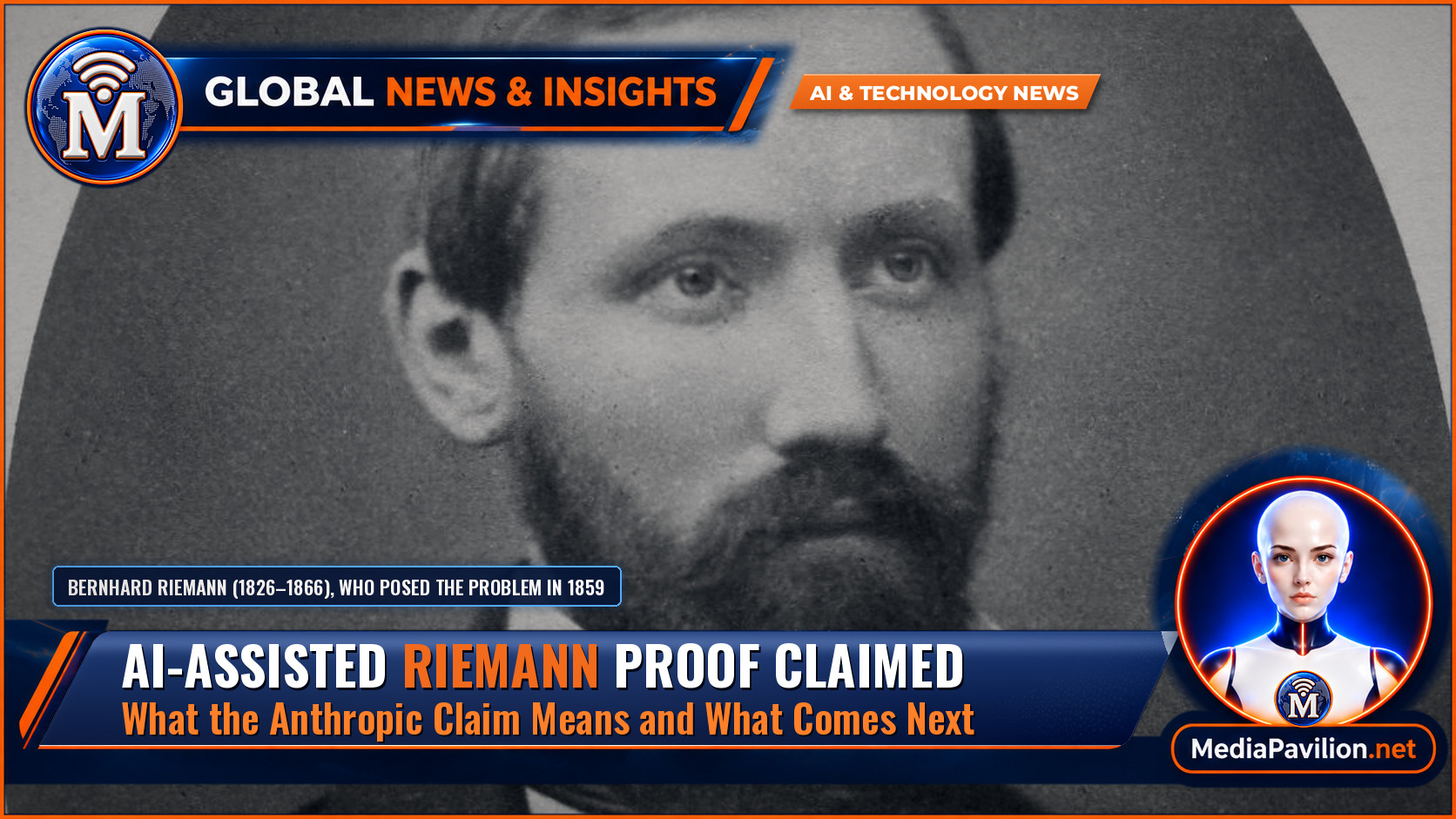
In 1859 the German mathematician Bernhard Riemann suggested that the prime numbers, which look scattered at random, follow a deep hidden pattern. His idea concerns the “zeros” of a function now called the Riemann zeta function. Apart from some trivial cases, Riemann conjectured, all of those zeros lie on a single vertical line, where the real part equals one-half. If true, primes are distributed among the whole numbers about as evenly as they possibly could be.
The statement has been checked by computer for trillions of zeros, but never proved. It is one of the seven Millennium Prize Problems set by the Clay Mathematics Institute, which carries a $1 million prize. Thousands of published results begin with the words “assuming the Riemann hypothesis”, so a proof would at a stroke confirm them all.
Has the AI Riemann Proof Been Verified?
Partly, and so far positively. A Lean proof that compiles without errors is normally taken as strong evidence that each logical step is correct. Andrew Sutherland of MIT has published a running log of independent checks. As of 12:55 UTC on Saturday, it reported that all 175,187 modules compile, that the headline theorems rely only on Lean’s three standard axioms, and that two independently written proof-checking kernels accept the full proof. Some final checks, including a run of the official comparator tool, were still in progress.
“Honestly the chance that anything is fishy here is approximately zero,” Sutherland told Scientific American. Kevin Buzzard of Imperial College London, a leading figure in the Lean community, has stressed the key question: whether the theorem written in the code is exactly the Riemann hypothesis, with no hidden change to the definitions. Sutherland’s log says the statements use the standard definitions from Lean’s shared Mathlib library.
Why Are Some Mathematicians Cautious?
Machine checks show that a formal statement follows from the axioms. They do not, by themselves, give mathematicians an understanding of why it is true. Andrew Granville, a number theorist at the University of Montreal, told Nature that Alpöge should have prepared a clearer write-up first. “What he released is garbled,” he said, and he linked the timing to Anthropic’s falling share price.
Others are openly excited. “If this fully checks out, it is clearly a historic milestone in mathematics,” the Fields Medal winner James Maynard of the University of Oxford told Nature. Hector Pasten of the Pontifical Catholic University of Chile told Scientific American that a correct, understood proof would be “something like a Rosetta Stone” linking different branches of mathematics.
What Does This Mean for AI?
AI tools have made rapid progress in mathematics this year, from olympiad-level problems to claimed solutions of open research questions, some of them disputed. A verified proof of the Riemann hypothesis would be the strongest evidence yet that large language models, paired with formal checking tools, can do frontier research rather than just assist with it. It would also sharpen debates about credit, transparency and how science should handle results that machines can check but people struggle to read. For background on the models involved, see our comparison of ChatGPT, Gemini and Claude and our report on Anthropic’s IPO filing.
What Happens Next?
In the short term, the remaining software checks should finish, and experts will scrutinise the exact statement being proved. The bigger task is human: mathematicians will want a readable account of the key ideas, which Alpöge has not yet published. Under the Clay Institute’s rules, a solution must appear in a qualifying peer-reviewed publication and win general acceptance in the mathematical community, with at least two years passing after publication, before the prize can be considered. So even in the best case, the $1 million question will not be settled quickly.
The Bottom Line
An Anthropic mathematician says he and Claude have proved the Riemann hypothesis, and early independent computer checks support the claim. It is not yet peer-reviewed or fully understood by people, so “claimed and partly verified” is the honest description for now. We will update this story as the checks and expert reviews come in.
Related Reading
- ChatGPT vs Gemini vs Claude: Plans and Prices 2026
- Anthropic IPO: S-1 Filing Reveals $16.3bn Revenue
- S&P 500 Correction: What the AI Sell-Off Means Now
- Do AI Detectors Work?
Featured image: Bernhard Riemann (1826–1866), portrait photograph, Wikimedia Commons, public domain. Cropped, colour-graded and combined with MediaPavilion branding.
Sources
- Scientific American — Anthropic mathematician claims to prove Riemann hypothesis, most famous problem in all of math (20 November 2026).
- Scientific American — The AI Riemann hypothesis proof is almost certainly true, independent mathematicians attest (20 November 2026).
- Nature — Mathematician says he and AI solved Riemann hypothesis (20 November 2026).
- Andrew Sutherland, MIT — Verification files for the Lean proof of the Riemann Hypothesis (21 November 2026).
- Clay Mathematics Institute — The Riemann Hypothesis (Millennium Prize Problem).