
SpaceX Catches Starship: What the First Ship Catch Means
SpaceX caught the upper stage of its Starship rocket with the arms of its launch tower on Saturday, the first time a Starship returning from orbit has been recovered this way. The ship, known as Ship 42, flew back to Starbase in South Texas about 22.5 hours after lift-off and lowered itself between the tower’s “chopstick” arms. The Super Heavy booster that launched it was lost over the Gulf of Mexico the day before.
The company had already caught boosters on three earlier flights, but never the ship itself. Here is what happened on Starship Flight 15, why the catch matters and what comes next.
What Happened on Starship Flight 15?
Starship lifted off from Starbase on Friday evening, 13 November, on its 15th test flight, according to SpaceX’s flight summary. After stage separation, the ship reached orbit and deployed 26 Starlink V3 satellites, which SpaceX said were already raising their orbits. The ship then coasted around Earth for more than 20 hours before relighting a single Raptor engine for a deorbit burn.
On Saturday afternoon it flew back over the Gulf, made a final “swoosh” manoeuvre, flipped upright using three Raptor engines and settled into the arms of the tower SpaceX calls “Mechazilla”. Space.com reported that the catch happened at 4:20 p.m. Eastern Time (21:20 GMT). The Associated Press described it as the first-ever capture of a Starship flying back from space.
What Went Wrong With the Booster?
The plan was a double catch: booster and ship. That did not happen. SpaceX said the booster’s boostback burn ended early because of low fuel mass, and its guidance system triggered an automated abort and diverted the vehicle to an offshore landing point. It performed a landing burn while hovering over the Gulf, and its flight termination system was then triggered. The company said the root cause is under investigation. The AP reported that wreckage remained in the Gulf, cordoned off by buoys.
Why Does a Starship Catch Matter?
Catching the ship is harder than catching the booster because the upper stage flies higher, faster and further, and it has to survive re-entry from orbit. “That was the missing link,” SpaceX’s Dan Huot said on the landing webcast, according to Space.com. “We caught a Starship, and now everything changes.” A BBC live report quoted the company calling the feat the “Holy Grail of space flight”.
Full reuse of both stages is central to SpaceX’s plans to cut launch costs, deploy larger Starlink satellites and carry crews and cargo to the Moon and, eventually, Mars. Starship is also the basis of the lunar lander NASA has contracted for its Artemis programme, which we covered in our report on NASA’s Artemis Moon-landing plans for 2028. A ship that can be caught, checked and flown again would, in principle, make frequent missions far cheaper than building a new upper stage each time.
Was Flight 15 a Full Success?
Not entirely. The Verge noted that SpaceX did not recover the whole vehicle, and Elon Musk had cautioned on an earnings call that “success is not guaranteed on these first flights”. Still, the booster had been caught on previous flights, so many observers see the booster failure as a fixable problem rather than a fundamental one. The ship catch was the piece that had never been demonstrated.
What Happens Next?
SpaceX has not announced a date for Flight 16. The investigation into the booster’s fuel problem is likely to shape the timing, and the company is expected to inspect Ship 42 closely for heat damage to judge how much work a caught ship needs before it can fly again. Any future flights also depend on the usual licensing from the US Federal Aviation Administration, which oversees commercial launches. For a broader look at how far space hardware travels, NASA’s Voyager 1 is about to reach one light-day from Earth this month, and our meteor shower calendar for 2026-27 covers what you can see from your own back garden.
Related Reading
- NASA Artemis Moon Landing 2028: The Landers and the Plan
- UK Space Agency Grant for Environmental Intelligence
- Meteor Shower Calendar 2026-27
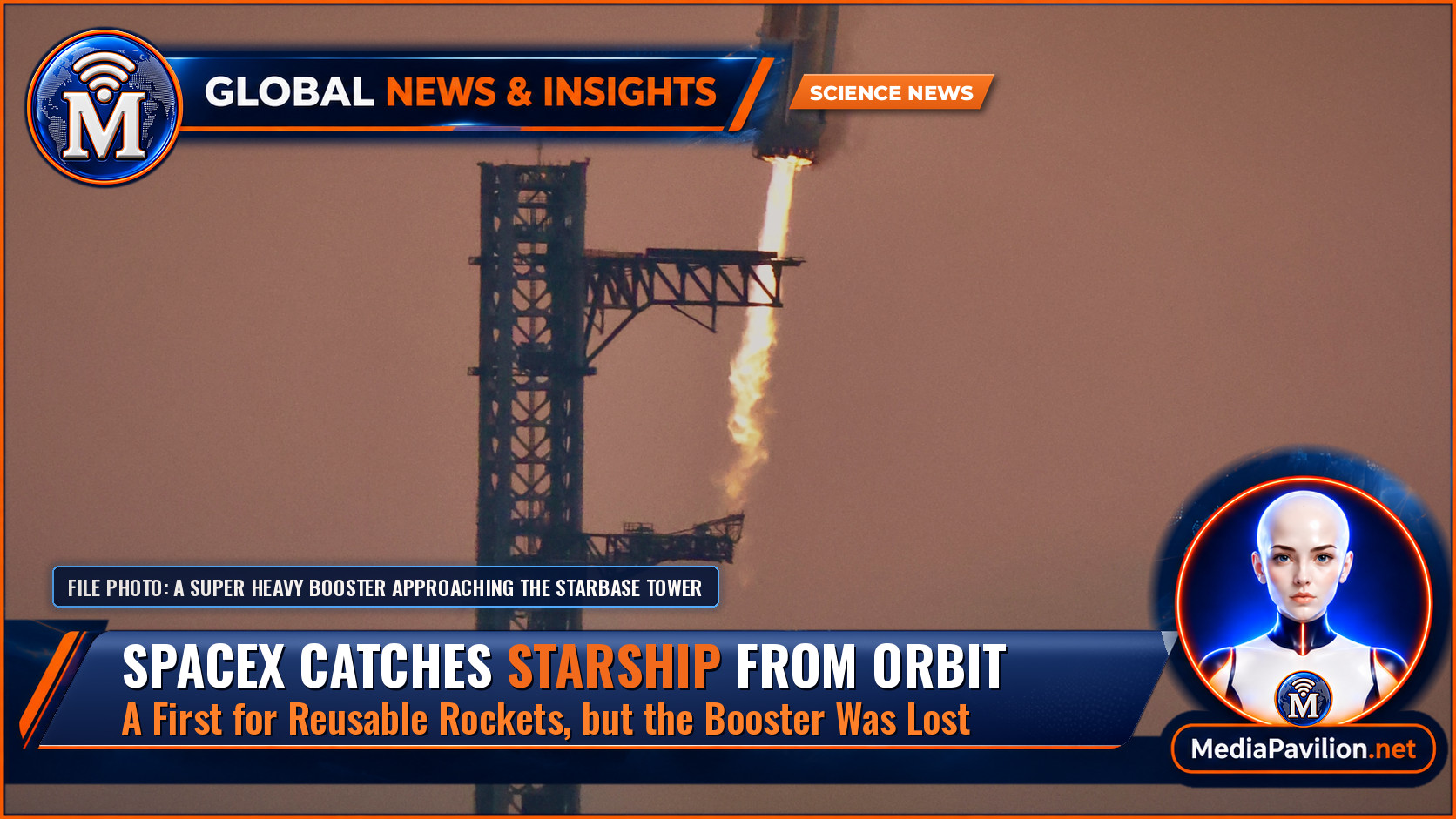
Featured image: a Starship Super Heavy booster on final approach to the Starbase launch tower (file photo, earlier flight), by Steve Jurvetson / Wikimedia Commons, CC BY 2.0. Cropped, colour-graded and combined with MediaPavilion branding.
Sources
- SpaceX — Starship Flight 15 (14 November 2026).
- Space.com — ‘Now everything changes’: SpaceX catches Starship upper stage for 1st time ever (14 November 2026).
- Associated Press — SpaceX’s Starship returns from orbit and is captured by launch pad arms in a dramatic first (14 November 2026).
- The Verge — Watch SpaceX successfully execute the first ‘chopstick’ catch of Starship (14 November 2026).
- BBC News — SpaceX successfully catches part of Starship rocket on its return to Earth (14 November 2026).