How to Read More Books: 12 Practical Habits That Actually Work
The most reliable way to read more books is not speed-reading but reading more often: a short daily habit, books you genuinely want to read and fewer barriers between you and the page. Twenty minutes a day at an average reading pace adds up to well over a dozen books a year. This guide sets out what the research says about reading speed, the habits that work and the tricks that are not worth your money.
How Many Books Do People Actually Read?
Less than they used to, at least in the United States. A Gallup survey published in January 2022 found Americans read an average of 12.6 books in the previous year, down from 15.6 in 2016, the lowest figure in Gallup’s trend dating back to 1990. The drop was steepest among the most frequent readers.
Averages are skewed by heavy readers, so the typical person reads far fewer. If you finish one book a month, you are already ahead of many adults. The good news is that the gap is mostly about time and habit, not ability.
How Fast Does the Average Person Read?
A 2019 review by the psychologist Marc Brysbaert, which pooled 190 studies involving nearly 18,000 participants, estimated that adults read English non-fiction silently at about 238 words per minute and fiction at about 260 words per minute, according to the paper in the Journal of Memory and Language. Older estimates of 300 words per minute or more appear to have been too high.
Here is what that means in practice. A typical novel runs to roughly 70,000 to 100,000 words. At 250 words per minute, a 90,000-word book takes about six hours. Read for 20 minutes a day and you will finish it in about 18 days, or roughly 20 books a year.
Does Speed-Reading Work?
Mostly not, at least not in the way it is marketed. A major review led by Keith Rayner and published in Psychological Science in the Public Interest in 2016 concluded that there is a trade-off between speed and accuracy. Readers can go faster, but comprehension falls, especially for detailed or unfamiliar material. Techniques that claim to eliminate “subvocalisation” (the inner voice) or to let you take in whole pages at a glance are not supported by the evidence.
The same review found that the best way to read faster with good understanding is to become a more skilled reader overall, chiefly by building vocabulary and background knowledge through, unsurprisingly, more reading. Skimming is a legitimate skill when you only need the gist, but it is not the same as reading.
How Can You Make Time to Read Every Day?
Treat reading like any other habit you want to keep. These steps work for most people:
- Set a small, fixed goal. “Ten pages before bed” or “20 minutes on the train” is easier to stick to than “read more”.
- Attach it to an existing routine. Read with your morning coffee, during lunch or straight after brushing your teeth.
- Carry a book everywhere. A paperback in your bag or an e-book app on your phone turns waiting rooms and queues into reading time.
- Swap some screen time. Replacing one episode or 20 minutes of scrolling a day is enough to reach 15 to 20 books a year.
- Keep a book by the bed and another in the living room so the easiest thing to pick up is a book.
- Track what you finish. A simple list or a free reading app makes progress visible and motivating.
Do Audiobooks and E-Books Count?
Yes. For understanding a story or the main ideas of a non-fiction book, research generally finds listening and reading produce similar comprehension, although print may have the edge for dense, technical material you need to study closely. Audiobooks turn commutes, workouts and chores into reading time, and e-readers make it easy to carry hundreds of books.
A Pew Research Center survey found that 75% of American adults had read a book in some format in the previous year, with 30% reading e-books and 23% listening to audiobooks. If you are choosing a device, our guide to Kindle vs Kobo compares the two main e-reader systems, including library borrowing.
How Do You Choose Books You Will Actually Finish?
Many people stall because they force themselves through books they think they should read. Try these approaches instead:
- Follow your curiosity. A gripping thriller you finish beats a classic you abandon on page 40.
- Mix lengths and genres. Alternate a long or demanding book with a shorter, lighter one.
- Use samples. Read the free preview of an e-book or the first chapter in a shop or library before committing.
- Give yourself permission to quit. If a book has not hooked you after 50 pages, move on. Life is too short, and quitting frees time for better books.
- Look at prize lists and recommendations from people whose taste you trust. Literary prizes, such as the Cundill History Prize, are a good way to find well-reviewed non-fiction.
How Can You Read Without Spending a Fortune?
Your local library is the best deal in reading. Most US public libraries lend e-books and audiobooks free through apps such as Libby and Hoopla, as well as print books. Second-hand bookshops, book swaps and free public-domain classics from projects such as Project Gutenberg add even more options. If you buy a lot of e-books, look out for regular daily deals rather than paying full price.
How Do You Remember More of What You Read?
Reading more is only useful if some of it sticks. Simple techniques help:
- Pause at the end of each chapter and summarise it in a sentence or two in your head.
- Take light notes or highlight sparingly, then review them when you finish.
- Talk about books. Explaining an idea to a friend or a book club is one of the best ways to remember it.
- Write a short review of every book you finish, even just three lines for yourself.
What Gets in the Way of Reading?
The biggest obstacles are usually tiredness, phones and the feeling that reading must be done in long, uninterrupted stretches. Put your phone in another room for your reading session, or use your phone’s focus mode. If you are exhausted at night, move reading earlier in the day. And remember that short sessions count: five pages a day is still about 1,800 pages a year.
If reading has slipped because you feel constantly drained, our guide to burnout signs and recovery may help you understand why.
A Simple 30-Day Plan to Read More
- Week 1: pick one book you are excited about and read 10 minutes a day at a fixed time.
- Week 2: increase to 15 to 20 minutes and add an audiobook for your commute or exercise.
- Week 3: remove one source of friction, such as phone scrolling in bed, and replace it with reading.
- Week 4: start a list of books you want to read next and join a library app so the next book is always ready.
Reading more is less about willpower than design. Make reading easy, enjoyable and routine, and the books will add up on their own.
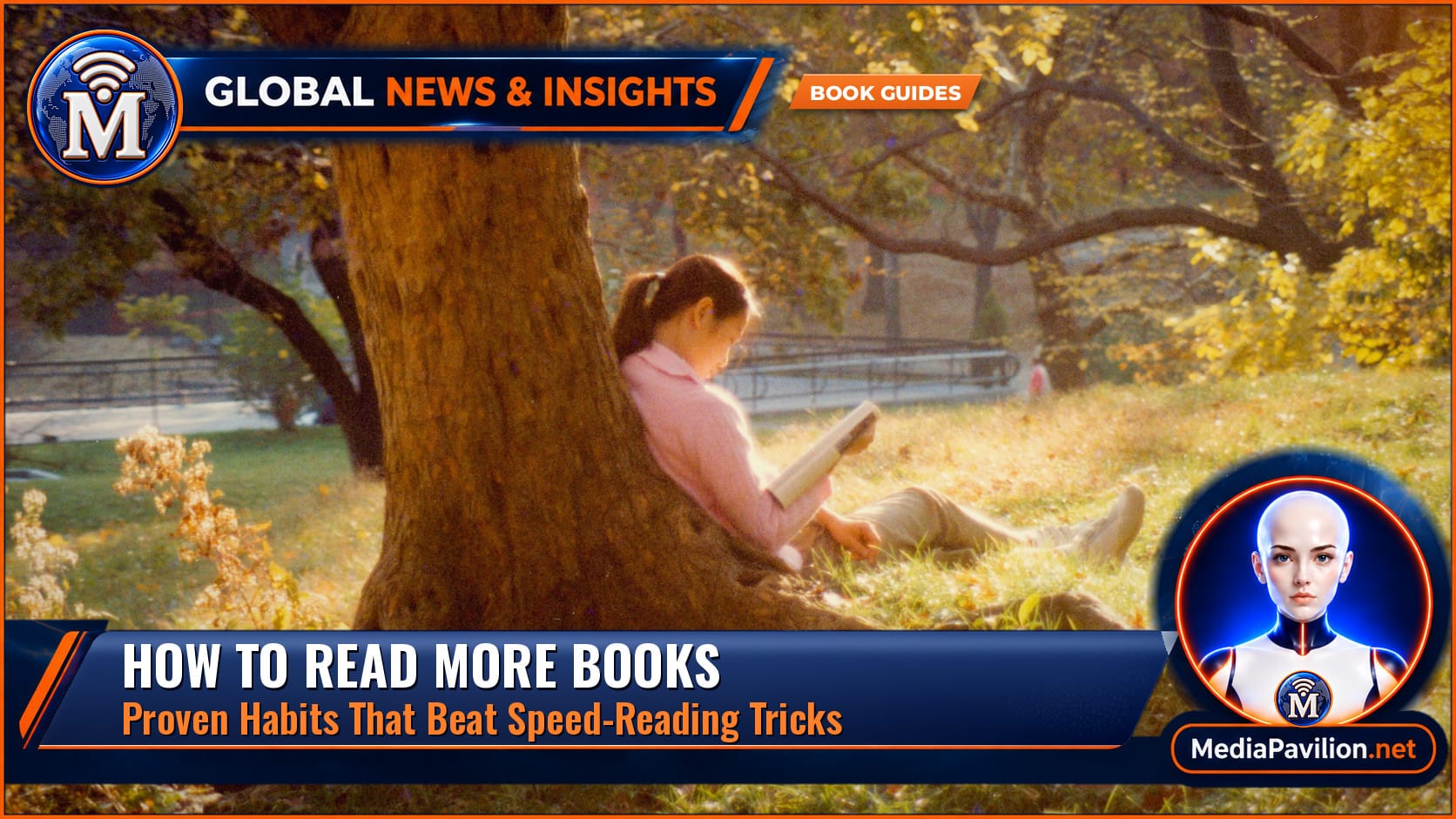
Featured image: Girl Reading a Book in Central Park 1995 (Explore) – Flickr – the bridge, by David Saddler / Wikimedia Commons, CC BY 4.0. Cropped, colour-graded and combined with MediaPavilion branding.
Sources
- Gallup — Americans Reading Fewer Books Than in Past (10 January 2022).
- Pew Research Center — Three-in-ten Americans now read e-books (6 January 2022).
- Journal of Memory and Language (Brysbaert) — How many words do we read per minute? A review and meta-analysis of reading rate (2019).
- Psychological Science in the Public Interest (Rayner et al.) — So Much to Read, So Little Time: How Do We Read, and Can Speed Reading Help? (2016).


