
New Zealand Election Too Close to Call as Special Votes Will Decide Luxon’s Fate
New Zealand’s general election has ended without a clear winner, with Prime Minister Christopher Luxon’s National Party and Chris Hipkins’ Labour Party almost level on the party vote and the final shape of Parliament depending on hundreds of thousands of special votes still to be counted. The official result is not due until 27 November, so New Zealanders face nearly three weeks of uncertainty over who will govern.
On election night figures, National’s existing coalition with ACT and New Zealand First was projected to hold 67 seats, just one more than the 66 needed for a majority in an enlarged Parliament, according to Radio New Zealand (RNZ) and SBS News. “We have a pathway to forming the next government, but it is too close to call,” Luxon told supporters in Auckland around midnight.
What Are the Preliminary New Zealand Election Results?
With 98.5% of votes counted, National and Labour were each on about 29.3% of the party vote, RNZ reported. That is a heavy fall for National from 38.1% in 2023, although it remained the largest party in Parliament because it won 42 of the 64 general electorate seats. SBS, citing RNZ, said Labour was marginally ahead on the party vote, with 29.36% to National’s 29.21%.
- National: 29.3%, 42 seats
- Labour: 29.3%, about 35 seats
- Greens: 13.3%, 16 seats (their best-ever result)
- ACT: 10.9%, 13 seats
- New Zealand First: 9.8%, 12 seats
- Opportunity: 6%, 7 seats (first time in Parliament)
- Te Pāti Māori: 5 seats
Because National and Te Pāti Māori won more electorates than their party vote would normally give them, Parliament is set to have a 10-seat overhang. That raises the number of seats needed to govern from the usual 61 to 66, RNZ said. The combined vote of the two big parties, 58.6%, was the lowest since New Zealand adopted its mixed-member proportional (MMP) system in 1996.
Why Is the Result Too Close to Call?
Special votes, which include ballots cast overseas and by people voting outside their home electorate, are counted after election night. The Electoral Commission had forecast about 700,000 special votes this year, RNZ reported, and estimates of how many were still outstanding on Sunday ranged from about 300,000 to 400,000. Special votes have traditionally leaned towards parties on the left, so even a small shift could cost the current coalition its one-seat margin.
Hipkins has not conceded. “It may take us a little bit longer to figure out exactly what it is that you’ve said. Every vote matters, and every vote must now be counted,” he said on Saturday night. “When the final result is known, I’ll have quite a bit more to say.” ACT leader David Seymour summed up the mood: “What’s clear is nothing’s clear tonight.”
Could the Opportunity Party Decide the Next Government?
If the right-leaning bloc slips below 66 seats, neither side could govern without the centrist Opportunity Party, which crossed the 5% threshold for the first time. Its leader, Qiulae Wong, a former sustainable-business consultant who took over the party in November 2025, has said she will talk first to whichever party has the most seats. “You have voted for unity over division,” she told supporters.
Opportunity’s flagship policy is a universal basic income of NZ$19,400 a year for most residents, paid for by a 1.75% annual land tax, SBS reported. Both National and Labour have ruled out adopting its tax plans, which could make any deal difficult.
Which Senior Ministers Lost Their Seats?
Even if National leads the next government, it will lose some of its most senior figures. Finance Minister Nicola Willis, who stood only on the party list, has no way back into Parliament on these numbers, RNZ reported. Paul Goldsmith lost the Epsom electorate and Chris Bishop lost Hutt South. Speaker Gerry Brownlee is also leaving. Willis, Goldsmith and Bishop held 19 ministerial portfolios between them, including finance, justice, transport and housing.
The weaker National result and stronger showings for ACT and New Zealand First are likely to shift the balance inside any renewed coalition, with the two smaller parties expected to push for bigger roles.
What Issues Shaped the Vote?
The campaign was dominated by the cost of living and a struggling economy, with unemployment at its highest level in a decade, SBS said. Willis pointed to petrol prices of NZ$3.60 a litre, global tariffs and the fuel shock linked to the war in the Middle East. “It’s been a very difficult time to be in government, for governments around the world,” she said. The result follows a pattern of voters punishing incumbents, seen this week in the US midterm elections, where Democrats won both houses of Congress.
Economic pressure is also building elsewhere in the region: Australia’s central bank raised its cash rate to 4.85% this week as inflation stays high.
What Happens Next?
The Electoral Commission will count special votes and publish the official result on 27 November. Coalition talks can begin informally before then, but no party is likely to commit until the final seat numbers are known. Under New Zealand’s caretaker convention, Luxon’s government stays in office until a new one is formed.
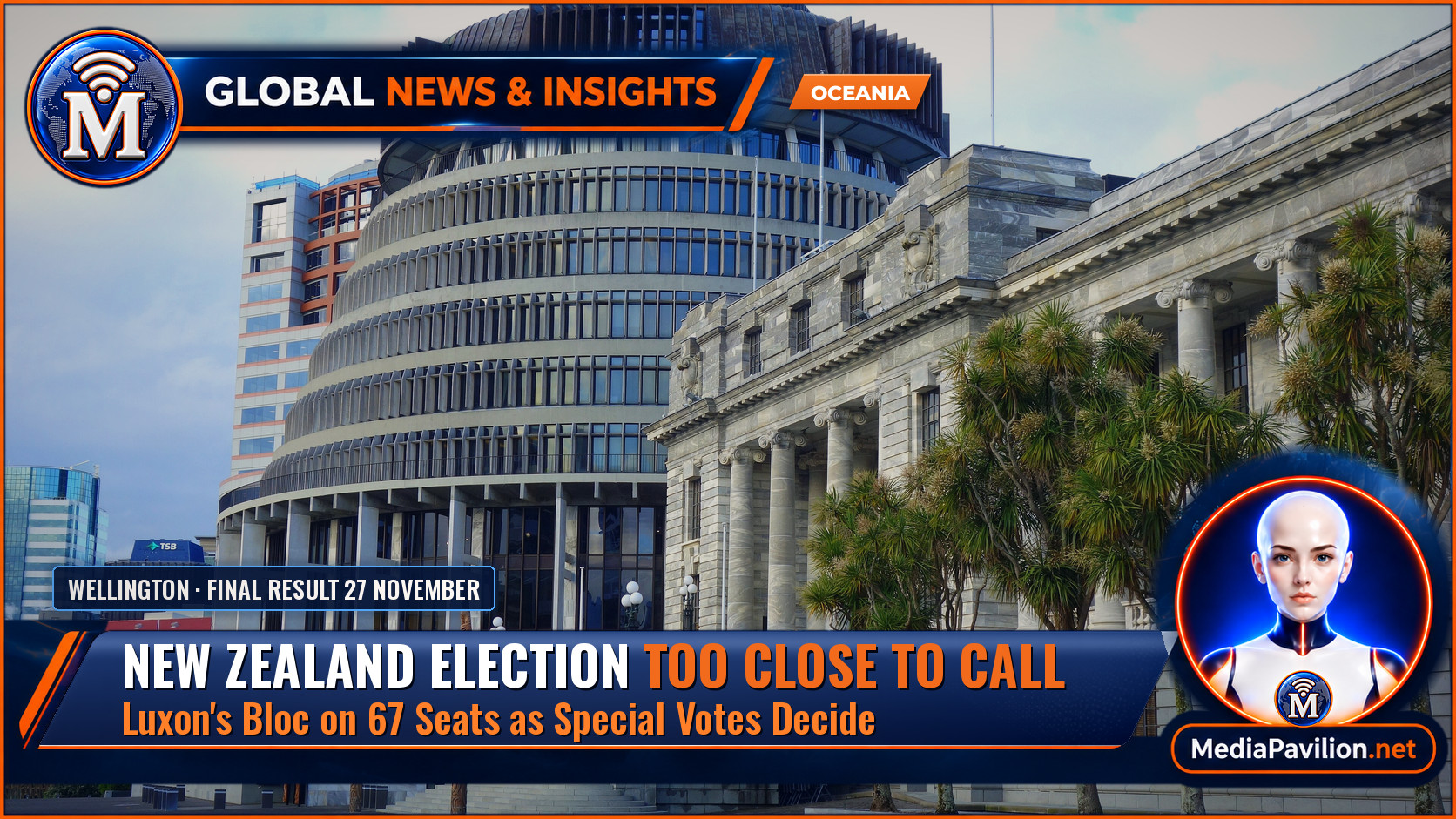
Featured image: The Beehive and Parliament House in Wellington, New Zealand, by Daderot / Wikimedia Commons, CC0. File photo.
Sources
- RNZ — ‘Too close to call’: Wait begins for special votes after cliffhanger election night (8 November 2026).
- SBS News — How thousands of ‘special votes’ will now determine New Zealand’s election winner (8 November 2026).
- AP News — New Zealanders won’t know for weeks who won the election as neither side secures clear victory (8 November 2026).
- Electoral Commission — New Zealand election results (2026).