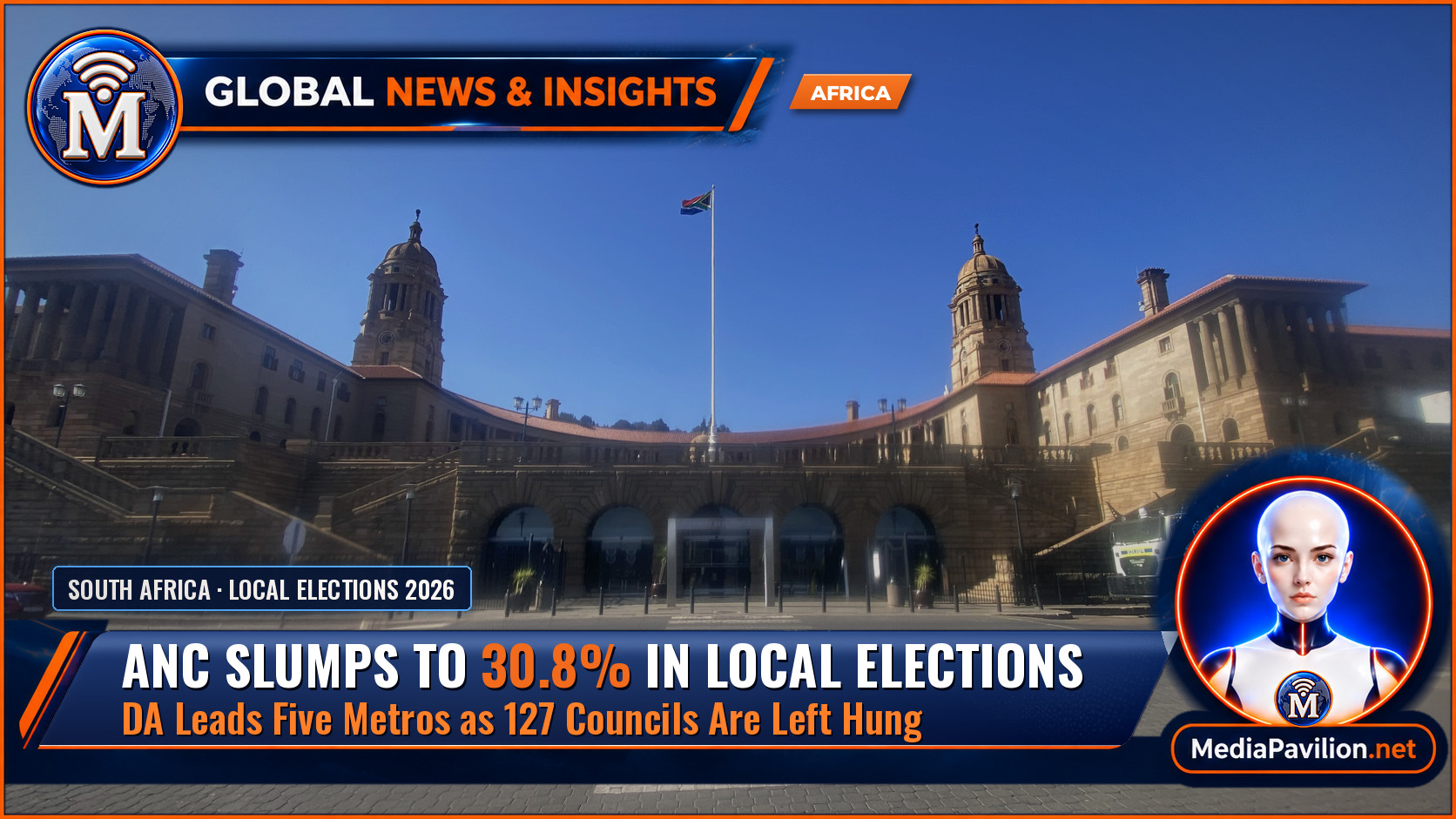
South Africa Local Election Results 2026: ANC Falls to 30.76% as 127 Councils Are Hung
South Africa’s African National Congress (ANC) remains the country’s largest party after the 2026 local government elections, but its share of the vote has fallen to 30.76%, more than 14 percentage points below its 2021 result. The Electoral Commission of South Africa (IEC) declared the 4 November elections free and fair on Sunday night, and the results leave most of the country’s councils, including seven of its eight big metros, without a single party in control.
The Democratic Alliance (DA) came second nationally with 24.64% and emerged as the leading party in five metros. Jacob Zuma’s uMkhonto weSizwe (MK) Party, contesting its first local elections, took 9.76% and became the biggest party in eThekwini, which includes Durban.
What Are the 2026 South Africa Local Election Results?
IEC chairperson Mosotho Moepya announced the final national figures at the National Results Operation Centre in Midrand. According to the official declaration reported by SAnews, the top five parties were:
- ANC: 30.76% of the vote, 3,246 council seats
- DA: 24.64%, 1,695 seats
- MK Party: 9.76%, 785 seats
- EFF: 6.22%, 588 seats
- ActionSA: 5.67%, 313 seats
- Other parties and independents: 22.97% combined
About 14.9 million of 29.2 million registered voters cast ballots, giving a turnout of 52%. That is 6.1 percentage points higher than the 45.9% recorded in 2021. Spoilt votes made up 1.84% of the total. A record field of 521 parties and 636 independent candidates fielded about 137,000 candidates for 10,526 council seats.
How Many Councils Are Hung?
Of South Africa’s 213 municipal councils, 127 are hung, meaning no party won more than half the seats, the IEC said. The ANC won outright control of 53 municipalities and leads in 128. The DA controls 12 outright and leads in 32. The Inkatha Freedom Party (IFP) won five outright, the MK Party three, and Rise Tsantsabane Communities one.
That leaves coalition negotiations to decide who runs a large part of local government, from water and electricity supply to refuse collection. The IFP has already said it is open to talks with all parties but will not sign deals simply to secure positions, IOL reported.
Who Won Johannesburg, Tshwane, Cape Town and eThekwini?
Cape Town is the only metro where one party, the DA, won an outright majority of seats. Everywhere else, deals will be needed, according to IOL’s analysis of the results.
- Johannesburg: DA first on 34.8%, ANC 20.3%, ActionSA 16.3%. The 270-seat council needs 136 for a majority, and preliminary figures give the DA 91 seats and ActionSA 43, just short together
- Tshwane: DA 34.4%, ActionSA second on 22.1%
- Ekurhuleni: DA leads with 30.7%
- Nelson Mandela Bay: DA 44.2%
- eThekwini: MK Party 86 of 223 seats (112 needed), DA 57, ANC 37, IFP 15
- Buffalo City and Mangaung: ANC leads, on 41.9% and 33.9% respectively, with the DA close behind in Mangaung on 33.5%
Johannesburg is already the focus of early bargaining. IOL reported claims that ActionSA wanted the DA to reconsider Helen Zille as its mayoral candidate, which ActionSA’s Herman Mashaba disputed. Zille has said she would prefer a two-party coalition with either ActionSA or the ANC.
What Did Ramaphosa Say About the Results?
President Cyril Ramaphosa, who leads the ANC, urged incoming councillors to put service delivery ahead of political power struggles as coalition talks begin. ANC secretary-general Fikile Mbalula has dismissed claims that Ramaphosa is resigning after the party’s electoral setbacks as “not true”, IOL reported.
The ANC’s decline has continued across successive elections, driven by frustration over unreliable municipal services and unstable coalitions. The party now governs nationally in a coalition, and these results will shape how much leverage each party brings to the next round of negotiations. For background on the country’s finances, read our report on South Africa’s mid-term budget.
Were the Elections Free and Fair?
The IEC declared the elections free and fair, citing the Human Sciences Research Council’s Election Satisfaction Survey. It found that 90% of voters regarded the procedures as free and 91% as fair, 95% were satisfied with IEC services, and 91% queued for 30 minutes or less. Trust in the commission stood at 81%, down from 93% in 2016, and the survey flagged concerns about intimidation, impartiality, inclusive voting and gaps in voter information.
Moepya said the commission would review the elections “honestly and systematically” and listen to concerns from voters, parties and observers. “The ballot paper has given you a mandate and a responsibility,” he told newly elected councillors.
What Happens Next?
Newly elected councils must now hold their first sittings to elect mayors, speakers and executive committees. In hung councils, that will depend on coalition deals, and the talks in Johannesburg, Tshwane, Ekurhuleni and eThekwini will be watched most closely because of the size of their budgets and populations.
Featured image: the Union Buildings, the seat of South Africa’s government in Pretoria, by Ruby D-Brown / Wikimedia Commons, CC BY 4.0. File photo.
Sources
- SAnews — IEC declares LGE 2026 Free and Fair (8 November 2026).
- IOL — ANC remains largest party as fragmented results put coalition government in spotlight (9 November 2026).
- IOL — The elections aftermath: Coalition battles loom as ANC loses ground and DA dominates metros (8 November 2026).
- Xinhua — Daily World Briefing, Nov. 9 (9 November 2026).