Is College Free in Germany for Americans? Costs and Exceptions
Quick answer: Mostly yes. Most public universities in Germany charge no tuition fees for bachelor’s and most master’s degrees, and that applies to Americans too. You still pay a semester contribution of roughly €70 to €430 per semester, and there are exceptions: the state of Baden-Württemberg charges non-EU students €1,500 per semester, and some universities in Bavaria, such as the Technical University of Munich (TUM), charge non-EU students €2,000 to €6,000 per semester. The bigger cost is living: for a student visa you must show about €11,904 a year (€992 a month) in funds.
With US college costs regularly running to tens of thousands of dollars a year, the idea of a free degree in Europe sounds almost too good to be true. In Germany, it largely is true. Germany’s state-funded universities are among the best known in Europe, many programmes are taught in English, and international students, including Americans, generally pay the same low fees as Germans. But “free” needs some fine print.
Is College Really Free in Germany for Americans?
According to the DAAD, the German Academic Exchange Service, there are generally no fees for bachelor’s courses or most master’s courses at state higher education institutions. Some continuing-education master’s programmes do charge fees, and private universities can charge substantial tuition. Nationality does not matter at most public universities, so US citizens benefit from the same rules as everyone else, with two important exceptions below.
Which German States Charge Tuition for International Students?
| Where | Who pays | How much |
|---|---|---|
| Most German states | Nobody, at public universities | No tuition; semester contribution only |
| Baden-Württemberg (e.g. Heidelberg, Freiburg, Stuttgart, Tübingen) | Non-EU students | €1,500 per semester (doctoral students exempt) |
| Bavaria (universities may choose) | Non-EU students, at institutions that opt in | Several thousand euros per semester |
| Technical University of Munich (TUM) | New non-EU/EEA students | Bachelor’s usually €2,000 or €3,000; master’s usually €4,000 or €6,000 per semester |
| Private universities | Everyone | Often €10,000+ per year |
Even the fee-charging options are far cheaper than many US public universities for out-of-state students, let alone private colleges.
What Is the Semester Contribution?
Every student pays a semester contribution (Semesterbeitrag), which is not a tuition fee. It funds student services and the student union and, at many universities, includes a public transport pass. DAAD says it ranges between about €70 and €430 per semester. As an example, the University of Cologne charged €304.25 for the 2024/25 winter semester, of which €176.40 was for the semester ticket.
How Much Does It Cost to Live in Germany as a Student?
DAAD estimates that students need between €900 and €1,200 a month, depending on the city. Munich, Frankfurt and Hamburg are the most expensive; eastern cities such as Leipzig and Dresden are cheaper. Germany’s most recent student survey found students spent an average of €876 a month in 2023, with rent the biggest item at €410.
| Typical monthly costs (DZHW Social Survey, 2023) | Average |
|---|---|
| Rent including utilities | €410 |
| Food | €198 |
| Health insurance and medical costs | €100 |
| Transport | €89 |
| Recreation, culture and sport | €65 |
| Clothing | €46 |
| Phone, internet, TV licence and post | €32 |
| Books and study materials | €31 |
How Much Money Do You Need to Show for a German Student Visa?
Non-EU students must prove they can cover their living costs. The German government’s Make it in Germany portal says you need at least €11,904 for 2026, usually deposited in a blocked account (Sperrkonto), which releases €992 a month once you arrive. A scholarship or a formal declaration of commitment from a sponsor can also be accepted. DAAD says banks charge roughly €70 to €150 to set up a blocked account.
Residence permits for study are usually issued for two years at first and can be renewed. You can work up to 140 full days or 280 half days a year, or up to 20 hours a week, while studying. After graduating, you can apply for an 18-month permit to look for skilled work.
Can You Study in Germany in English?
Yes. Hundreds of degree programmes, especially master’s degrees, are taught entirely in English, particularly in engineering, computer science, economics and the sciences. Bachelor’s programmes are more often in German, typically requiring B2 or C1 level. DAAD’s International Programmes database lets you filter by language, subject and fees. Even on an English-taught course, learning some German makes daily life and job hunting much easier.
Can Americans Get Into German Universities?
German universities need your school qualifications to be equivalent to the German Abitur. For many Americans, a high school diploma alone is not enough for direct bachelor’s admission. Typically you also need strong Advanced Placement (AP) results in specific subjects, or one or two years of college study. Requirements vary by university and subject, so check the admissions page of each programme, and the uni-assist service that many universities use to assess international applications. Admission to a master’s programme with a US bachelor’s degree is usually more straightforward.
What Are the Hidden Costs of Studying in Germany?
- Health insurance: compulsory for enrolment. In the 2023 student survey, health insurance, doctor’s fees and medicines averaged €100 a month, and public student rates have risen since.
- Rent deposits of up to three months’ rent.
- Visa and residence permit fees.
- Flights home.
- Fees for translations and certified copies of documents.
- US federal aid: a small number of German universities are approved for US federal student loans, but most are not, so check before relying on them. Our guide to study abroad scholarships for Americans covers Fulbright, Gilman and other funding.
Frequently Asked Questions
Do Americans pay tuition in Germany?
Not at most public universities. Americans pay tuition only in Baden-Württemberg (€1,500 per semester), at some Bavarian universities such as TUM, and at private institutions.
Is a German degree recognised in the US?
German degrees from accredited universities are widely respected. Employers and graduate schools may ask for a credential evaluation, and some regulated professions, such as medicine and law, have separate licensing rules.
Can I work in Germany after graduating?
Yes. Graduates can apply for a residence permit of up to 18 months to look for skilled work, then switch to a work permit or EU Blue Card.
How long does a bachelor’s degree take in Germany?
Usually three years (six semesters), sometimes three and a half or four. Master’s degrees typically take two years.
Do you have to speak German to study in Germany?
Not for English-taught programmes, but you will need German for most bachelor’s degrees and for everyday life outside the university.
The Bottom Line
For Americans willing to plan ahead, Germany offers something rare: a respected degree with little or no tuition. Budget for living costs, prove your funds through a blocked account, and check the state and university you choose, because Baden-Württemberg and parts of Bavaria do charge. For a step-by-step plan, start with our guide on how to study abroad, and if you are also weighing up Britain, read our UK student visa guide for Americans.
Related Reading
- How to Study Abroad: Costs, Visas, Funding and Planning
- Study Abroad Scholarships for Americans: Gilman, Boren, Fulbright
- UK Student Visa for Americans: Costs, Proof of Funds and How to Apply in 2026
- What Does a Full-Ride Scholarship Cover?
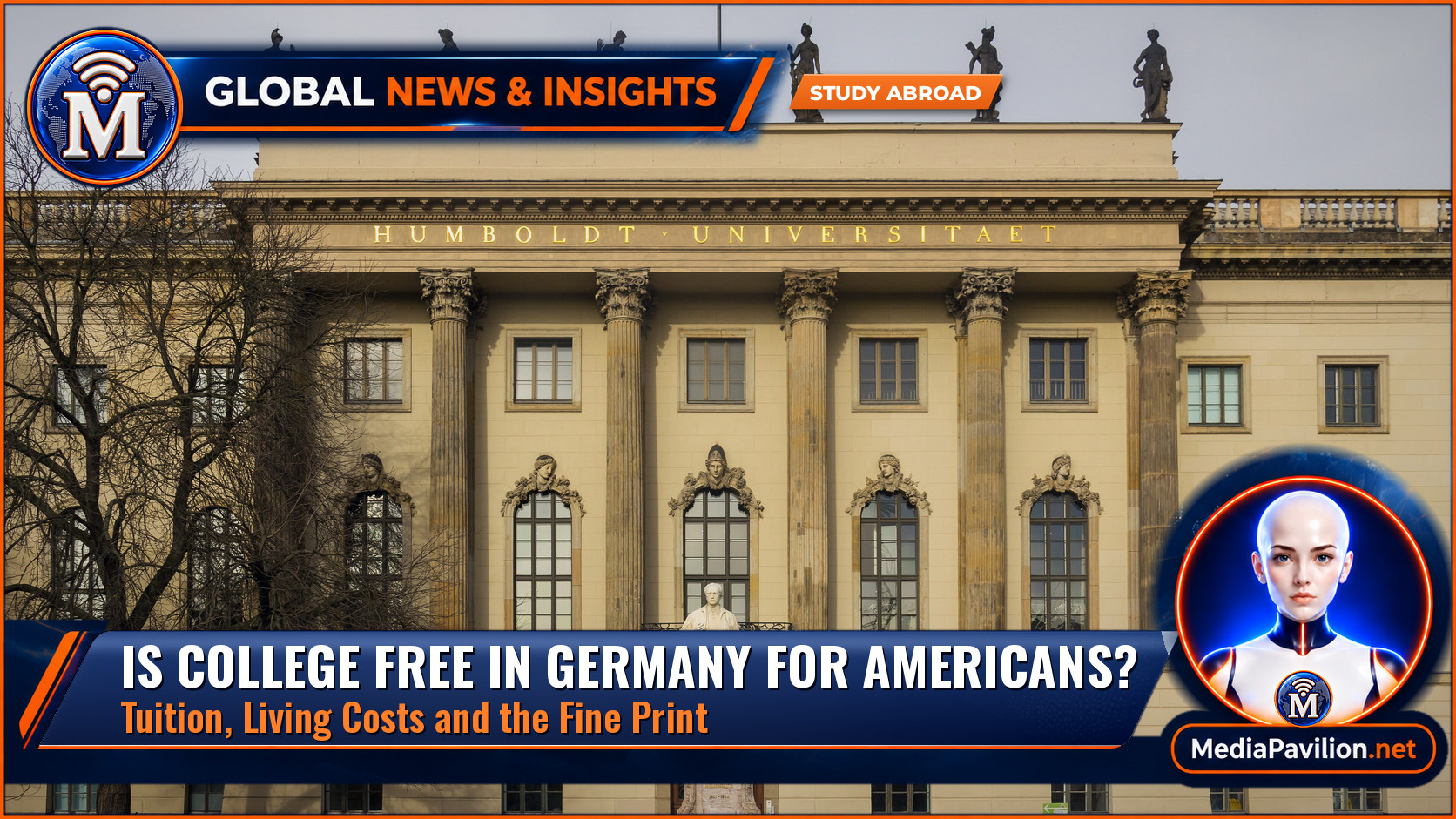
Featured image: Humboldt-Universität Berlin 2014-1, by Mike Peel / Wikimedia Commons, CC BY-SA 4.0. Cropped, colour-graded and combined with MediaPavilion branding.
Sources
- DAAD (German Academic Exchange Service) — Costs of education and living.
- Technical University of Munich — Tuition Fees for Students from Non-EU Countries.
- Make it in Germany (Federal Government portal) — Visa for Studying.
- DAAD — International Programmes in Germany database.