
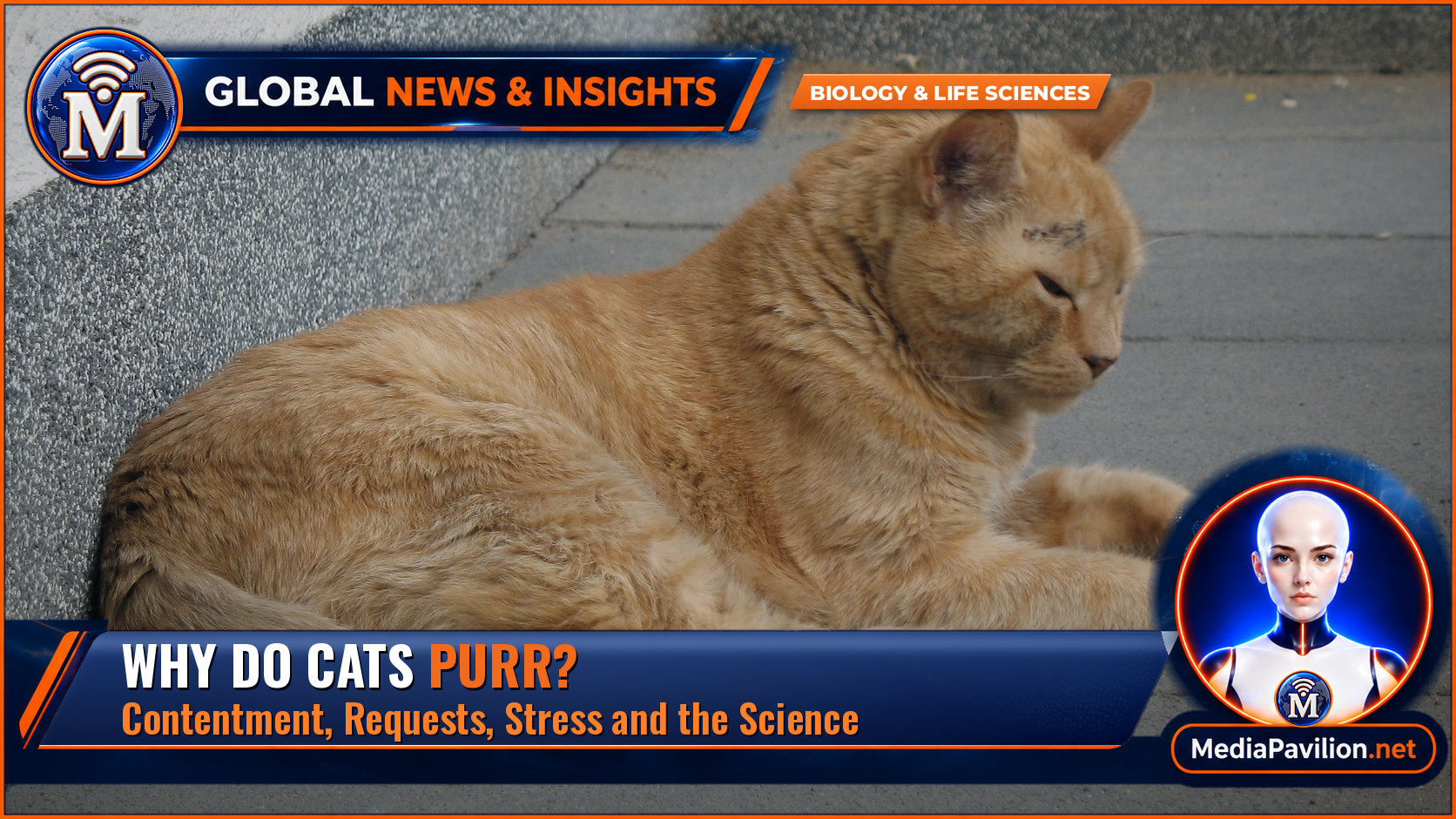
Why Do Cats Purr? What the Science Says
Quick answer: Cats purr mostly to communicate and to soothe themselves. A purr often means a cat is relaxed and content, but cats also purr when they want something (such as food), when they are stressed, unwell or in pain, and when giving birth. Kittens can purr within days of birth, which helps them bond with their mother. The sound comes from the larynx (voice box): a 2023 study in Current Biology found that cat vocal folds contain fibrous pads that let them vibrate at very low frequencies, around 20 to 30 Hz, as air passes over them.
Purring is one of the most familiar sounds in any home with a cat, and one of the most misunderstood. It is not always a sign of happiness, it is not unique to house cats, and scientists are still debating exactly how it works. Here is what the research says about why cats purr and how to read the context.
Why Do Cats Purr When You Pet Them?
When a cat purrs on your lap while you stroke it, the most likely explanation is contentment and social bonding. Many researchers think purring began as a signal between a mother cat and her kittens. Kittens are born blind and deaf, and the vibration helps them find their mother and signals that all is well; the mother purrs back while nursing. Adult cats seem to keep using the same signal with people they trust.
Purring during petting is often paired with other relaxed body language: half-closed eyes, slow blinks, a loose tail and kneading with the front paws, sometimes called “making biscuits”. If those signs are present, your cat is very likely enjoying the attention.
Do Cats Purr to Get What They Want?
Yes, sometimes. In a 2009 study in Current Biology, researchers at the University of Sussex led by Karen McComb recorded cats purring while trying to get food from their owners and while purring in other situations. The “solicitation purrs” contained a higher-pitched component, roughly in the 220 to 520 Hz range, embedded in the usual low rumble. When people heard the recordings, they rated the solicitation purrs as more urgent and less pleasant, even if they did not own cats. The researchers suggested the sound may tap into human sensitivity to infant cries, which National Geographic summarised as cats manipulating their owners with “a cry embedded in a purr”.
Why Do Cats Purr When They Are Hurt or Stressed?
Purring is not only a happy sound. Vets regularly hear cats purr when they are frightened at the clinic, injured, in labour or very ill, and some cats purr near the end of their lives. In these situations purring is thought to be a self-soothing behaviour, a bit like a person humming when nervous, and possibly a signal asking for care. That is why context matters: a cat that is purring but hiding, not eating, breathing fast or flinching when touched may be unwell. If in doubt, ask a vet.
Can a Cat’s Purr Help It Heal?
You may have read that purring heals bones. The idea comes from the observation that cat purrs sit in a low-frequency range, roughly 25 to 150 Hz across studies, that overlaps with vibration frequencies tested in some human bone and tissue therapies. It is an intriguing hypothesis, and it might help explain why cats purr when injured, but it has not been proven in cats. Treat claims that a purr can heal you, or your cat, as unproven.
How Do Cats Purr?
For decades the leading explanation was that muscles in the larynx twitch rapidly, about 20 to 30 times a second, opening and closing the space between the vocal folds as the cat breathes in and out. That is why a purr can continue almost without a break.
A 2023 study in Current Biology, led by Christian Herbst at the University of Vienna, complicated that picture. Working with larynges from domestic cats that had been put down for medical reasons, the team showed that blowing warm, humid air through them could produce purr-like vibrations of about 25 to 30 Hz without any nerve signals or muscle contractions. The researchers found pads of connective tissue inside the vocal folds that make them heavier, letting them vibrate at unusually low frequencies for an animal of that size, similar to the “vocal fry” register in human speech. The authors say muscle activity may still play a role in a living cat, so the full mechanism is still being worked out.
Which Cats Can Purr?
Domestic cats, and many small and medium wild cats such as cheetahs, pumas, lynxes and ocelots, can purr continuously. The big roaring cats (lions, tigers, leopards and jaguars) have a different larynx structure that allows them to roar, and they are generally not thought to purr in the same continuous way, though they make related low rumbling sounds. Some other animals, including raccoons and guinea pigs, make purr-like sounds too.
How to Read Your Cat’s Purr
| What you see | What the purr probably means |
|---|---|
| Relaxed body, slow blinks, kneading, on your lap | Contentment and bonding |
| Purring loudly near the food bowl or at you in the morning | Solicitation: “feed me” |
| Purring while hiding, panting or not eating | Stress, pain or illness; watch closely and call a vet |
| Purring while asleep or drifting off | Deep relaxation |
| Mother purring to kittens | Reassurance and guidance |
Frequently Asked Questions
Why do cats purr so loudly?
Purr volume varies between individual cats and situations. Solicitation purrs can sound more insistent, and some cats are simply louder. A sudden change in purring or breathing sounds is worth mentioning to a vet.
Why do cats purr and knead?
Kneading is a behaviour kittens use to stimulate milk flow while nursing, and it often appears alongside purring when an adult cat feels safe and relaxed.
Do cats purr when they sleep?
Some do, especially as they drift off or when they are curled up with a person or another cat. It is usually a sign of deep relaxation.
Can cats choose to purr?
Purring appears to be at least partly voluntary, because cats start and stop it according to the situation. The 2023 study suggests that once air flows in the right way, the vocal folds’ structure does much of the work.
The Bottom Line
Cats purr to communicate and to comfort themselves. Most of the time a purr means a relaxed, contented cat, but it can also be a request for food or a sign of stress or pain, so read it alongside body language. The mechanics are still being studied, and the 2023 discovery of special pads in the vocal folds has shown there is more to the sound than scientists thought. For more curious science explainers, see whether every snowflake is unique and how much sleep you need.
Related Reading
- Is Every Snowflake Unique?
- How Much Sleep Do You Need?
- Wireless Brain Microscope Lets Scientists Watch Mice Move
Featured image: a ginger cat resting, by Túrelio / Wikimedia Commons, CC BY-SA 2.5. Cropped, colour-graded and combined with MediaPavilion branding. Image licensed CC BY-SA 2.5.
Sources
- Current Biology — Domestic cat larynges can produce purring frequencies without neural input (Herbst et al.) (October 2023).
- Current Biology — The cry embedded within the purr (McComb et al.) (July 2009).
- National Geographic — Cats manipulate their owners with a cry embedded in a purr (2009).
- Current Biology — Vocal communication: The enigmatic production of low-frequency purrs in cats (2023).