Is Buy Now, Pay Later Bad? Fees, Credit and Risks
Quick answer: Buy now, pay later (BNPL) is not automatically bad. Used for a planned purchase you could afford anyway, a “pay in 4” plan from Klarna, Afterpay or Affirm can be interest-free. It turns bad when it hides overspending: 47% of BNPL users paid at least one instalment late in the past year, according to a 2026 LendingTree survey, and late fees can reach $7 to $8 per missed payment. Longer BNPL loans can carry APRs of up to about 36%. Most BNPL activity still does not affect FICO scores, but that is changing as lenders report more data to the credit bureaus.
Every Black Friday checkout now seems to come with a tempting button: split this into four payments, no interest. Adobe expects Americans to spend about $21.3 billion through buy now, pay later between 1 November and 31 December 2026, up 6.6% on last year. So is it a smart budgeting tool or a debt trap in disguise? The honest answer is that it depends on how you use it. This guide explains how BNPL works, what it really costs, how it affects your credit, and a simple checklist for deciding whether to click that button.
How Does Buy Now, Pay Later Work?
BNPL lets you split a purchase into smaller payments. The most common version, often called “pay in 4”, charges 25% at checkout and the rest in three more payments every two weeks, usually from a debit or credit card on automatic payment. There is typically no interest if you pay on time. Providers make money mostly from fees paid by the retailer, plus late fees and interest on longer plans.
| Type of plan | Typical term | Interest | Main risk |
|---|---|---|---|
| Pay in 4 | 6 weeks | Usually 0% | Late fees; stacking several plans |
| Monthly instalments | 3 to 60 months | 0% to about 36% APR | Interest costs like a credit card or personal loan |
| Pay in 30 days | 30 days | Usually 0% | Forgetting the due date |
The three biggest US providers are Klarna, Afterpay and Affirm. Terms vary by provider, retailer and your credit profile, so always read the agreement on screen before you confirm.
Is Buy Now, Pay Later Bad for You?
It can be, for three reasons. First, it makes spending feel painless. Splitting a $400 gift into four $100 payments makes it easier to buy things you would not have bought outright. Second, plans pile up: it is easy to have five or six running at once across different apps, with payments landing on different days. Third, the costs arrive when something goes wrong, such as a declined card or an overdraft.
The data backs this up. In its 2026 BNPL tracker, LendingTree found that 47% of BNPL users had paid late at least once in the past year, up from 41% in 2025 and 34% in 2024, although most late payments were a week or less overdue.
How Much Are BNPL Late Fees?
For pay-in-4 plans, the providers’ published terms set out the fees:
- Afterpay (US): up to $8 per missed instalment, capped at 25% of the order value, according to Afterpay’s help centre
- Klarna Pay in 4 (US): up to $7 per missed payment, also capped at 25% of the purchase, according to Klarna
- Affirm: says it charges no late fees, but many of its longer plans charge interest
On a $100 order, a capped 25% fee means up to $25 in charges, which is the equivalent of a very high interest rate. Your bank may also charge an overdraft fee if an automatic payment pulls your balance below zero.
Does Buy Now, Pay Later Affect Your Credit Score?
Mostly not yet, but the picture is shifting. myFICO says that, as far as it knows, none of the three major credit bureaus currently feeds BNPL information into FICO Score calculations. Affirm reports its US loans to Experian and TransUnion, and Klarna reports some longer-term plans, but at the time of writing that data does not change your FICO or VantageScore. Afterpay says it does not report to US credit bureaus.
Two important exceptions: a provider can still send an unpaid account to collections, which can damage your credit; and some providers run a soft credit check before approving you. Lenders reviewing a mortgage or car-loan application may also ask about or see BNPL debts. Our guide to what a good credit score is explains the factors that matter most.
When Does Buy Now, Pay Later Make Sense?
- The purchase is planned and you have the money now, but you prefer to spread the cash flow
- It is genuinely 0% interest with no account or service fees
- You have only one or two plans running
- Your payment card has enough buffer to cover every instalment on time
- You are not using it for everyday groceries or bills
When Should You Avoid BNPL?
- You could not afford the item if you paid in full today
- You already have several BNPL plans open
- Your checking account is often close to zero (overdraft risk)
- The plan charges interest higher than a 0% card or a personal loan
- You are applying for a mortgage soon and want a clean financial picture
Is BNPL Better Than a Credit Card?
It depends on your habits. A pay-in-4 plan paid on time is cheaper than carrying a card balance, since average card APRs are above 20%. But credit cards offer stronger legal protections for disputes and fraud under the Fair Credit Billing Act, plus rewards and, if paid in full each month, free short-term credit and a positive payment history that builds your score. If you pay your card off every month, it is usually the better option. If you tend to carry a balance, a single 0% BNPL plan paid on time can cost less.
A 60-Second Checklist Before You Click “Pay in 4”
- Would I buy this today if I had to pay the full price?
- Is the interest really 0%, and what are the late fees?
- Do I know the exact dates of all four payments?
- Will my account definitely have enough on each date?
- How many other BNPL plans do I have running right now?
- Could I return the item easily, and how do refunds work on the plan?
If you answer “no” or “not sure” to any of these, pay another way or wait. Prices on many items stay low through Cyber Monday; see our guide to Black Friday vs Cyber Monday to judge which day is better for what you want.
Want a buffer so you never need to borrow for the holidays? Our printable Emergency Fund & Budget Planner ($8, A4 and US Letter) helps you set a monthly budget, plan a holiday sinking fund and track debt pay-down. It is a MediaPavilion product; our free guide on how to build an emergency fund covers the basics.
Frequently Asked Questions
Is buy now, pay later a loan?
Yes. Even interest-free BNPL is a form of short-term credit: you are borrowing to pay later, and you agree to a repayment schedule and fees.
Is buy now, pay later bad for your credit?
Paying on time usually has no effect on FICO scores today, because the bureaus do not yet feed BNPL data into FICO calculations. Missed payments that go to collections can hurt your credit.
Is buy now, pay later interest-free?
Pay-in-4 plans are usually interest-free. Longer monthly plans can charge APRs of up to about 36%, depending on the provider and your credit.
What happens if you miss a BNPL payment?
You may be charged a late fee (up to $7 with Klarna Pay in 4 or $8 with Afterpay in the US), your account may be paused, and persistent non-payment can be sent to collections.
Is buy now, pay later a scam?
The major providers are legitimate regulated lenders. Scams do exist, though: be wary of unknown sites that only accept BNPL or ask you to pay a fee to get approved.
Related Reading
- What Is a Good Credit Score?
- How to Build an Emergency Fund
- Black Friday vs Cyber Monday
- Black Friday 2026 Tech Deals
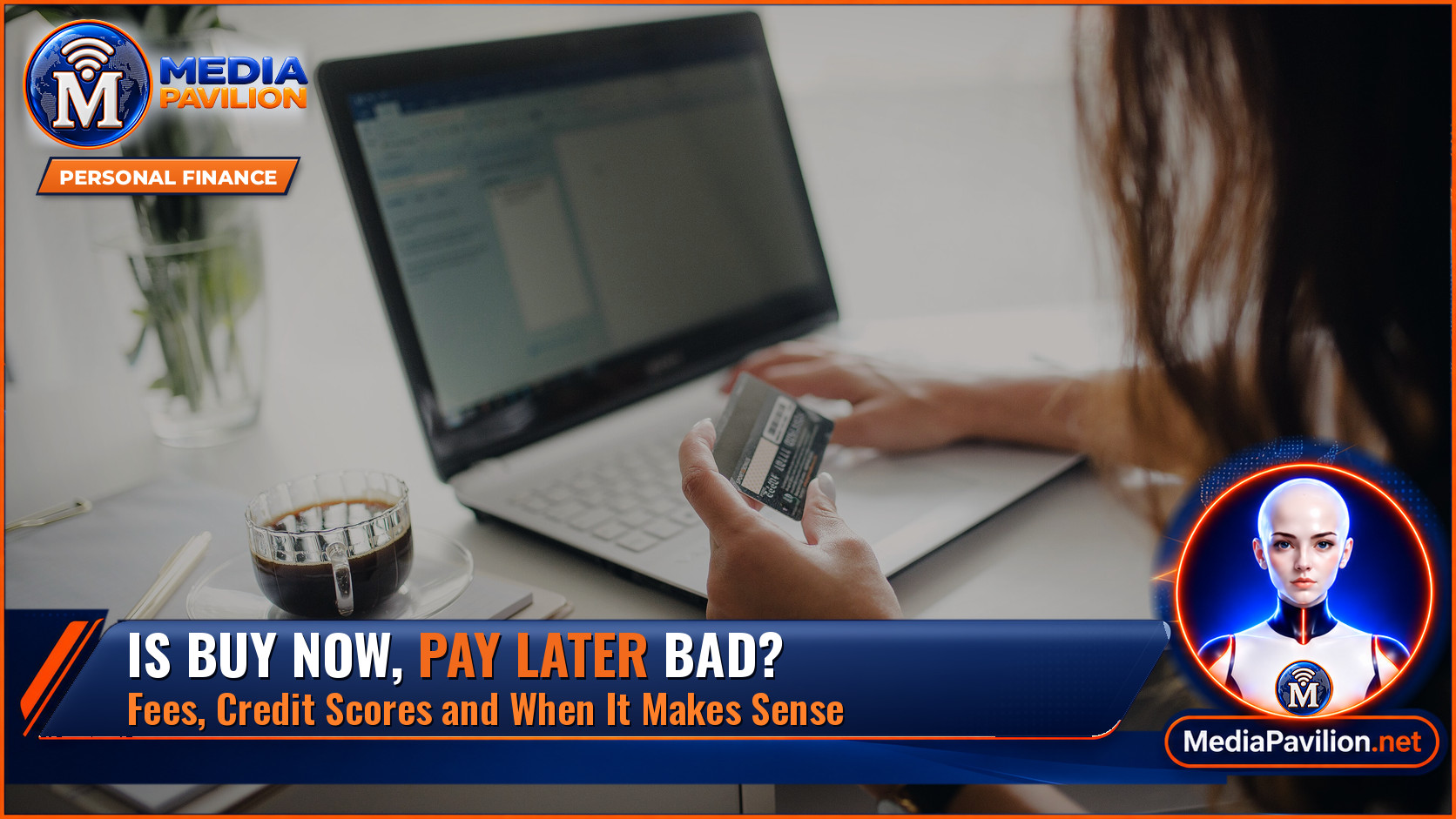
Featured image: a shopper holding a payment card while using a laptop (file photo), by Shixart1985 / Wikimedia Commons, CC BY 2.0. Cropped, colour-graded and combined with MediaPavilion branding.
Sources
- LendingTree — BNPL Tracker: Nearly Half of BNPL Users Have Paid Late in the Past Year (2026).
- Adobe — U.S. Holiday Shopping Season to Hit Record $275.1 Billion Online (28 September 2026).
- myFICO — How will a Buy Now Pay Later account impact my FICO Scores? (accessed 22 November 2026).
- Afterpay — Is there a cost to using Afterpay? (accessed 22 November 2026).
- Klarna — Pay in 4 (accessed 22 November 2026).
- Affirm — Paying on time should count (23 October 2026).