Credit Card Interest Rate Cap: Trump Backs 10% Limit Again
Could your credit card rate really drop to 10%? President Donald Trump said on Saturday 21 November 2026 that he would work with the incoming Democratic Congress to cap credit card interest rates, reviving a promise from his 2024 campaign that went nowhere in the current Congress.
“I would do it. These credit card companies have made a lot,” Trump told Fox News Channel’s “Saturday in America”, according to the Associated Press. Senators from both parties welcomed the remarks within hours. Here is what a 10% cap would mean, how close it is to becoming law, and what you can do about high card interest today.
What did Trump say about a credit card interest rate cap?
Asked whether he could work with Democrats next year on a one-year cap, Trump replied that he would, Fox Business reported, adding that “the fees are too high and the interests are too high”. He acknowledged critics might say a cap is “not free enterprise” but argued that consumers should not face excessive charges.
Trump first called for a one-year 10% cap in a Truth Social post in January, but no bill reached his desk. AP reports that the idea stalled because of industry pressure and limited interest among Republicans. Democrats take control of Congress in January, which is why Saturday’s comments drew so much attention.
Which bills would cap credit card interest at 10%?
Two bills with the same name, the 10 Percent Credit Card Interest Rate Cap Act, are already filed in the 119th Congress:
- S. 381 in the Senate, introduced by Sen. Bernie Sanders on 4 February 2025 with Republican Sen. Josh Hawley as an original cosponsor.
- H.R. 1944 in the House, introduced by Rep. Alexandria Ocasio-Cortez on 6 March 2025.
Both would cap card APRs at 10% until 1 January 2031. Under the House bill, a lender that knowingly breaks the cap would forfeit all interest on the debt, and borrowers could sue to recover interest and fees. Both bills are still sitting in committee. A new Congress starts in January, so supporters would most likely need to reintroduce legislation.
On Saturday Hawley wrote on X, “The President is right. Let’s pass my bill,” and Sen. Elizabeth Warren replied, “Let’s cap credit card interest rates and save Americans money,” Fox Business reported.
How much would a 10% cap save you?
Average rates sit roughly double the proposed cap. WalletHub puts the average APR at 22.49% for new card offers and 21.19% for existing accounts (16 November 2026), and Bankrate’s weekly index was 19.76% on 18 November. Store cards average about 33%, according to WalletHub.
Here is a simple illustration of yearly interest if you carried a balance all year (rounded, ignoring compounding and fees):
| Balance carried | At 21.19% APR | At 10% APR | Difference per year |
|---|---|---|---|
| $2,000 | about $424 | $200 | about $224 |
| $6,000 | about $1,271 | $600 | about $671 |
| $10,000 | about $2,119 | $1,000 | about $1,119 |
Card balances in the US hit a record $1.29 trillion, up 67% since early 2021, according to Federal Reserve Bank of New York figures cited by Fox Business. That scale is why the cap is politically popular.
What are the arguments against a cap?
Banking groups have warned that a 10% ceiling could be “devastating” for millions of borrowers, saying lenders would cut credit lines and push people with lower scores towards more expensive options. A March 2026 Congressional Research Service briefing on rate caps makes a similar point more neutrally: issuers could limit card lending, change rewards or add other fees to make up lost interest income, and price caps that restrict supply can reduce overall consumer welfare.
CRS also notes there is currently no general national cap on card interest rates and that any binding limit would generally require legislation. A presidential statement alone does not change your APR.
Will credit card interest rates actually be capped?
Not soon, and possibly not at all. Watch for three things in January: a reintroduced bill with bipartisan sponsors, committee hearings in the House Financial Services and Senate Banking committees, and whether the White House puts formal pressure behind it. Even if a law passes, issuers would likely tighten approvals first.
What can you do about high card interest now?
- Call your issuer and ask for a lower APR, especially if your score has improved. Check where you stand with our guide to what counts as a good credit score.
- Look at a 0% balance transfer card, but check the transfer fee (often 3% to 5%) and the date the promotional rate ends.
- Pay down the highest-rate card first while making minimums on the rest.
- Be careful with Black Friday financing. Buy now, pay later can look cheaper but has its own late-fee traps; see is buy now, pay later bad?
- Build a small buffer so the next surprise bill does not land on a card. Our emergency fund guide shows how to start.
Rates on new cards could also move with the Federal Reserve. If the Fed raises rates in December, as some economists now expect, variable card APRs tied to the prime rate would rise too, regardless of any cap debate.
Related Reading
- What Is a Good Credit Score? Ranges Explained
- Is Buy Now, Pay Later Bad? Fees, Credit and Risks
- The 50/30/20 Rule: How to Budget Your Paycheck
- How to Build an Emergency Fund
- Thanksgiving Gas Prices 2026 Could Set a Record
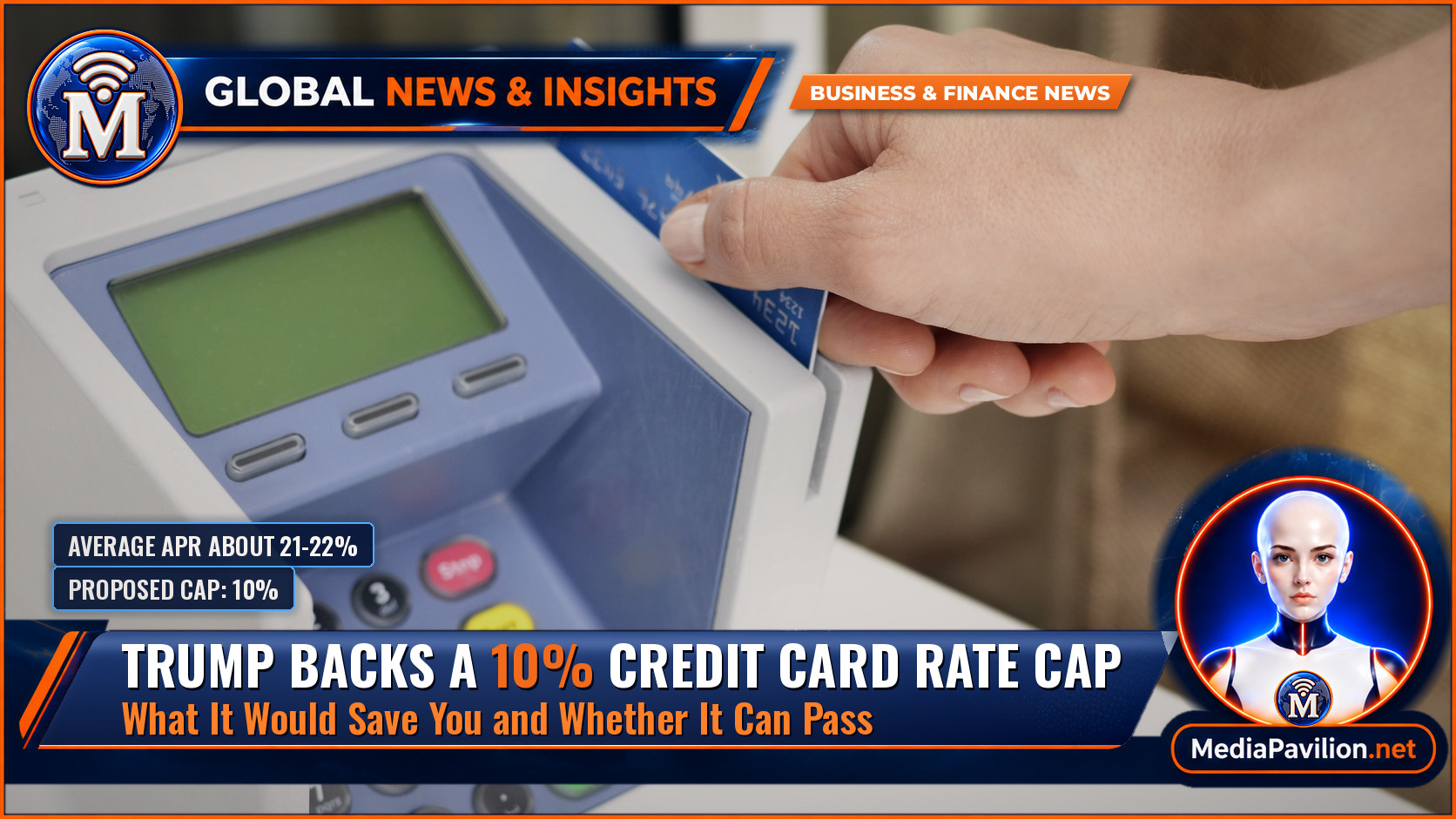
Featured image: paying with a credit card at a card terminal (file photo), by Hloom Templates / Wikimedia Commons, CC BY 2.0. Cropped, colour-graded and combined with MediaPavilion branding.
Sources
- AP News — Trump vows to work with Democrats to cap credit card interest rates at 10% (21 November 2026).
- Fox Business — Trump opens door to bipartisan deal on credit card rates as Americans face record debt (21 November 2026).
- Congress.gov — S.381 – 10 Percent Credit Card Interest Rate Cap Act (4 February 2025).
- Congress.gov — H.R.1944 – 10 Percent Credit Card Interest Rate Cap Act (6 March 2025).
- Congressional Research Service — Interest Rate Caps on Credit Cards: Policy Issues (IF12861) (10 March 2026).
- WalletHub — Average Credit Card Interest Rates (16 November 2026).
- FRED, St. Louis Fed — Bankrate Monitor: Credit Card APR (BRMCC01) (18 November 2026).
- Bloomberg via Yahoo Finance — US Consumers Are Holding Up Against Inflation Going Into Holiday Season (21 November 2026).