
Gemini 4 Carbon: Google’s Strongest AI Model, Explained
Google has made Gemini 4 Carbon, which it calls its strongest AI model yet, available to paying developers, businesses and Google AI Ultra subscribers. The model was released on Tuesday 10 November 2026, about two weeks after Google first gave it to a small group of cybersecurity defenders, according to The Verge. Google says Carbon is built for the hardest work: long, multi-step coding projects, cybersecurity and open-ended scientific research.
Carbon arrives only weeks after Google’s previous frontier model, Gemini 4 Argon, and a day after a major rival launch from Anthropic. Here is what Gemini 4 Carbon is, who can use it, what it costs and how it compares.
What Is Gemini 4 Carbon?
In its launch announcement, Google DeepMind describes Carbon as its strongest model, with “frontier performance” in cybersecurity and in “long-horizon agentic workflows” across complex knowledge work, software engineering and scientific reasoning. In plain terms, it is designed to carry out long tasks with many steps, often by acting as an agent that plans, uses tools and checks its own work.
Google is not replacing Argon. According to 9to5Google, Google says “Argon remains the ideal choice for the majority of software engineering and knowledge work, while Carbon is built for tasks that test the limits of a model’s intelligence.” In the Gemini app’s model picker, Argon is labelled for “Code & analysis” and Carbon for “Most complex work”. Gemini 3.1 Pro has been removed from the app with this launch.
Who Can Use Gemini 4 Carbon?
- Developers and businesses: through the Gemini API in Google AI Studio and Gemini for business, for all paying developers and enterprises.
- Consumers: Google AI Ultra subscribers can use it in the Gemini app, AI Mode in Search and Google Antigravity, Google’s agentic development platform.
- Free and lower-tier users: not included for now. The Verge reported that it is unclear when, or if, Carbon will reach lower tiers or free users. Argon stays available to AI Pro subscribers and above.
How Much Does Gemini 4 Carbon Cost?
Google is using an introductory price of $2 per million input tokens and $10 per million output tokens until 30 November, the same as Argon’s launch price. After that, 9to5Google reported, the price rises to $4 per million input tokens and $20 per million output tokens.
The Verge estimated the introductory price at around a fifth of the cost of OpenAI’s GPT-6 Astra and a quarter of Anthropic’s Fable 5.2, which launched on Monday. Per-token prices do not tell the whole story, though: models use different numbers of tokens for the same task, which is why independent testers such as Artificial Analysis publish cost-per-task comparisons between Carbon and Argon.
Is Gemini 4 Carbon Better Than Rival Models?
On Google’s own figures it is near the top. Google says Carbon ranks first on a new Multimodal Knowledge Agents (MKA) benchmark, created with the independent testing firm Artificial Analysis, while using three times fewer tokens than the next best model across 200 tasks. The Verge said Google’s benchmark results put Carbon among the most powerful models on the market across most measures, behind Anthropic’s Fable 5.2.
Benchmarks should be treated with caution. Companies choose which results to highlight, and real-world performance depends heavily on the task. Independent comparisons, such as those published by Artificial Analysis, are a useful check as more data come in.
What Is the Antigravity “Swarm” Feature?
Alongside Carbon, Google is previewing /swarm in Antigravity. It turns “a single prompt into a coordinated team of agents you can track in real time”, according to Google. Developers can give Carbon the roles that need the deepest reasoning, such as design, coordination and auditing, while faster, lighter models handle other jobs in parallel and “adversarial verifiers” test each change.
Why Does This Launch Matter?
For months, the AI race at the very top looked like a contest between OpenAI and Anthropic. The Verge described Carbon’s release, so soon after Argon, as “a decisive return” for Google at the frontier. It also lands in a busy week: Anthropic launched Fable 5.2 on Monday, and OpenAI introduced business profiles and shopping agents in ChatGPT on Tuesday.
For businesses, the practical question is cost versus capability. For everyday users, little changes unless they pay for AI Ultra. The broader AI boom remains a major driver of markets and even electricity prices, as the latest US inflation data showed. Our coverage of Nvidia’s investigation into Jensen Huang looks at another big story shaping the sector this week.
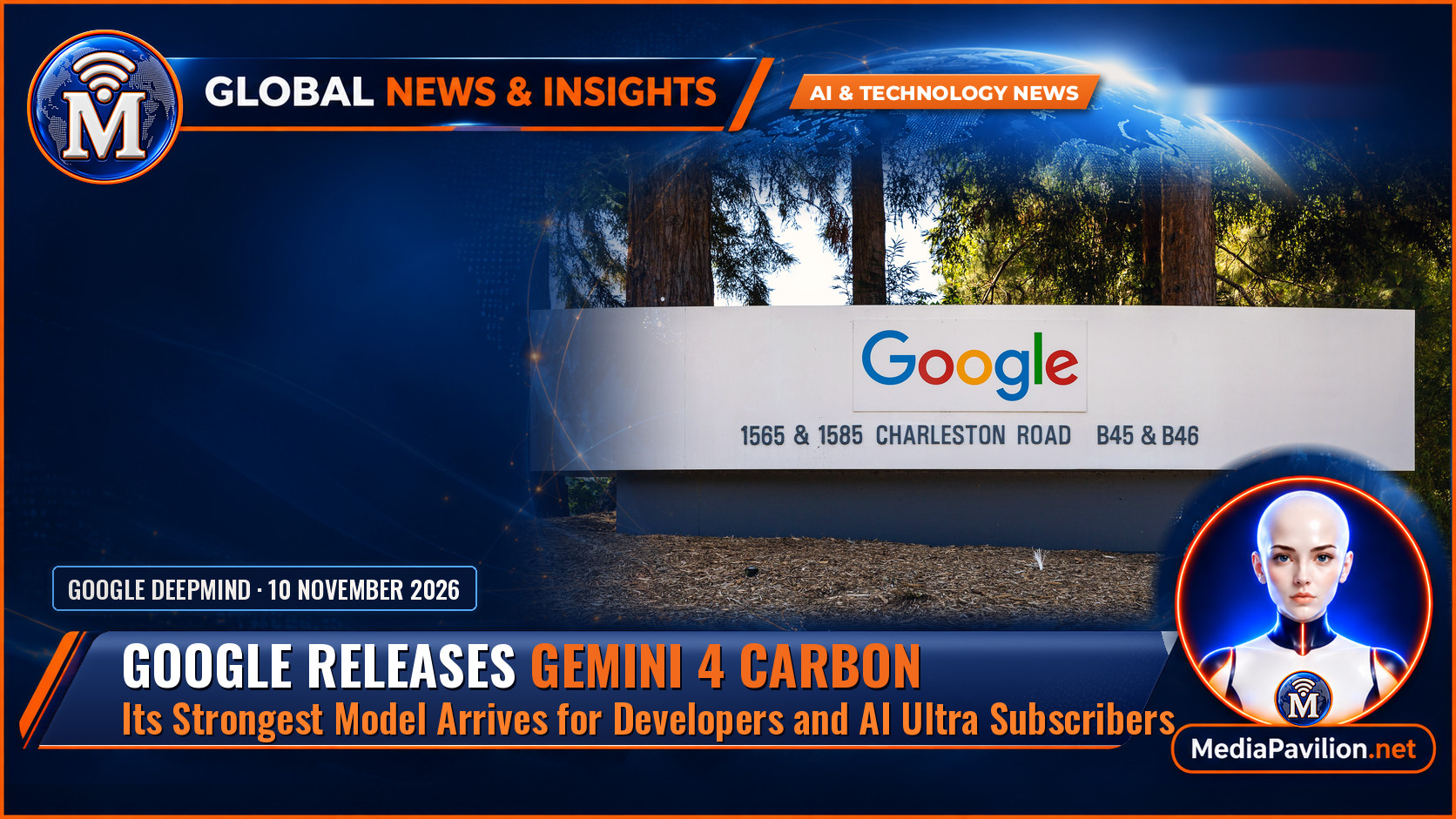
Featured image: Google sign on Charleston Road, Mountain View, by Dietmar Rabich / Wikimedia Commons, CC BY-SA 4.0. File photo. Image licensed CC BY-SA 4.0.
- Google (The Keyword) — Gemini 4 Carbon is now available (10 November 2026).
- The Verge — Google releases Gemini 4 Carbon with agent ‘swarm’ feature (10 November 2026).
- 9to5Google — Gemini 4 Carbon rolling out to Gemini app for AI Ultra, Argon remains (10 November 2026).
- Artificial Analysis — Gemini 4 Carbon (Medium) vs Gemini 4 Argon (High): Model Comparison.
- OpenAI — Introducing Businesses in ChatGPT (10 November 2026).