
Hegseth Impeachment: Massie’s 8 Articles and the House Vote
Republican Representative Thomas Massie has filed eight articles of impeachment against Defense Secretary Pete Hegseth, forcing the House of Representatives to vote on them within two legislative days. The Kentucky congressman accuses Hegseth of waging an unauthorised war against Iran in breach of the 1973 War Powers Resolution, along with charges over civilian casualties, strikes on alleged drug boats, the capture of Venezuela’s Nicolás Maduro and military action in Yemen.
Hegseth has dismissed the effort as “sham articles of impeachment”, and President Donald Trump said on Monday, 9 November, that he would “stand by him”. Here is what the charges say, how the vote works and why the outcome matters beyond Hegseth himself.
What Are the Eight Articles of Impeachment Against Hegseth?
Massie’s office published a summary of the charges alongside the full resolution. In brief:
- Articles I to III, the Iran war: waging war without a declaration, authorisation or imminent threat (Section 2(c) of the War Powers Resolution); continuing after both chambers passed H. Con. Res. 86 directing US forces to withdraw (Section 5(c)); and carrying on past the law’s 60-day limit and 30-day withdrawal window (Section 5(b))
- Article IV, civilian casualties: ignoring laws meant to limit harm to civilians; The Hindu reports that it cites the 28 February strike on the Shajareh Tayyebeh Elementary School in Iran
- Article V, “extrajudicial killings”: replacing maritime law enforcement with lethal military strikes on suspected drug-smuggling boats in the Caribbean and eastern Pacific, which Massie’s summary says caused at least 243 deaths
- Article VI, free speech: using Pentagon authority to retaliate against Senator Mark Kelly after he reminded troops they can refuse unlawful orders
- Article VII, Venezuela: directing Operation Absolute Resolve, which seized Nicolás Maduro and Cilia Flores, without legal authority
- Article VIII, Yemen: launching Operation Rough Rider without congressional authorisation or an imminent threat
“By engaging in hostilities in Iran for more than 90 days without congressional authorization, Secretary Hegseth is breaking the law and must be held accountable,” Massie said in his statement.
When Will the House Vote on Hegseth’s Impeachment?
Because Massie filed the resolution as a privileged measure, House leaders must bring it to the floor within two legislative days, NBC News reported. That puts a vote, or a procedural move to block it, in the coming days. Republican leaders could try a motion to table the resolution, which needs a simple majority.
Massie first tried to force a vote in September, before the midterm elections. NPR reported that Speaker Mike Johnson called an early recess to avoid it, so the resolution expired and Massie reintroduced it on Monday.
Could Hegseth Actually Be Removed From Office?
Removal is unlikely in the current Congress. A simple majority in the House would impeach him, and NPR said there could be enough votes if all Democrats join Massie and a handful of other Republicans. But conviction and removal need a two-thirds vote in the Senate, which Republicans still control until January.
The political ground is shifting. Democrats won both the House and the Senate in last week’s midterm elections, and NBC News reported that Trump and Vice President JD Vance both blamed Republican losses on the Iran war. NPR said Hakeem Jeffries, expected to become the next Speaker, has already signalled support for an impeachment push. Massie, who lost his Republican primary and leaves Congress at the end of the year, said his effort was “a much gentler version of what’s coming” when Democrats take over, and urged Trump to replace Hegseth while a successor could still be confirmed.
Not all Republicans agree. Representative Warren Davidson told NPR that impeaching Hegseth would be “scapegoating”, arguing that presidents of both parties have ignored Congress’s war powers since the Korean War, and that Congress should use its spending power instead.
How Has Hegseth Responded?
In a video released last week, Hegseth said the effort “didn’t work against President Trump and it won’t work with me”. Asked whether he had enough Republican support to survive, he said: “We’re not worried about that.” NBC News reported that he planned a news conference on Tuesday morning to address the impeachment effort.
The last cabinet officer impeached by the House was Homeland Security Secretary Alejandro Mayorkas in 2024. The Senate, then led by Democrats, dismissed the charges without a trial.
Why Does the War Powers Question Matter?
The Constitution gives Congress the power to declare war, but the last formal declaration was during the Second World War. The War Powers Resolution requires the president to notify Congress within 48 hours of sending forces into hostilities and to end them within 60 days, plus up to 30 days to withdraw, unless Congress authorises them. Presidents of both parties have often treated those limits as advisory. Massie said the vote is ultimately about “the balance of power between the executive branch and Congress”.
The vote comes as Trump says the war with Iran is “militarily effectively over”, while the US naval blockade continues. Read our explainer on whether the Iran war is over for the latest.
Related Reading
- Democrats Win the House and Senate in a Midterm Rout
- US Disables Cargo Ship in Gulf of Oman and Launches Task Force Iron Gate
- More news from the Americas
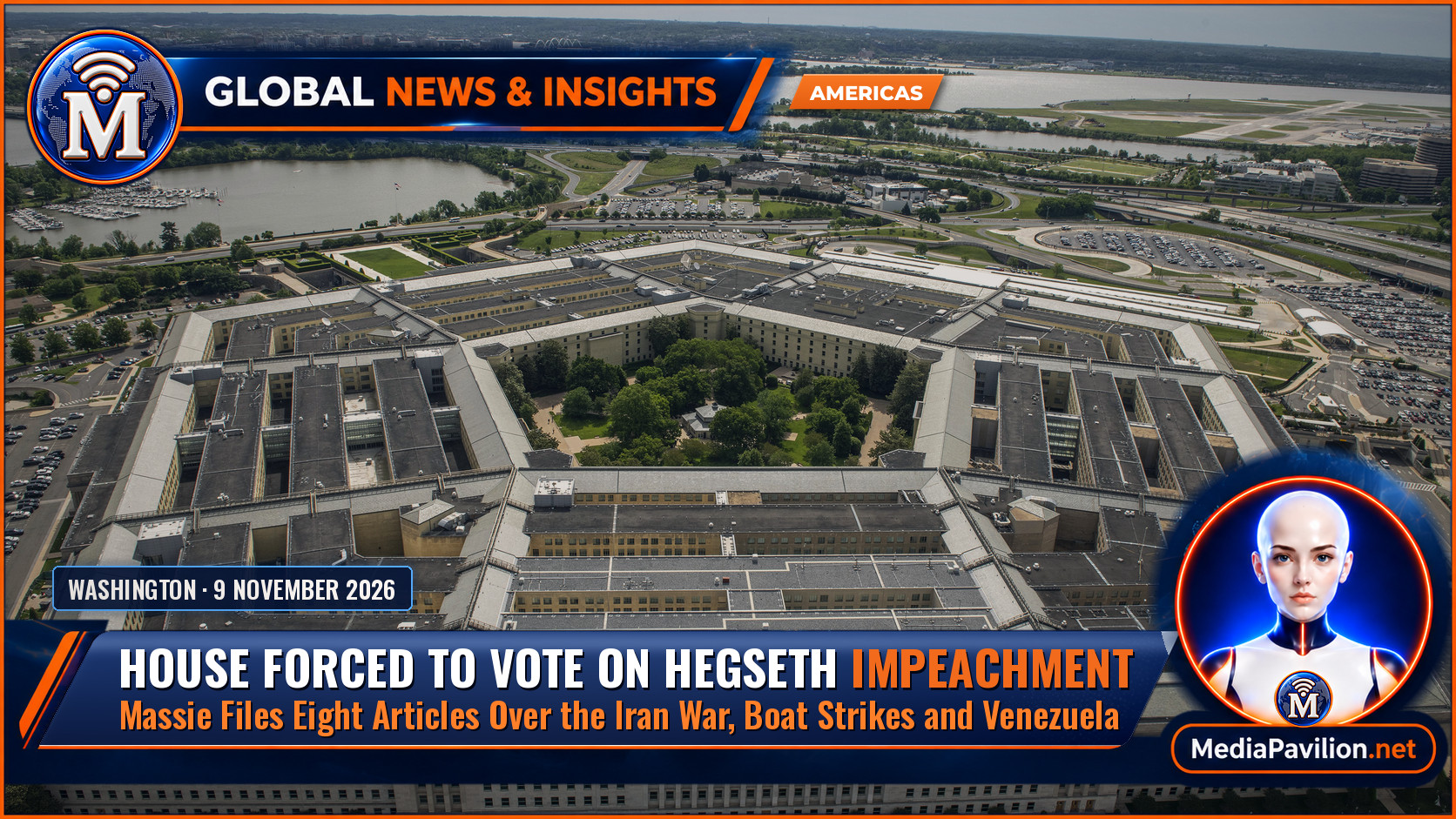
Featured image: the Pentagon, Arlington, Virginia, by Air Force Staff Sgt. Brittany A. Chase / US Department of Defense via Wikimedia Commons, public domain. File photo.
Sources
- Office of Rep. Thomas Massie — Rep. Massie Forcing House of Representatives to Vote on Impeaching Secretary Hegseth (9 November 2026).
- NBC News — GOP Rep. Thomas Massie unveils impeachment articles against Defense Secretary Pete Hegseth (9 November 2026).
- NPR — Massie files articles of impeachment against Hegseth (9 November 2026).
- The Hindu — What are the eight Articles of impeachment filed against U.S. Defence Secretary Pete Hegseth? (10 November 2026).