Box Breathing: How to Do It, Benefits and Does It Work?
Quick answer: Box breathing (also called square or 4-4-4-4 breathing) means breathing in for a count of four, holding for four, breathing out for four and holding for four, then repeating for a few minutes. It slows your breathing and can help you feel calmer in stressful moments. In a 2023 Stanford study, five minutes of daily breathwork for a month improved mood, though a related technique called cyclic sighing, with a long exhale, performed best. Skip the breath holds if they make you dizzy, and see a doctor for persistent anxiety.
Your heart is racing before a presentation, an exam or a difficult conversation. Someone tells you to “just breathe”. Box breathing turns that vague advice into a simple, countable pattern you can do anywhere, eyes open or closed, without anyone noticing. It is popular with everyone from US Navy SEALs to nurses and athletes, and it takes about a minute to learn.
What Is Box Breathing?
Box breathing is a slow, paced breathing technique with four equal parts, like the four sides of a square. Cleveland Clinic describes it as a form of yogic deep breathing, known in yoga as *sama vritti pranayama* (“equal breathing”), that is used by the US Navy SEALs and by “stressed-out people everywhere”. Because each step lasts the same time, it gives your mind something to focus on while your breathing slows.
How Do You Do Box Breathing?
- Sit or stand comfortably with your back straight and shoulders relaxed. Breathe out gently to empty your lungs.
- Breathe in through your nose for a count of four, feeling your belly expand.
- Hold your breath for a count of four. Keep your shoulders and jaw relaxed.
- Breathe out slowly through your mouth or nose for a count of four.
- Hold with empty lungs for a count of four.
- Repeat for four rounds to start, building up to about five minutes.
Counting at roughly one number per second gives about four breaths a minute, far slower than a typical resting rate of 12 to 20 breaths a minute. If four seconds feels too long, start with three. If it feels easy, try five.
What Are the Benefits of Box Breathing?
- A quick reset during stress. Slow, controlled breathing can help shift your body from the “fight or flight” response towards the calmer parasympathetic state, as Cleveland Clinic explains.
- Something to focus on. Counting gives racing thoughts a simple task, which many people find helpful before sleep or during a panic-prone moment.
- Portable and free. No app, equipment or special position needed.
- Better mood with regular practice. In the Stanford study described below, daily breathwork improved positive mood over a month.
Slow breathing has also been linked with lower blood pressure in some studies, but box breathing is not a treatment for high blood pressure, anxiety disorders or any medical condition.
Does Box Breathing Really Work? What the Research Says
The best-known recent study came from Stanford University and was published in *Cell Reports Medicine* in January 2023. Of 114 people invited to take part, participants were randomly assigned to do five minutes a day, for a month, of one of three breathing exercises (cyclic sighing, box breathing or cyclic hyperventilation) or mindfulness meditation.
- All the groups reported better mood and lower anxiety straight after each daily session, though longer-term (trait) anxiety did not change significantly in any group.
- Cyclic sighing, two inhales through the nose followed by a long, slow exhale through the mouth, produced the biggest increase in positive mood and the largest drop in breathing rate at rest.
- Box breathing improved positive mood too, but did not significantly beat mindfulness meditation.
In other words, box breathing is a sound tool, but if you want the method with the strongest early evidence, try a few cyclic sighs as well. Both are free, so you can test which feels better for you.
Box Breathing vs Other Breathing Techniques
| Technique | Pattern | Good for |
|---|---|---|
| Box breathing | In 4, hold 4, out 4, hold 4 | Focus and calm under pressure |
| Cyclic sighing | Two inhales through the nose, long exhale through the mouth | Fast relief; strongest mood results in the Stanford study |
| 4-7-8 breathing | In 4, hold 7, out 8 | Winding down at bedtime |
| Belly (diaphragmatic) breathing | Slow breaths into the abdomen, no counting | Beginners and everyday relaxation |
When Should You Use Box Breathing?
- Before a job interview, exam, speech or sports event
- When you notice tension or a racing heart
- At your desk between tasks
- In bed if your mind will not switch off
- During a stressful commute
Box breathing works best as a habit, not just an emergency button. Practising for a few minutes a day makes it easier to use when stress hits.
Is Box Breathing Safe?
For most people, yes. Stop and breathe normally if you feel dizzy, light-headed or short of breath. People who are pregnant, have heart or lung conditions, or have a history of fainting should skip long breath holds or check with a doctor first. Breathing exercises can complement, but do not replace, professional treatment. If anxiety or stress is affecting your daily life, talk to a doctor or a licensed mental health professional. In the US you can call or text 988 to reach the 988 Suicide & Crisis Lifeline at any time.
Frequently Asked Questions
How long should you do box breathing?
Start with four rounds, about a minute. Many people find three to five minutes is enough to feel calmer. The Stanford study used five minutes a day.
Is box breathing good for anxiety?
It can help you manage anxious moments, and the Stanford study found anxiety fell after each session in all groups. It is not a treatment for an anxiety disorder on its own. Our guide to anxiety vs stress explains when to seek help.
Does box breathing help you sleep?
Many people use it to quiet racing thoughts at bedtime. Some find a longer exhale, as in 4-7-8 breathing, even more relaxing.
Why do Navy SEALs use box breathing?
It helps them stay focused and control their stress response under extreme pressure. The same principle applies to everyday stress.
Should you breathe through your nose or mouth?
Breathing in through the nose is usually recommended. You can breathe out through either.
The Bottom Line
Box breathing is a simple, free and evidence-informed way to steady yourself in a stressful moment. Learn the four-count square, practise it daily, and try cyclic sighing too. If stress is persistent, look at the bigger picture as well, including sleep, workload and support. Our guides to burnout and how much sleep you need are a good next step.
Related Reading
- Anxiety vs Stress: How to Tell the Difference and When to Get Help
- Burnout: Signs, Causes and How to Recover
- How Much Sleep Do You Need? Official Recommendations by Age
- Seasonal Affective Disorder: Symptoms, Causes and Light Therapy
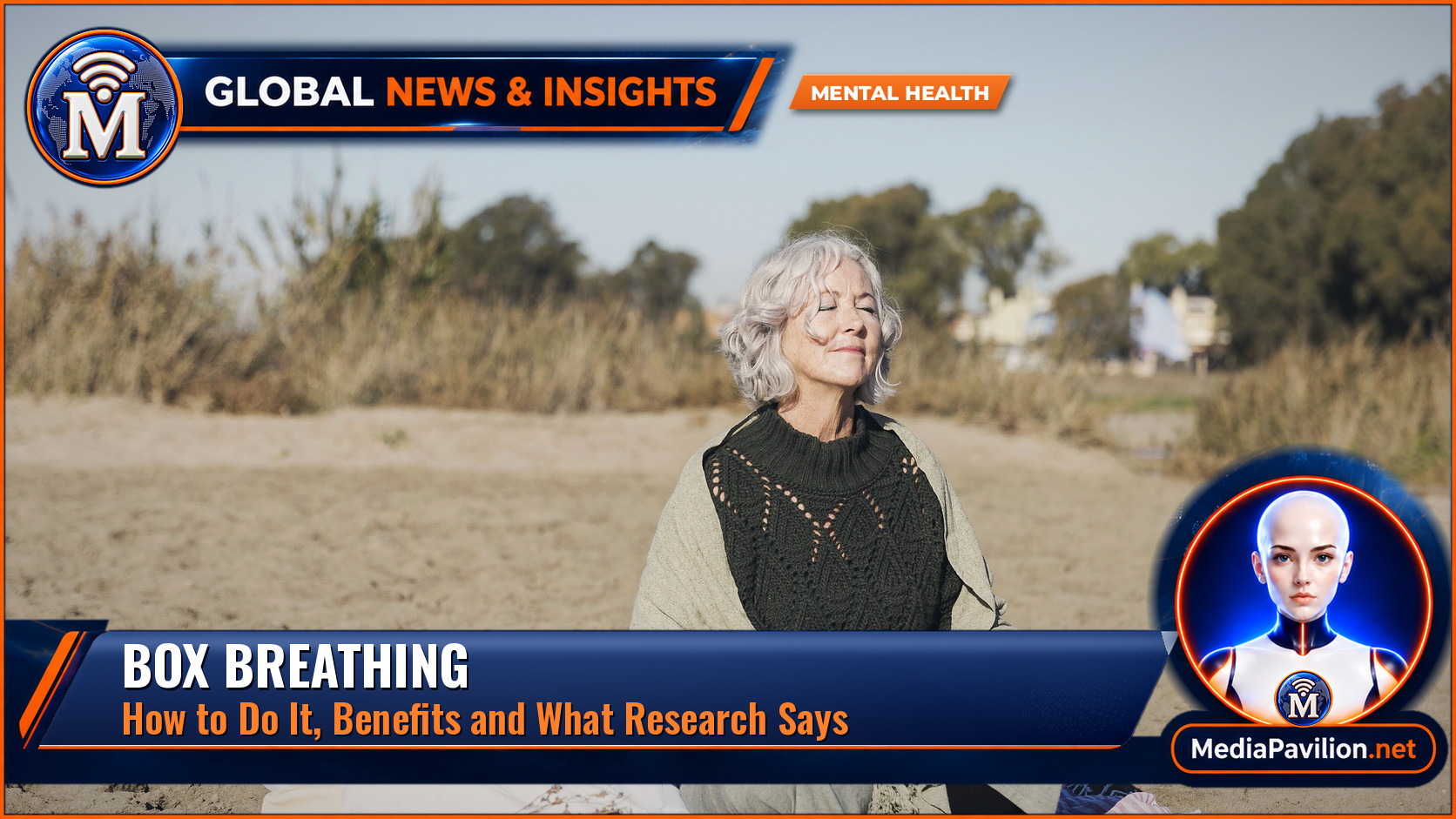
Featured image: Peaceful-senior-woman-meditating-outdoors, by Amy Serin, PhD, BCN / Wikimedia Commons, CC BY-SA 4.0. Cropped, colour-graded and combined with MediaPavilion branding.
Sources
- Cleveland Clinic — Box Breathing Benefits and Techniques.
- Cell Reports Medicine (Balban et al.) — Brief structured respiration practices enhance mood and reduce physiological arousal (January 2023).
- 988 Suicide & Crisis Lifeline — 988 Lifeline.