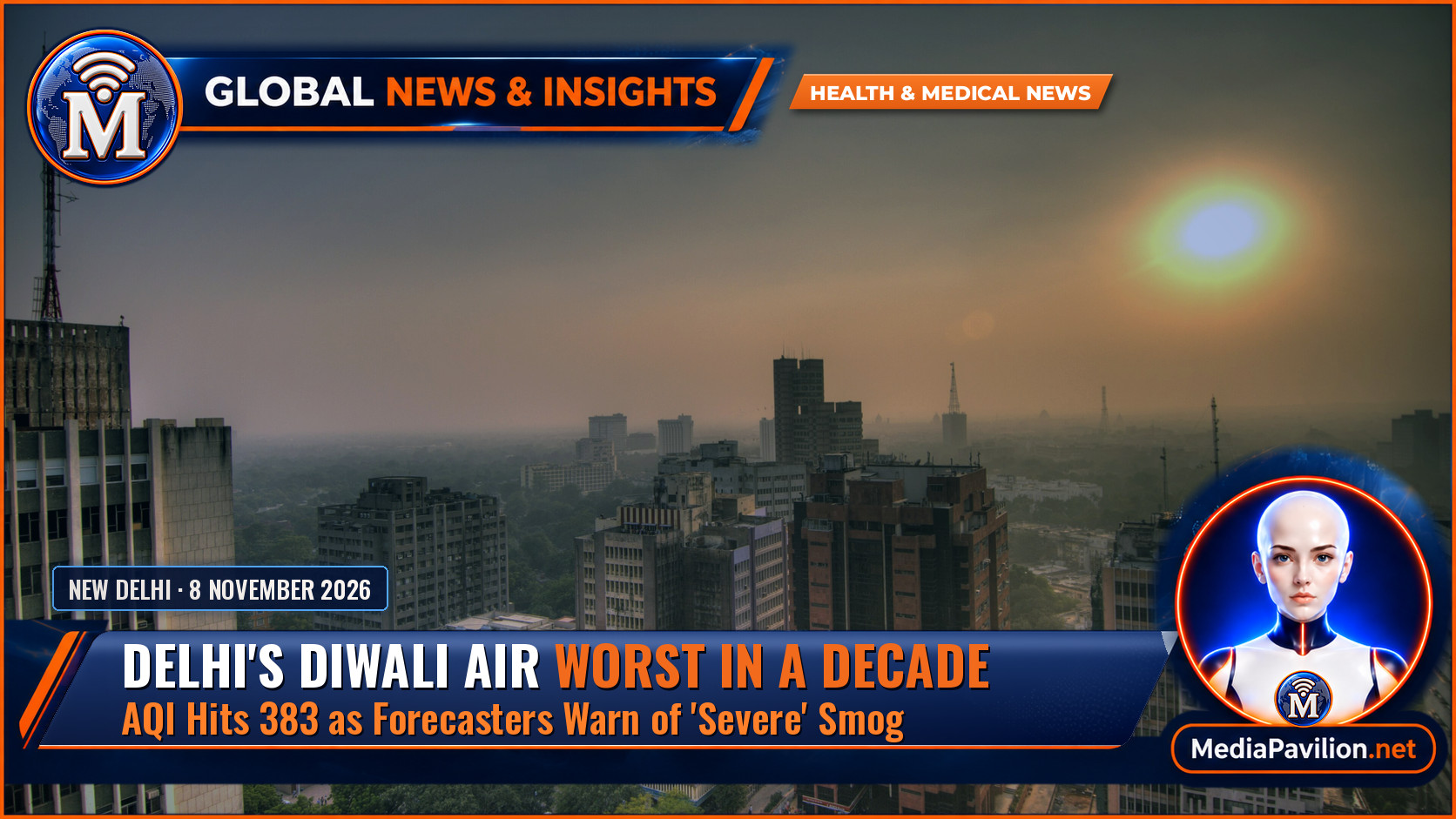
Delhi Records Worst Diwali-Eve Air in a Decade as Smog Heads for ‘Severe’
Delhi woke up to a thick toxic haze on Diwali morning after recording its most polluted day before the festival in a decade, and forecasters expect the air to turn “severe” as fireworks go off on Sunday night. The city’s average air quality index (AQI) reached 383 at about 9.30am on Sunday 8 November, the Hindustan Times reported, with 24 of 54 monitoring stations already in the “severe” band.
On Saturday, Diwali eve, the AQI stood at 369 at 4pm on the Central Pollution Control Board (CPCB) scale, which runs from 0 to 500. That was the highest reading on the day before Diwali since 2016, when it hit 404, according to the Hindustan Times and The Times of India.
How Bad Is Delhi’s Air Quality Today?
Readings in the “very poor” range (301 to 400) are linked to breathing problems with prolonged exposure, and anything above 400 is classed as “severe”, affecting healthy people as well as those with existing conditions. On Sunday morning, Jahangirpuri in north Delhi recorded the city’s worst AQI at 450, followed by RK Puram at 444, the Hindustan Times reported.
Fine particles are the main concern. Between 10am and 11am on Saturday, levels of PM2.5, particles small enough to lodge deep in the lungs, averaged 295 micrograms per cubic metre across Delhi’s 59 monitoring stations. India’s safe limit for a 24-hour average is 60, and the World Health Organization’s guideline is far stricter, at 15 micrograms per cubic metre.
- Diwali eve AQI (Saturday, 4pm): 369, worst pre-Diwali reading since 2016
- Diwali morning AQI (Sunday, 9.30am): 383, with 24 of 54 stations “severe”
- Worst stations: Jahangirpuri 450, RK Puram 444
- Forecast: about 406 by 4am on Monday (IITM)
- PM2.5 peak on Saturday: 295 µg/m³ average, against India’s 24-hour limit of 60
Will Pollution Get Worse After Diwali Fireworks?
Forecasters think so. The Air Quality Early Warning System for Delhi expects air quality to stay in the “severe” category on 8 and 9 November, and the Indian Institute of Tropical Meteorology (IITM) forecasts the AQI climbing to about 406 by 4am on Monday. Calm, cold weather traps pollution close to the ground at this time of year, while smoke from crop burning in Punjab and Haryana adds to the load.
History points the same way. Last year, the average PM2.5 reading across 27 stations reached 1,137 micrograms per cubic metre at 2am on Diwali night, up from 535 at 10pm, when firecrackers were supposed to stop, the Hindustan Times reported. This year starts from a worse base: last year’s Diwali-eve AQI was 296.
Are Firecrackers Allowed in Delhi This Diwali?
Only certified “green” firecrackers are allowed, and only for limited hours. Under a Supreme Court order made public on 2 November, they could be sold in Delhi and the surrounding National Capital Region (NCR) from 4 to 6 November and set off between 6am and 7am and between 8pm and 10pm on 7 and 8 November. A full ban returns from 9 November.
What Restrictions Are in Force Under GRAP Stage 3?
The Commission for Air Quality Management (CAQM) invoked Stage 3 of the Graded Response Action Plan (GRAP) on Friday, The Indian Express reported. The rules include:
- A ban on BS-III petrol and BS-IV diesel private cars and light vehicles in Delhi and the high-density districts of Gurugram, Faridabad, Sonipat, Ghaziabad and Gautam Buddh Nagar
- A ban on older diesel goods vehicles registered in Delhi, and an entry ban on similar vehicles from outside the city
- A halt to most construction and demolition work, stone crushers and mining across the NCR, with exemptions for essential projects such as railways, metro lines and hospitals
- Hybrid learning for children up to Class V, with online classes as an option
- Powers for state governments to let offices run at 50% capacity, with others working from home
How Can People Protect Themselves From Toxic Air?
Health authorities generally advise people in Delhi to limit time outdoors during the worst hours, especially children, older people, pregnant women and anyone with asthma, heart or lung disease. Well-fitted N95 or FFP2 masks reduce exposure to fine particles far better than cloth masks, and keeping windows closed and using an air purifier can help indoors. Anyone who exercises outdoors may want to move workouts inside for a few days; our guide to how much exercise you need each week shows how to keep up activity safely.
Visitors travelling to north India over the festival period should check daily AQI readings, carry any inhalers or medicines they need, and seek medical help for chest pain, severe breathlessness or wheezing that does not settle.
Featured image: Smog over the Delhi skyline, by wili hybrid / Wikimedia Commons, CC BY 2.0. File photo.
Sources
- Hindustan Times — Diwali eve crackers leave Delhi under a toxic haze, air quality nears ‘severe’ (8 November 2026).
- The Times of India — Delhi’s Diwali-eve air quality worst in 10 years; AQI set to worsen more (8 November 2026).
- The Indian Express — GRAP 3 announced: 3 stages in, Delhi not winning battle against toxic air (6 November 2026).
- India Today — Delhi air pollution: AQI turns severe at 11 stations on Diwali, GRAP III restrictions continue (8 November 2026).
- World Health Organization — Ambient (outdoor) air pollution fact sheet (2024).