What Is an AI Agent? How It Works, With Examples
Quick answer: An AI agent is software that uses an AI model, usually a large language model, to pursue a goal on its own over several steps: it plans, takes actions with tools (such as searching the web, running code, clicking through a website or sending an email), checks the results and decides what to do next. A chatbot answers your message; an agent goes and does the task. Examples include coding agents that fix bugs across a codebase, browser agents that book or buy things, and customer-service agents that can issue refunds. They are powerful but still make mistakes, so they need limits and human checks.
“Agent” may be the most overused word in technology this year. Every big AI company is selling one, and some, like the AI-assisted Riemann hypothesis proof claim that made headlines this week, hint at how much these systems can now do. This guide cuts through the marketing: what an AI agent actually is, how it works, real examples, how it differs from a chatbot, and the risks to understand before you hand one the keys.
What Is an AI Agent in Simple Terms?
Think of the difference between asking a knowledgeable friend for directions and hiring a driver. A chatbot gives you information. An agent takes a goal, such as “find three flights to Denver under $300 and put the best one on hold”, and works out the steps, uses the tools it has been given, and reports back when it is finished or stuck.
IBM defines an AI agent as a system that can autonomously perform tasks on behalf of a user or another system by designing its own workflow and using available tools. Anthropic, which makes Claude, draws a useful line in its engineering guide Building effective agents: “workflows” follow steps a developer has fixed in advance, while “agents” let the model decide its own process and which tools to use.
How Does an AI Agent Work?
Most agents are built from the same basic parts, running in a loop:
| Part | What it does | Example |
|---|---|---|
| Model (“brain”) | Understands the goal, reasons and decides the next step | A large language model such as GPT, Gemini or Claude |
| Tools | Let it act in the world | Web search, a browser, a code interpreter, a calendar, an email account, company databases |
| Memory | Keeps track of what has happened and what it has learned | The conversation so far, notes, files, past tasks |
| Planning loop | Repeats: plan, act, observe the result, adjust | “Search failed; try a different query” |
| Guardrails | Limit what it may do and when it must ask a human | Spending caps, approval before sending, blocked websites |
The loop is the key idea. A chatbot produces one answer. An agent keeps going, perhaps for dozens of steps, until it meets the goal or hits a limit.
What Are Examples of AI Agents?
- Coding agents: tools such as Claude Code, OpenAI’s Codex and GitHub Copilot’s coding agent can read a codebase, write changes, run tests and fix failures.
- Browser or “computer use” agents: these can operate a web browser or desktop like a person, filling forms, comparing products or gathering research.
- Research agents: “deep research” features run many searches, read sources and write a cited report.
- Customer-service agents: they answer questions and can also take actions such as rebooking, issuing refunds or updating an account, within rules set by the company.
- Personal assistants: agents connected to email and calendars can schedule meetings, draft replies and chase follow-ups.
For a comparison of the main assistants behind many of these products, see our guide to ChatGPT vs Gemini vs Claude.
What Is the Difference Between an AI Agent and a Chatbot?
| Feature | Chatbot | AI agent |
|---|---|---|
| Main job | Answer questions, write text | Complete a task or goal |
| Steps | One reply per message | Many steps in a loop |
| Tools | Few or none | Search, browser, code, apps, accounts |
| Autonomy | Waits for you each time | Decides its own next step |
| Risk if wrong | A bad answer you can ignore | A wrong action, such as a sent email or a purchase |
The line is blurring: many chatbots now include agent modes. A good test is whether the system can change something outside the chat, such as a file, a booking or a message, without you doing it.
Is an AI Agent the Same as Automation?
Not quite. Traditional automation, such as a rule that files every invoice email into a folder, follows fixed instructions and breaks when something unexpected happens. An agent uses a model to interpret messy situations and choose what to do, which makes it more flexible but also less predictable. Many businesses combine the two: fixed workflows for routine steps and an agent for the judgement calls. Physical robots are a related but different field, which we explain in how robots work.
What Are the Risks of AI Agents?
- Mistakes that act: an agent that misunderstands can delete the wrong file or buy the wrong item, not just give a wrong answer.
- Prompt injection: hidden instructions on a webpage or in an email can trick an agent into doing something its user never asked for. The OWASP Gen AI Security Project ranks prompt injection as the top risk for AI applications.
- Too much access: an agent with your email, payment and file permissions is a tempting target for scammers.
- Cost and loops: agents can burn through paid usage if they get stuck repeating steps.
- Accountability: if an agent makes a costly error, it may be unclear who is responsible.
Many of the safety habits in our guide to spotting phishing emails apply to agents too: be wary of links, attachments and requests that seem urgent.
How Can You Use an AI Agent Safely?
- Start with low-stakes tasks. Research, summaries and drafts before payments or deletions.
- Give the least access needed. A read-only calendar is safer than full email control.
- Require approval for important actions. Sending, buying, publishing and deleting should need a human click.
- Keep logs and check the work. Review what the agent did, not just what it says it did.
- Protect accounts. Use strong, unique passwords and two-factor authentication on anything an agent can reach.
Frequently Asked Questions
What is an AI agent and how does it work?
It is software that uses an AI model to plan and carry out multi-step tasks with tools, repeating a loop of planning, acting and checking results until the goal is met or it needs help.
Is ChatGPT an AI agent?
ChatGPT is mainly a chatbot, but it includes agent features that can browse, use tools and carry out tasks. The same is true of Gemini and Claude.
What can AI agents do today?
They can write and fix code, research topics and write reports, fill in online forms, manage inboxes and calendars and handle routine customer-service requests. They still struggle with long, unfamiliar tasks and need supervision.
Are AI agents safe to use?
They can be, with limits. Keep their permissions narrow, require approval for important actions and watch for prompt-injection attacks hidden in web pages or emails.
Will AI agents replace jobs?
They are already automating parts of many jobs, especially routine computer work. Most organisations are using them to assist staff rather than replace whole roles, but the balance is changing quickly.
The Bottom Line
An AI agent is an AI model given a goal, tools and the freedom to work through the steps itself. That makes it far more useful than a chatbot for real tasks, and far riskier when it gets things wrong. Used with narrow permissions and human approval for anything important, agents can save hours of routine work.
Related Reading
- ChatGPT vs Gemini vs Claude: Plans and Prices 2026
- Do AI Detectors Work?
- How Do Robots Work?
- Riemann Hypothesis Proof: What Anthropic’s AI Claim Means
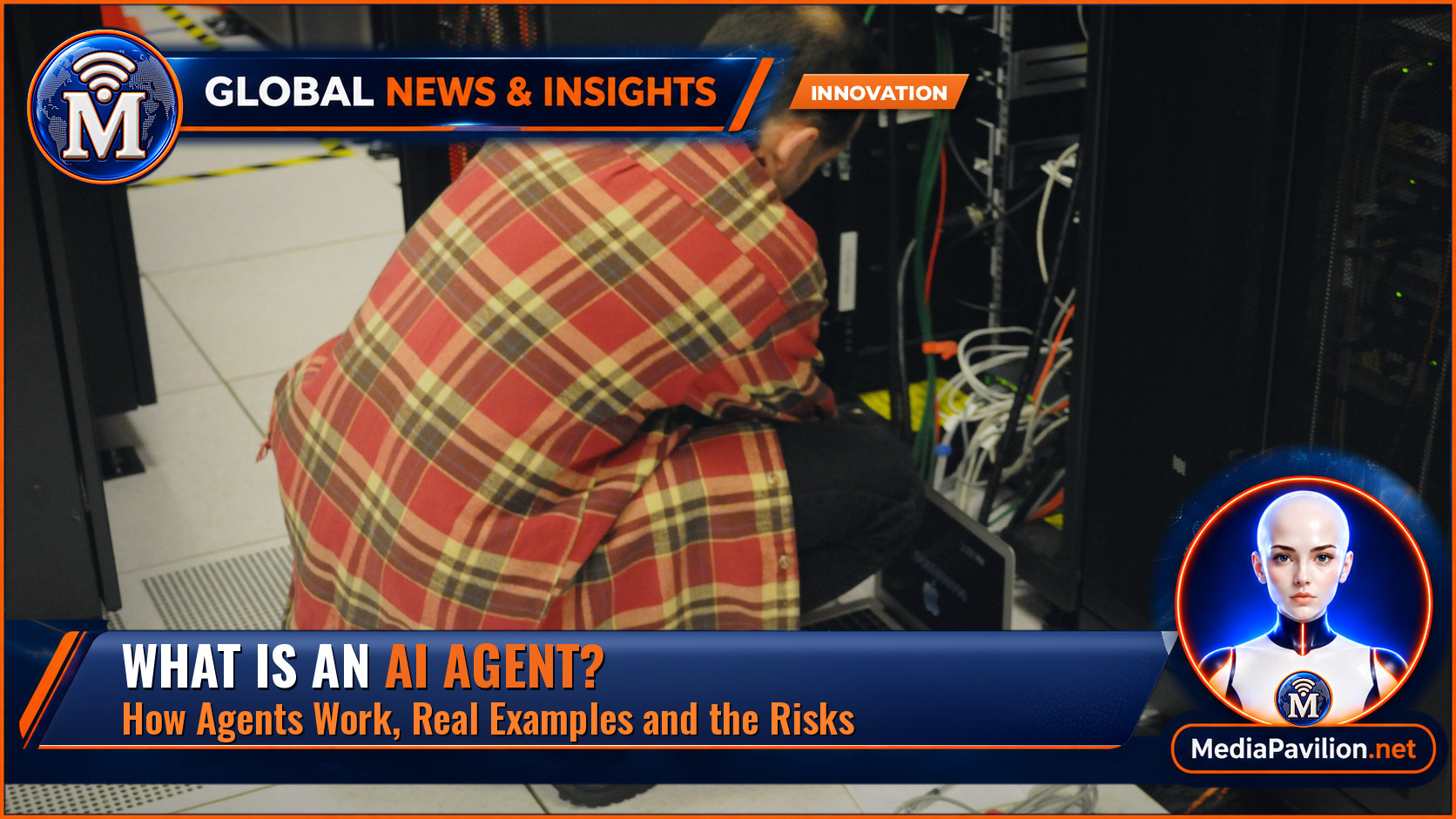
Featured image: a technician working on a server rack at the NERSC data centre, Berkeley, California (file photo), by Derrick Coetzee / Wikimedia Commons, CC0. Cropped, colour-graded and combined with MediaPavilion branding.
Sources
- IBM — What are AI agents?.
- Anthropic — Building effective agents (December 2024).
- OWASP Gen AI Security Project — LLM01: Prompt Injection.
- Google Cloud — What are AI agents?.