CPI Report October 2026: Prices Rise 0.4%, Fed Hike Looms
US consumer prices rose 0.4% in October, a faster increase than economists had expected, according to the Bureau of Labor Statistics (BLS) report published on Tuesday 10 November 2026. Core prices, which strip out food and energy, rose 0.3%, also above forecasts. The figures land at an awkward moment for the Federal Reserve, which is already weighing a second interest-rate rise in four months.
There is an unusual gap in this CPI report: no headline annual inflation rate. Here is what the October numbers show, why the yearly figure is missing and what the report could mean for interest rates, mortgages and household budgets.
What Did the October 2026 CPI Report Show?
The Consumer Price Index increased a seasonally adjusted 0.4% from September. Economists surveyed by Dow Jones had forecast 0.3%, CNBC reported. That is a slowdown from September’s 0.6% jump, but it matches August’s monthly increase. The main moving parts were:
- Shelter: up 0.3%, accounting for more than 30% of the overall monthly rise, the BLS said.
- Energy: up 0.7%, with the gasoline index up 1% and natural gas down 0.8%. That is far cooler than September’s 5.2% energy jump.
- Food: up 0.5%, driven by snacks (+1%), beef (+0.9%) and meats, poultry, fish and eggs (+0.5%).
- Electricity: up 0.9%, a rise some Fed officials link partly to the power demands of the AI data-centre build-out.
- Cars: new vehicles up 0.2%, used cars and trucks down 1.2%.
- Other items: transportation services up 0.8%, airline fares up 0.4%, apparel up just 0.1%.
Why Is There No Annual Inflation Rate This Month?
The BLS did not publish a year-on-year headline or core figure because the government shutdown in October 2025 stopped it from collecting enough price data that month. Without an October 2025 baseline, there is no clean 12-month comparison. The bureau did publish annual changes for some individual items where data exist.
The most recent full annual reading is for September 2026, when prices were up 3.7% on a year earlier, according to ABC News’s Good Morning America. That was up from 3.4% in August and is well above the Fed’s 2% target. Inflation has now run above that target for roughly five and a half years.
Why Are Gas Prices Falling but Energy Inflation Still Rising?
Many drivers have noticed cheaper fuel in recent days, so a 1% rise in the gasoline index can look odd. The answer is timing. The CPI measures average prices across October, while the recent relief at the pump came later. AAA put the national average for regular gasoline at $3.98 a gallon on 10 November, down from $4.37 a month earlier, EconoTimes reported, citing AAA data. A year ago it was $3.07, a reminder of how much the Iran war has lifted fuel costs.
If pump prices keep easing, energy could pull the November CPI lower. Shelter and food, though, tend to move more slowly, which is why economists are watching the core figure closely.
Will the Fed Raise Interest Rates in December?
Markets now expect it. After the report, traders fully priced in a quarter-point rise at the Fed’s next meeting on 8 and 9 December, according to CNBC, which cited CME Group’s FedWatch tool. Odds of a larger half-point move rose to about 13.6% from near zero.
Fed Governor Christopher Waller said before the release that a half-point rise should be “on the table” if core CPI came in “around 0.3”. It did. Dallas Fed President Lorie Logan said after the data that she sees a need for two more quarter-point increases, while Philadelphia Fed President Anna Paulson said “further gradual tightening seems appropriate”. The Fed raised rates in September and held them at 3.75%–4% in October, so a December move would be its second hike in four months.
The labour market gives policymakers room to act. Employers added 165,000 jobs in October, as we reported in our October jobs report explainer.
What Does Hotter Inflation Mean for Your Money?
The effects depend on what you borrow and save. These are the main points to watch, though the outcome will depend on what the Fed actually decides in December:
- Credit cards and variable loans: rates usually follow the Fed’s benchmark, so a December rise would make carrying a balance more expensive.
- Mortgages: fixed rates track Treasury yields, which jumped after the report. Buyers shopping for a loan may see quotes edge higher.
- Savings: high-yield savings and certificate of deposit rates could stay elevated, which helps savers.
- Shopping: a net 37% of small businesses in the October NFIB survey said they plan to raise prices in the next three months, the highest since July 2022, CNBC reported. That makes it worth comparing prices before big holiday purchases; our guide to Black Friday vs Cyber Monday deals can help.
How Did Markets React?
Stocks fell and Treasury yields rose after the release. “This was the report the market could least afford to see,” Karen Manna, fixed income investment strategist at Federated Hermes, told CNBC. Markets were already fragile after last week’s sharp fall in technology shares, which we covered in our report on the Nasdaq’s post-midterm slide.
When Is the Next CPI Report?
The November CPI report is scheduled for 10 December 2026 at 8:30 a.m. Eastern Time, one day after the Fed’s decision. Before then, the Fed will also see the personal consumption expenditures (PCE) price index, its preferred inflation gauge, later in November. Logan warned that PCE could also move higher. You can check release dates on the BLS schedule.
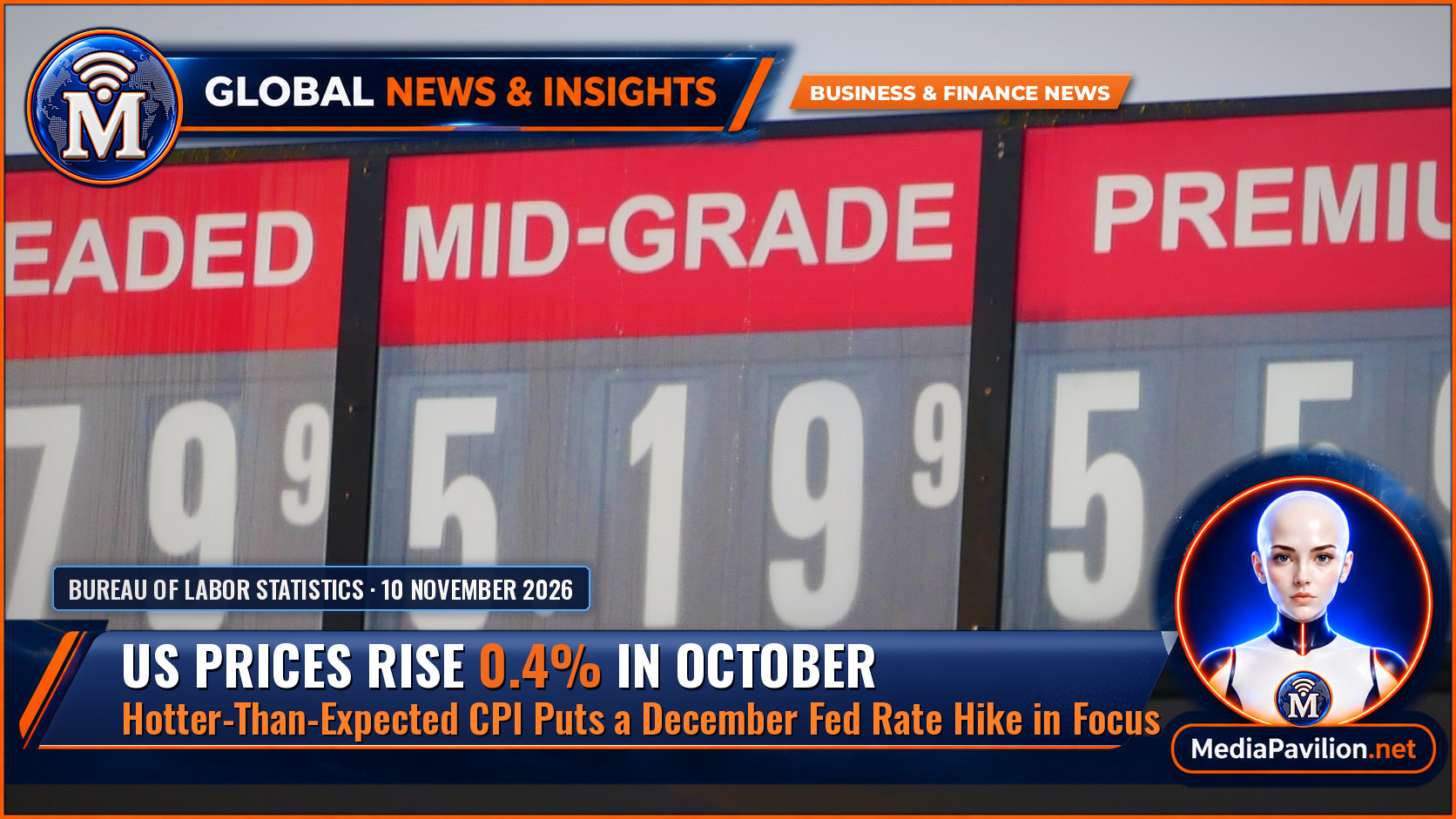
Featured image: petrol prices on a US forecourt sign, by Rick Obst / Wikimedia Commons, CC BY 4.0. File photo.
- CNBC — Consumer prices rose 0.4% in October, more than expected, complicating Fed’s inflation fight (10 November 2026).
- Good Morning America (ABC News) — Consumer prices increased 0.4% in October, higher than expected (10 November 2026).
- EconoTimes — U.S. Inflation Rises 0.4% in October as Average Gas Drops Below $4 (10 November 2026).
- Anadolu Agency — Morning Briefing: Nov. 11 (11 November 2026).
- US Bureau of Labor Statistics — Consumer Price Index.