Remote Jobs With No Experience: 8 Roles That Hire
Quick answer: The remote jobs most open to people with no experience are customer service, chat and email support, data entry, virtual assistance, transcription and captioning, online tutoring, content moderation and entry-level sales. Most need reliable internet, a quiet space and solid communication skills rather than a degree. Customer service alone employed about 2.7 million people in the US in 2025, with median pay of $21.53 an hour (BLS). Never pay to get a job: upfront fees are the clearest sign of a scam.
“Remote, no experience needed” is one of the most searched job phrases in America, and also one of the most abused by scammers. The good news: real entry-level remote jobs exist, they are mostly in a handful of predictable fields, and you can make yourself a strong candidate in a few weeks without a degree.
Here is where to look, what each job actually involves, and how to stand out when you have nothing on your CV yet.
What remote jobs can you get with no experience?
| Job | What you do | Why beginners get hired | Good to know |
|---|---|---|---|
| Customer service representative | Answer calls, chats or emails; process orders and returns | Training is usually on the job; BLS lists no experience requirement | Many roles need a headset and fixed shifts |
| Chat and email support | Written support for apps, retailers and banks | Good fit if you type fast and write clearly | Often called “support specialist” |
| Data entry | Type or check information in spreadsheets and databases | Accuracy and speed matter more than background | Pay is modest; scams are common here |
| Virtual assistant | Manage inboxes, calendars, bookings and research | Organised people can start with friends or small businesses | Often freelance rather than salaried |
| Transcription and captioning | Turn audio and video into text | Paid tests replace experience at many firms | AI tools are shrinking basic work; accuracy jobs remain |
| Online tutor | Teach a school subject or language over video | Subject knowledge counts more than job history | Some platforms require a degree; many do not |
| Content moderator / AI data rater | Review posts or rate AI answers against guidelines | Guidelines are taught; attention to detail is key | Can involve upsetting content |
| Sales development representative | Contact potential customers and book meetings | Companies hire for energy and resilience | Pay often includes commission |
How much do entry-level remote jobs pay?
It varies widely by employer and country, so treat any figure as a rough guide. The most reliable US benchmark is customer service: the US Bureau of Labor Statistics reports a median wage of $21.53 an hour ($44,770 a year) in May 2025 for customer service representatives. The typical entry requirement is a high school diploma, with short-term on-the-job training and no prior experience.
BLS also projects that customer service employment will decline 5% from 2025 to 2035 as automation spreads, yet still expects about 289,500 openings a year, mostly to replace people who leave. In other words: competition is real, but so is turnover.
Which remote jobs require no experience and no degree?
Customer service, chat support, data entry, content moderation, transcription and virtual assistant work rarely ask for a degree. Tutoring and some AI-rating roles may, depending on the platform. When a listing says “degree preferred”, apply anyway if you meet the rest; preferences are not requirements.
How do you get a remote job with no experience?
- Pick one or two job types, not ten. A focused CV beats a generic one.
- Build proof quickly. Type at 50+ words per minute (free typing tests show your speed), take a free Google or Microsoft spreadsheet course, or volunteer to manage a club’s inbox for a month.
- Rewrite your CV around skills. Retail, hospitality, caring and school projects all show communication and problem-solving. Our guides to CV vs resume and chronological vs functional resumes explain the right format.
- Set up a work-ready space. Most employers ask about internet speed, a quiet room and sometimes a wired connection.
- Search the right places. Company careers pages, LinkedIn and Indeed with the “remote” filter, and specialist remote boards. Large employers of support staff often hire seasonally ahead of the holidays.
- Prepare for a video interview. Test your camera and audio, and have two or three questions ready; see questions to ask in a job interview.
- Consider freelancing in parallel. Virtual assistant and transcription work often starts freelance; our freelancing for beginners guide covers first clients and rates.
How do you spot a remote job scam?
US consumer agencies, including the Federal Trade Commission and Social Security’s Ticket to Work programme, warn that work-from-home scams often promise high pay for easy work and target people looking for flexible jobs. Walk away if you see any of these:
- You are asked to pay for training, equipment, a “starter kit” or a background check.
- You are sent a cheque to buy equipment and told to send part of the money back.
- The interview happens only by text or chat app, with no video call or named manager.
- The pay is far above market for “simple” tasks such as liking posts or reviewing products.
- The email comes from a free address rather than the company’s domain, or the company has no real website.
Our full guide on how to find legitimate remote jobs and avoid scams goes deeper, including how to check a company in two minutes, and you can report a scam to the FTC at ReportFraud.ftc.gov.
Is remote work worth it for a first job?
There are trade-offs. You save commuting time and costs, but you may get less informal mentoring, and some people find working alone tough on their mood. Our comparison of remote work vs the office weighs it up with 2026 figures. If you go remote, schedule regular video check-ins and ask for feedback early.
Frequently asked questions
What is the easiest remote job to get with no experience?
Customer service and chat support usually have the most openings and the most structured training, which makes them the most realistic first step for many people.
Are there remote jobs with no experience and no phone calls?
Yes: chat and email support, data entry, transcription, content moderation and AI data rating are mostly written work. Search for “non-phone” or “chat support” in listings.
Can teenagers or students get remote jobs?
Some platforms accept workers from 18, and tutoring or freelance work can suit students. Check the minimum age and tax rules before signing up.
Do remote jobs pay less than office jobs?
Not necessarily. For the same role pay is often similar, though some employers adjust pay by location. Entry-level remote roles typically pay in line with their in-office equivalents.
Related Reading
- How to Find Legitimate Remote Jobs and Avoid Scams
- Remote Work vs In Office: Pros, Cons and 2026 Figures
- How to Start Freelancing
- How to Make Money With AI: 7 Realistic Ways
- What to Know Before Quitting Your Job
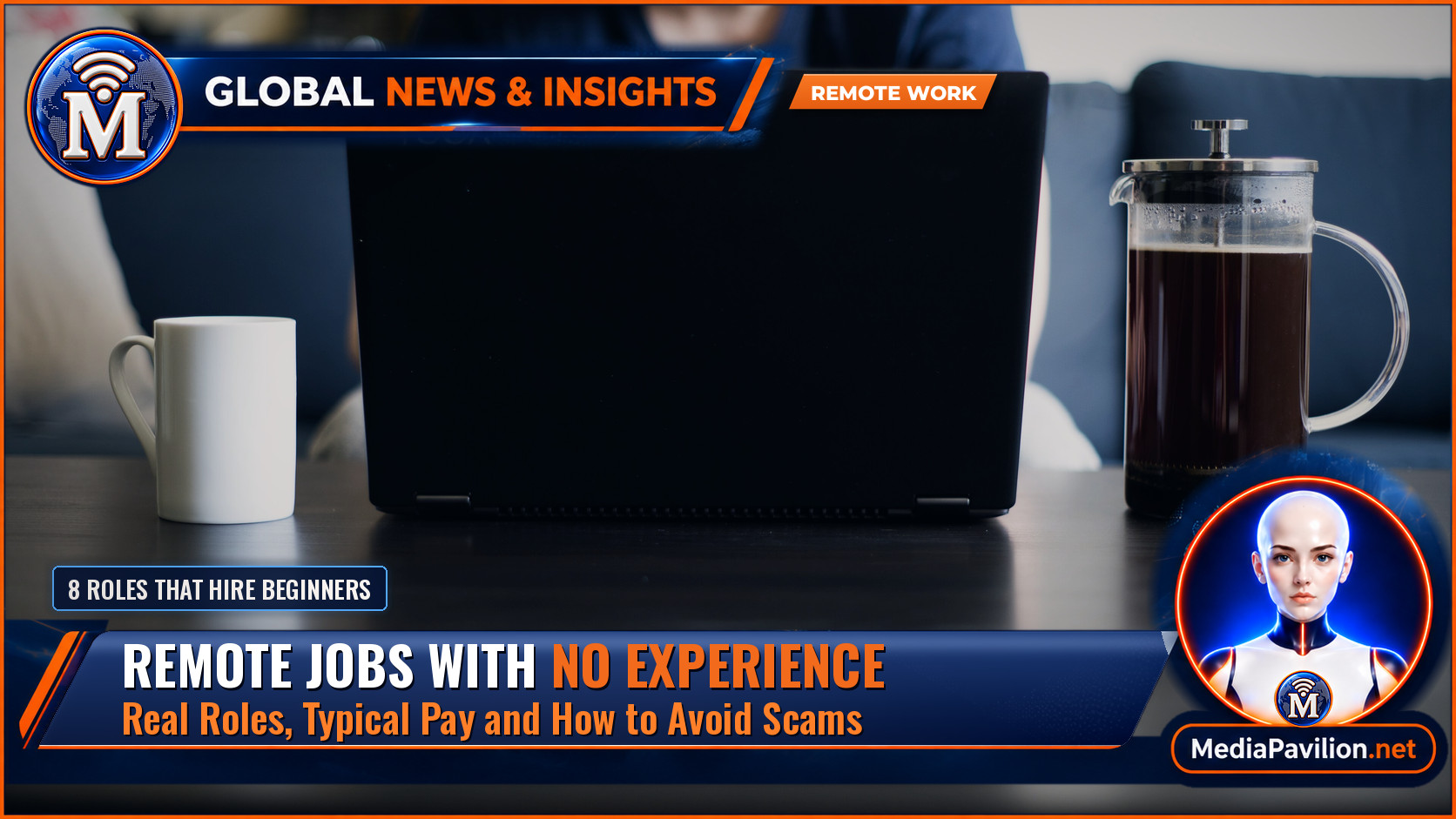
Featured image: working from home with a laptop and coffee (file photo), by Microbiz Mag / Wikimedia Commons, CC BY 2.0. Cropped, colour-graded and combined with MediaPavilion branding.
Sources
- U.S. Bureau of Labor Statistics — Occupational Outlook Handbook: Customer Service Representatives (accessed November 2026).
- Social Security Administration, Ticket to Work — How to Spot a Work From Home Scam (28 August 2024).
- Federal Trade Commission — ReportFraud.ftc.gov (accessed November 2026).