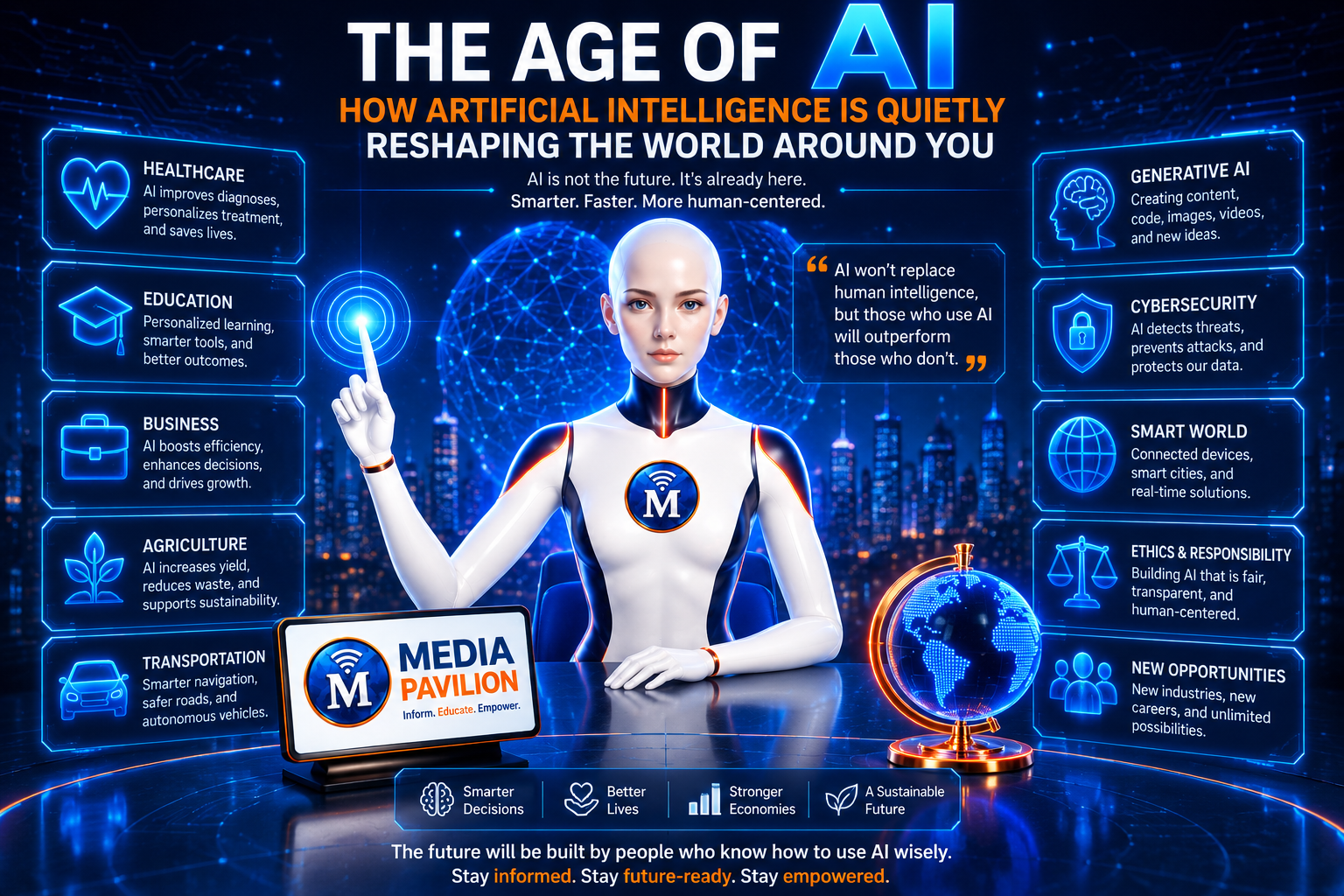
The Age of AI: How Artificial Intelligence Is Quietly Reshaping the World Around You
Artificial Intelligence (AI) is no longer a glimpse into the future—it has become part of everyday life. Whether you’re unlocking your smartphone with facial recognition, receiving personalised movie recommendations, translating languages instantly, or using an AI assistant to brainstorm ideas, you’re already interacting with AI more often than you may realise.
Yet despite its growing presence, AI remains one of the most misunderstood technologies of our time.
Some believe AI will replace every job. Others imagine intelligent robots taking over the world. Those extremes do not explain how a particular system works or where its limits lie. AI is neither magic nor science fiction—it’s a powerful tool that, when used responsibly, has the potential to solve some of humanity’s biggest challenges while creating entirely new opportunities.
What Exactly Is Artificial Intelligence?
Artificial Intelligence refers to computer systems designed to perform tasks that normally require human intelligence. These tasks include learning from experience, recognising patterns, understanding language, making decisions, solving problems, and even generating creative content such as images, music, videos, and articles.
Many modern AI systems learn patterns from training data. Their capabilities depend on the system, data and task; they do not necessarily keep learning or improving during everyday use.
Think of AI as an incredibly fast learner that processes information at a scale no human could achieve alone.
AI Is Already All Around Us
Many people assume AI belongs only in research laboratories or technology companies. In reality, it’s quietly working behind the scenes in countless aspects of daily life.
Today, AI helps to:
- Detect fraud in online banking.
- Recommend products while shopping online.
- Improve medical diagnoses.
- Predict traffic and optimise navigation.
- Filter spam emails.
- Translate conversations in real time.
- Assist students with personalised learning.
- Help farmers monitor crops and improve harvests.
- Support businesses by analysing customer behaviour.
- Create realistic images, videos, and written content.
As computing power continues to grow, AI will become even more deeply integrated into everyday services.
Industries Being Transformed
Healthcare
Doctors are increasingly using AI to analyse medical scans, identify diseases earlier, discover new medicines, and personalise treatment plans. While AI doesn’t replace medical professionals, it can help them make faster and more informed decisions.
Education
AI-powered learning platforms adapt lessons to each student’s pace, helping learners strengthen weak areas while allowing teachers to spend more time on meaningful interaction instead of repetitive administrative tasks.
Business
From customer support chatbots to financial forecasting and supply chain optimisation, businesses are using AI to improve efficiency, reduce costs, and deliver better customer experiences.
Agriculture
Modern farms are embracing AI-powered drones, sensors, and satellite imagery to monitor crop health, predict weather impacts, detect pests early, and maximise food production while reducing waste.
Transportation
Autonomous driving technology, intelligent traffic management, predictive vehicle maintenance, and route optimisation are changing how people and goods move around the world.
The Rise of Generative AI
One of the biggest breakthroughs in recent years has been Generative AI.
Unlike earlier AI systems that mainly analysed information, generative AI can create entirely new content, including:
- Articles
- Computer code
- Music
- Videos
- Images
- Business plans
- Marketing campaigns
- Educational materials
This technology is empowering individuals, startups, educators, artists, researchers, and entrepreneurs to produce work that once required entire teams.
Rather than replacing creativity, generative AI often enhances it by allowing people to focus more on ideas and strategy while automating repetitive tasks.
Challenges That Must Be Addressed
Like every transformative technology, AI also presents important challenges.
These include:
- Protecting personal privacy.
- Preventing misinformation and deepfakes.
- Reducing bias in AI systems.
- Ensuring transparency in automated decisions.
- Preparing workers for changing job markets.
- Developing responsible regulations.
Addressing these issues requires collaboration between governments, technology companies, researchers, educators, businesses, and everyday users.
Responsible AI development will determine whether society enjoys its full benefits while minimising potential risks.
Will AI Replace Human Jobs?
This is one of the most common questions people ask.
History shows that major technological revolutions often eliminate certain tasks while creating entirely new industries and careers.
AI is likely to automate repetitive, predictable work. At the same time, it is creating demand for professionals in areas such as AI engineering, cybersecurity, data science, robotics, digital marketing, prompt engineering, AI ethics, machine learning, automation consulting, and human-AI collaboration.
The future workforce will increasingly value creativity, emotional intelligence, leadership, communication, adaptability, and critical thinking—skills that complement AI rather than compete with it.
Preparing for an AI-Driven Future
Whether you’re a student, entrepreneur, professional, or business owner, now is the ideal time to begin building AI literacy.
Practical steps include:
- Learn the basics of artificial intelligence.
- Explore AI tools that improve productivity.
- Develop digital and analytical skills.
- Stay informed about emerging technologies.
- Continue learning throughout your career.
- Use AI responsibly and ethically.
Those who embrace continuous learning will be better positioned to thrive in the rapidly evolving digital economy.
AI Is a Tool—People Shape Its Impact
Artificial intelligence can support human work, but it can also displace tasks and introduce errors. Its effects depend on how it is designed, adopted and checked.
The real competitive advantage in the coming decades won’t simply belong to those who have access to AI, but to those who understand how to combine technology with human judgement, creativity, ethics, and innovation.
The future will not be built by AI alone.
It will be built by people who know how to use AI wisely.
Final Thoughts
Artificial Intelligence represents one of the most significant technological shifts of the 21st century. Its influence will continue to grow across healthcare, education, finance, agriculture, transportation, entertainment, scientific research, and nearly every other sector of society.
As AI becomes increasingly accessible, the greatest opportunity lies not in fearing the technology but in understanding it.
Knowledge empowers better decisions.
Innovation creates new possibilities.
Responsible use builds a better future.
At MediaPavilion.net, we remain committed to our mission to Inform. Educate. Empower. By delivering trusted insights into AI, technology, business, science, and global opportunities, we aim to help readers stay informed and prepared for the world of tomorrow.
The AI revolution has already begun. The question isn’t whether it will change the world—it’s how we choose to shape that future together.
Sources
- NIST — AI Risk Management Framework and generative AI risk resources
- International Labour Organization — Generative AI and Jobs: A Refined Global Index of Occupational Exposure (20 May 2025)
- European Commission Joint Research Centre — AI adoption across strategic sectors (14 October 2026)
These background references support the discussion of AI, employment and technology limitations; future applications and outcomes remain uncertain.