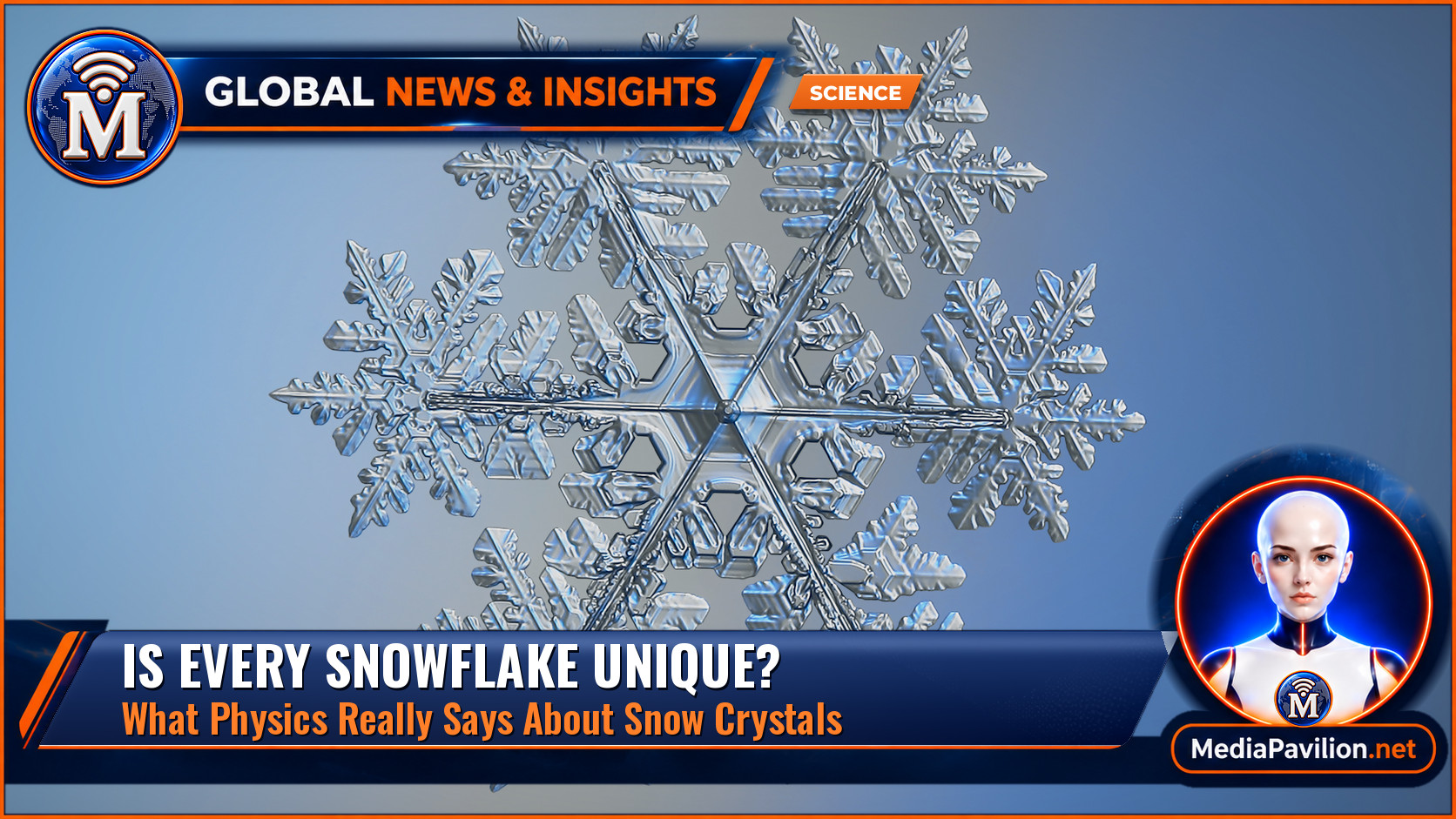
Is Every Snowflake Unique? What Snow Crystal Science Says
Quick answer: For all practical purposes, yes: no two complex snowflakes are exactly alike. Caltech physicist Kenneth Libbrecht, one of the world’s leading snow crystal researchers, says the odds of two large, intricate snowflakes looking identical are so small that you would not find a match even if you examined every snowflake ever made. But the rule has exceptions: tiny, simple crystals such as hexagonal prisms can look the same under a microscope, and in 1988 scientist Nancy Knight photographed two snow crystals from a Wisconsin storm that looked identical.
It is one of the first science facts many of us learn as children, usually while cutting paper snowflakes at a school table. It is also one of the few playground facts that largely survives scrutiny. The full answer, though, depends on what you mean by “alike” and what you mean by “snowflake”, and it explains a lot about the beautiful physics happening above your head every time it snows.
Are All Snowflakes Really Unique?
Libbrecht breaks the question into three levels on his Caltech snow crystal site:
- At the molecular level, no two are exactly alike. A typical small snow crystal contains around 10^18 water molecules. Roughly one in 5,000 naturally occurring water molecules contains a deuterium atom, and about one in 500 contains a heavier oxygen-18 atom. These “rogue” molecules are scattered randomly through every crystal, so their exact layout is effectively unique.
- Simple, small crystals can look alike. Under an optical microscope, plain hexagonal prisms often look essentially identical, and they are very common. They are just too small to notice with the naked eye.
- Large, complex snowflakes are all different. A big stellar snowflake has hundreds of distinguishable features, and the number of ways they can be arranged is astronomically larger than the number of snowflakes that have ever fallen. Libbrecht notes that Earth produces roughly 10^24 snow crystals a year, and that is still nowhere near enough for an exact repeat.
Has Anyone Ever Found Two Identical Snowflakes?
Sort of. In 1988, Nancy Knight, a scientist at the US National Center for Atmospheric Research (NCAR), published a paper titled “No Two Alike?” in the *Bulletin of the American Meteorological Society*. She described two snow crystals collected during a field study in Wisconsin that looked identical under the microscope. They were relatively simple column-shaped crystals, not the classic star-shaped flakes, and they appear to have grown side by side in almost exactly the same conditions.
NCAR’s tribute to Knight recalls that the paper caused a flood of publicity. Her husband and fellow scientist Charlie Knight pointed out that many snow crystals are “alike” in the sense of similar, and that “no two alike” was being misread as “no two identical”. In laboratory conditions, Libbrecht has also grown “identical twin” snowflakes side by side. They look extremely similar, but are not identical down to the molecule.
Why Are Snowflakes Six-Sided?
Water molecules freeze into a hexagonal crystal lattice, so ice crystals naturally grow with six-fold symmetry. A snowflake begins as a tiny hexagonal prism, and as it tumbles through the cloud, water vapour condenses on its corners faster than on its flat faces, because the corners stick out further into the moist air. That is why arms sprout from the six corners and branch outwards.
The six arms of a snowflake usually look alike because they all experience the same changing temperature and humidity at the same time as the crystal falls. Each arm “records” the same journey. But no two snowflakes take exactly the same path through a cloud, which is why each one ends up different.
What Determines a Snowflake’s Shape?
Temperature and humidity. Japanese physicist Ukichiro Nakaya mapped the relationship in the 1930s, and scientists still use versions of his “snow crystal morphology diagram”. In broad terms:
| Approximate temperature | Typical crystal shape |
|---|---|
| 0°C to −3°C (32°F to 27°F) | Thin plates |
| −3°C to −8°C (27°F to 18°F) | Needles and columns |
| −10°C to −22°C (14°F to −8°F) | Plates and the classic star-shaped “stellar dendrites”, especially around −15°C (5°F) when humidity is high |
| Below about −22°C (−8°F) | Small plates and columns |
Higher humidity produces more elaborate branching. Drier air yields simpler shapes. As a crystal falls through layers of different conditions, it can switch between these forms, which is how you get capped columns and other hybrids.
What Is the Difference Between a Snowflake and a Snow Crystal?
Scientists use “snow crystal” for a single ice crystal. A “snowflake” can be a single crystal or a clump of many crystals stuck together. The US National Severe Storms Laboratory describes snowflakes as “collections of ice crystals that cling to each other as they fall toward the ground”. The big, fluffy flakes you see on milder, wetter days are usually clusters of many crystals.
Who First Photographed a Snowflake?
Wilson “Snowflake” Bentley, a farmer from Jericho, Vermont, is credited with taking the first photographs of individual snow crystals through a microscope in the 1880s. Over his lifetime he photographed thousands of them, and his images helped popularise the idea that no two snowflakes are alike. The Jericho Historical Society still displays his work in the town’s Old Red Mill.
How Can You See Snowflakes Up Close?
- Chill a piece of dark fabric or card outside so flakes do not melt on contact.
- Catch flakes during light snow on a cold day, ideally below about −10°C (14°F), when stellar crystals are most common.
- Use a magnifying glass or a clip-on macro lens for your phone.
- Photograph quickly, before your breath or body heat melts them.
Frequently Asked Questions
Is it true that no two snowflakes are alike?
For large, complex snowflakes, effectively yes. Small, simple crystals can look the same under a microscope, and at the molecular level no two are exactly identical.
How many snowflakes fall each year?
Libbrecht estimates around 10^24 snow crystals fall on Earth each year, a one followed by 24 zeros.
Why are snowflakes white?
Ice itself is clear, but snow is made of countless crystal faces that scatter all colours of light equally, so it looks white.
Can it be too cold to snow?
Not exactly, but very cold air holds little moisture, so heavy snow is less likely in extremely cold conditions.
How big can a snowflake get?
Most single crystals are a few millimetres across. Clumps of many crystals can be several centimetres wide on mild, wet days.
The Bottom Line
The childhood fact holds up: every big, intricate snowflake you will ever catch is almost certainly one of a kind, shaped by its own path through the cloud. Small, simple crystals can be twins, and scientists have found and even grown look-alikes, but the classic six-armed star is a genuine original. If winter skies interest you, see our guides to how to see the northern lights and El Niño vs La Niña, which shapes how snowy your winter may be.
Related Reading
- El Niño vs La Niña: What They Are and How They Shape Your Winter Weather
- How to See the Northern Lights: Best Times, Places and Forecast Tips
- Why Do Leaves Change Colour in Autumn? The Science Explained
- Does Cold Weather Make You Sick? What the Science Says
Featured image: Real snowflake macro photo 2021-02-11 1, by Alexey Kljatov / Wikimedia Commons, CC BY-SA 4.0. Cropped, colour-graded and combined with MediaPavilion branding.
Sources
- Caltech (Kenneth Libbrecht) — Snowflakes – No Two Alike?.
- NCAR & UCAR News — Nancy Knight: The life of a singular scientist.
- NOAA National Severe Storms Laboratory — Types of Winter Precipitation.
- Jericho Historical Society — Snowflake Bentley.