FAA Ground Stop: Why Flights Halted and Delays Remain
The Federal Aviation Administration lifted a nationwide ground stop on Friday evening, but thousands of US flights were still cancelled or delayed on Saturday as airlines tried to recover from a communications failure in the air-traffic-control system. Officials said there was no evidence of a cyberattack and blamed ageing equipment that had been overloaded by new technology.
It was the first nationwide halt to departing flights since January 2023, and only the second since the days after the 11 September 2001 attacks, according to the Associated Press. Here is what went wrong, what travellers can expect this weekend and why the disruption is landing so close to Thanksgiving.
What Happened and When Were Flights Allowed to Leave Again?
The FAA halted departures at airports across the United States at about 4 p.m. Eastern Time on Friday, a ground stop that lasted more than four hours, CNBC reported. Transportation Secretary Sean Duffy said routers were overloaded with data and began sending inconsistent information to Air Route Traffic Control Centers, so the agency stopped departures as a precaution. The FAA said late Friday that it thoroughly tested the systems “to confirm they were stable” before clearing flights to resume.
Homeland Security Secretary Markwayne Mullin, briefing reporters at the White House with Duffy, said loved ones were safe and that the public was “never” in danger. “We have seen zero evidence that this is a cyberattack,” he said, according to a Department of Homeland Security readout. Asked about a possible cyberattack, he also said officials were “not ruling out anything,” Anadolu Agency reported. The FAA said every flight had been accounted for. Microsoft, which was dealing with a separate global outage of its own, said it had no indication the ground stop was related to its services.
How Many Flights Were Cancelled and Delayed?
FlightAware recorded about 9,000 US flight cancellations and more than 7,000 delays on Friday, CNBC reported, though some of those disruptions were due to bad weather rather than the ground stop alone. By 5:45 a.m. Eastern Time on Saturday, more than 3,000 US flights had already been cancelled and close to 1,000 delayed, as airlines tried to get diverted aircraft and crews back into position. Aviation data firm Cirium estimates that around 3 million people would typically be scheduled to fly on a Saturday, usually one of the lighter days of the week.
Airlines were offering travel waivers and using spare aircraft where they could, with Thanksgiving travel only about two weeks away. If you still have a trip planned over the holiday, our guide to the busiest days to travel for Thanksgiving is a useful starting point.
Was This a Cyberattack?
Officials say they have not seen evidence that it was. Mullin said new technology being added to an old air-traffic-control system overwhelmed it, according to the Associated Press, and he called the outdated network a national security risk that Congress had failed to fund properly. Duffy described the problem as a “communication issue” and “an emergency,” and said lawmakers need to approve more money to overhaul the system. Airline executives have complained for years about ageing equipment and a shortage of controllers.
The January 2023 nationwide stop was caused by a malfunction in a key FAA computer system. Friday’s halt was longer than that episode, and CNBC described it as the longest nationwide ground stop since 11 September 2001. The FAA has not published a full technical report.
How Were Sports and Other Travel Affected?
The disruption forced NBA, NHL and college teams to change their travel plans. Duffy said college football programmes travelling on charter flights could get priority if they contacted the FAA to arrange times. The Southeastern Conference said some games had been moved to Sunday because of the flight disruption, and that it was working with member universities. Passengers already dealing with European disruption may remember the hoax bomb threats that hit more than 50 European flights earlier this month; Friday’s halt was a different problem, centred on US air-traffic communications.
What Should Travellers Do Now?
Check your airline app or website before setting off, and keep an eye on waiver policies if your flight is cancelled or severely delayed. Saturday schedules are thinner than weekday ones, which can help airlines recover, but diverted aircraft still have to be moved and crews have legal limits on how long they can work. If you need a new passport before a later trip, our explainer on how long it takes to get a passport sets out the current US times and fees. Storm delays are also still a factor in some parts of Europe, as we reported in our account of Storm Charles in Portugal.
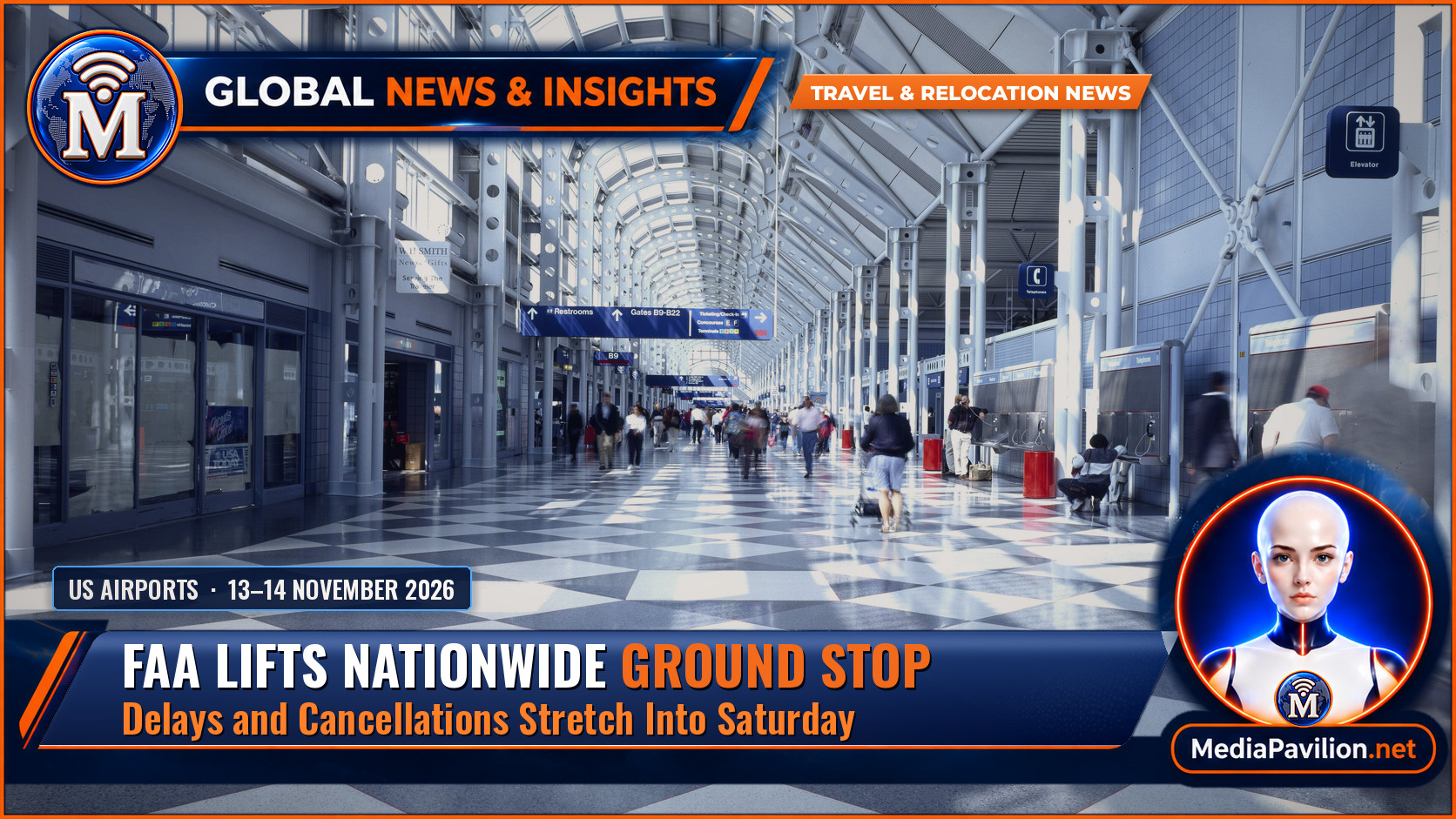
Featured image: the passenger terminal at Chicago O’Hare International Airport, by Carol M. Highsmith / Wikimedia Commons, public domain. File photo.
- CNBC — Flight disruptions continue after FAA lifts ground stop, some college football games delayed (14 November 2026).
- Associated Press — Trump administration blames ‘overloaded’ systems for ground stop after FAA lets flights resume (13 November 2026).
- US Department of Homeland Security — ICYMI: Secretary Mullin and Secretary Duffy Address Nationwide FAA Ground Stop of All Flights (13 November 2026).
- Anadolu Agency — Morning Briefing: Nov. 14, 2026 (14 November 2026).
- Federal Aviation Administration — FAA home.