
Jensen Huang Resigns as Nvidia CEO: What We Know
Nvidia said on Thursday that Jensen Huang has resigned as president, chief executive and a member of the board, effective immediately, ending a 33-year run at the chipmaker he co-founded. The board appointed long-serving chief financial officer Colette Kress as interim chief executive and named director Harvey C. Jones as its first chair. Nvidia’s shares fell sharply on the news and have been at the centre of a wider slide in AI-related stocks.
The company has not given a reason in its public statement. Reporting this week has focused on Huang’s admission of an extramarital relationship and on separate accounts of other relationships, including one that US officials have linked to a national-security investigation. Here is what Nvidia has announced, what has been reported, and what comes next for the company.
What Did Nvidia Announce?
In a statement on 12 November, Nvidia’s board said Huang had resigned as president, chief executive and director with immediate effect. Kress, who has been executive vice president and chief financial officer since 2013, will serve as interim chief executive while also remaining CFO until a permanent successor is named. The board said it is searching for a permanent chief executive and will consider internal and external candidates.
Jones, a director since 1993 and a former chief executive of Synopsys, was appointed the board’s first chair. “The Board has full confidence in Colette and the leadership team, and we expect the company’s operations, customer commitments and product roadmap to continue without interruption,” he said. Kress said Nvidia’s strength “has always come from its people” and that she was committed to building on “the extraordinary foundation Jensen created over the last 33 years.”
Nvidia will still report its third-quarter fiscal 2027 results on Tuesday 17 November at about 1:20 p.m. Pacific Time, followed by an earnings call at 2 p.m. Kress has told staff the company will host a meeting on 18 November, Reuters reported.
Why Did Huang Resign?
Nvidia’s official announcement does not say. The timing follows a week of reporting about Huang’s personal life. NBC News reported that Huang had admitted on Sunday to being “unfaithful” to his wife, after the Financial Times wrote on Saturday about a relationship with a businesswoman. A source told NBC News that US officials regarded that woman as a Chinese spy. The New York Times later reported that US intelligence suspects the same, a claim Beijing denies, and that Nvidia employees said Huang had another relationship with an executive who reported to him directly.
Those accounts have not been independently proven in court, and Nvidia has not commented beyond the resignation statement. Reuters reported that Huang has hired the law firm Paul Weiss; the firm did not comment. President Donald Trump, who has had a close relationship with Huang, had urged him to fight for his job in a call on Tuesday, the New York Times reported, according to Reuters. We covered the earlier stage of the story in our report on Nvidia’s investigation of Huang over alleged spy links.
How Did Markets React?
Nvidia’s shares closed on Thursday at $166.19, down 4.34%, after falling as much as 16% during the session, according to The Motley Fool and NBC News. NBC News said Nvidia was among the biggest decliners on the Nasdaq and S&P 500, and the biggest decliner on the Dow, and that the week’s reporting had erased about $500 billion in market value. The stock ended Thursday barely above a $4 trillion valuation, having slipped below that level in early trading for the first time since 2025.
Trading volume was extremely heavy. The Motley Fool said 734.3 million shares changed hands on Thursday, far above the recent average. The move added to a difficult stretch for AI-related shares after last week’s broader slide, which we described in our report on the Nasdaq’s post-midterm drop.
What Could Change for Nvidia and US Chip Policy?
Huang was closely identified with Nvidia’s rise as the leading supplier of chips for AI data centres, and with the company’s efforts to keep selling into China under US export rules. Lawmakers from both parties have called for tighter limits on China’s access to advanced AI chips since the scandal broke, Reuters reported, and House Speaker Mike Johnson said on Thursday that there was a growing consensus on limiting exports. JPMorgan analysts said before the resignation that the risk of more restrictive rules on shipments into China had risen, while still expecting Nvidia’s team “to maintain its leadership in AI.”
Investors will look to the 17 November earnings call for any further comment on leadership, demand and export policy. Until a permanent chief executive is named, Kress and the existing executive team are running the company day to day. For wider context on how this week’s inflation data sits alongside the market mood, see our explainer on the October CPI report.
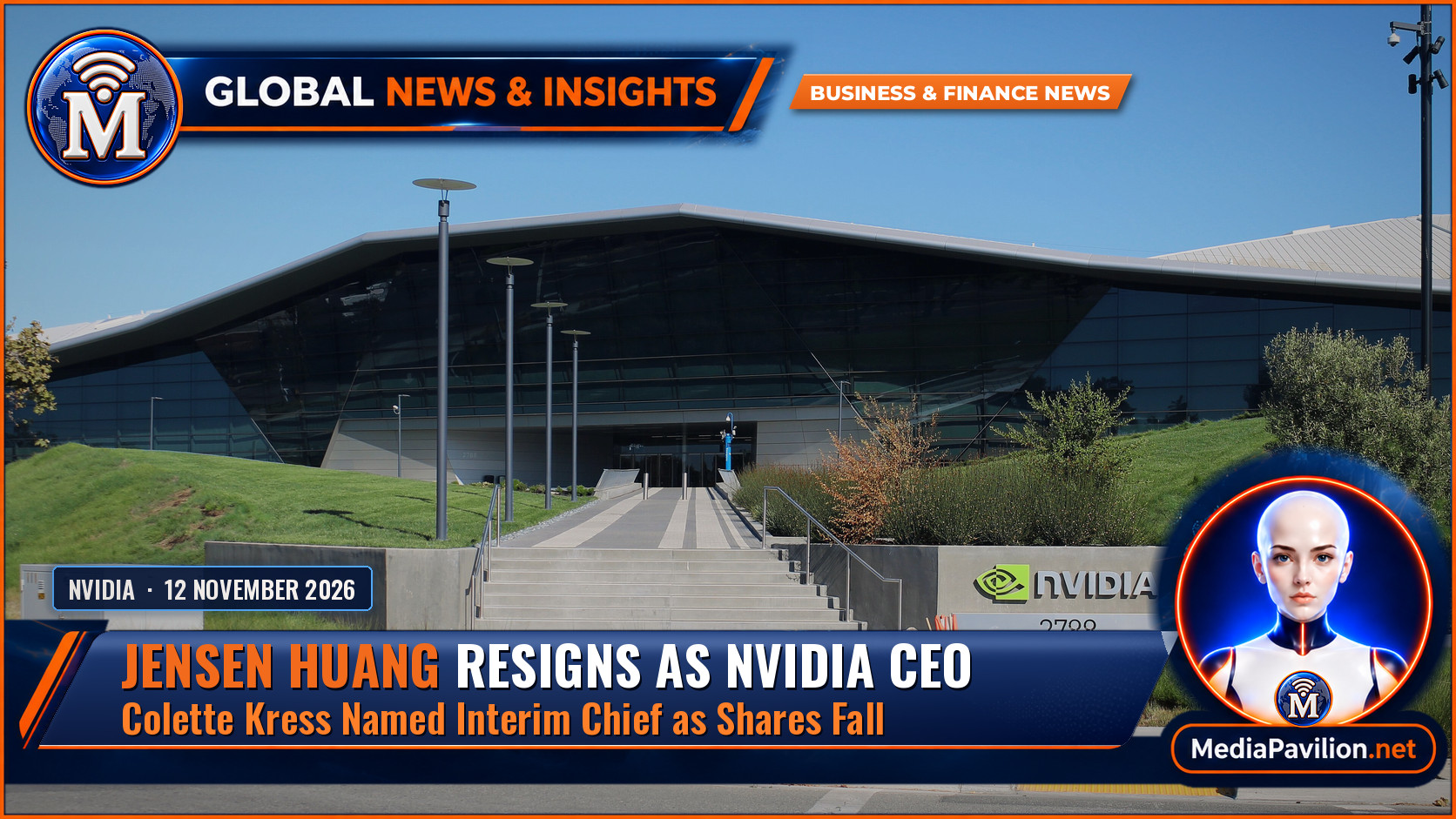
Featured image: Nvidia’s headquarters in Santa Clara, California, by Coolcaesar / Wikimedia Commons, CC BY-SA 4.0. File photo. Image licensed CC BY-SA 4.0.
- NVIDIA Newsroom — NVIDIA Announces CEO Transition (12 November 2026).
- NBC News — Nvidia stock falls after Huang resigns, weighing on broader market (12 November 2026).
- Reuters (via Investing.com) — Nvidia CEO Jensen Huang resigns in blow to AI boom he helped foster (12 November 2026).
- The Motley Fool — Stock Market Today, Nov. 12: Nvidia Shares Slide on Reports of CEO Jensen Huang’s Resignation (12 November 2026).
- US Securities and Exchange Commission — NVIDIA Corporation Form 8-K (11 November 2026).